Vocabulary Expansion is all about growing your word collection-like adding colorful threads to your language tapestry. These worksheets aren't just fun; they help students learn new words and how to use them effectively, using tools like dictionaries and thesauruses (think of those as treasure maps for language). As students explore definitions, synonyms, antonyms, and word roots-including energy-related vocabulary-they become more confident readers, writers, and communicators.
Building a strong vocabulary isn't just about memorizing-it's about understanding how words work together, what shades of meaning they carry, and how to fit them into your own ideas. Whether you're looking for a word that sounds fancy, precise, or just plain perfect, this collection offers a variety of activities that help you choose words with purpose and power.
These worksheets are organized to support deep learning: some focus on discovering new words, others on making choices, and yet others on seeing words in action. You'll explore descriptive words, how words change form (like verbs and roots), and puzzle your way through context. It's designed for classroom use, homework, or solo exploration-wherever vocabulary adventure calls!
Looking At Each Worksheet
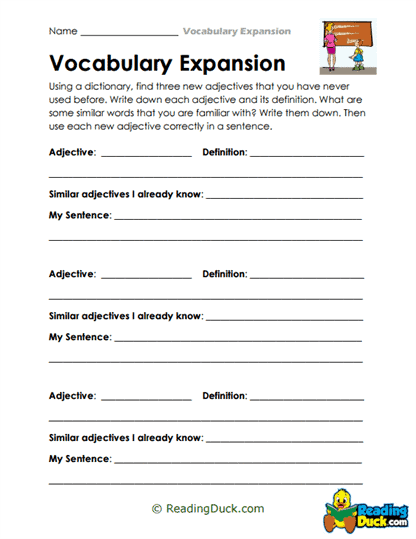
Adjective Adventure
Students explore and collect descriptive words that bring writing to life. It's like a safari hunt-but for adjectives prowling through sentences! Encourages lively language and sensory detail. Ideal for encouraging vivid descriptions in writing. Bonus: turn this into a classroom "Adjective Detective" scavenger hunt!
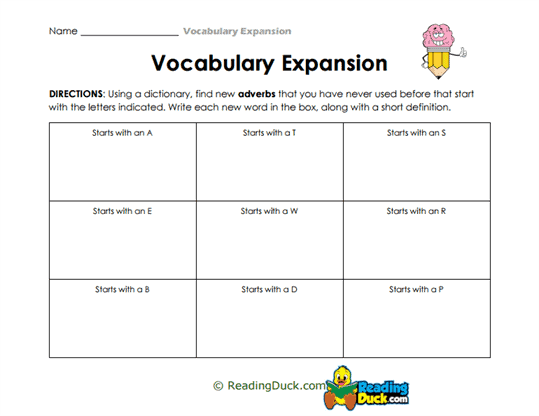
Adverb Hunt
Learners track down adverbsthat add action and detail, like "quietly" or "brightly." It's a treasure hunt where each clue adds a splash of flavor to actions. Sharpens awareness of how actions are described. Great for revising dull sentences. Bonus: challenge students to rewrite a common scene using only adverbs they found.
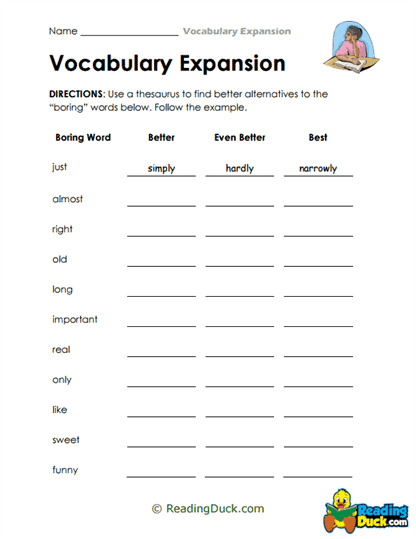
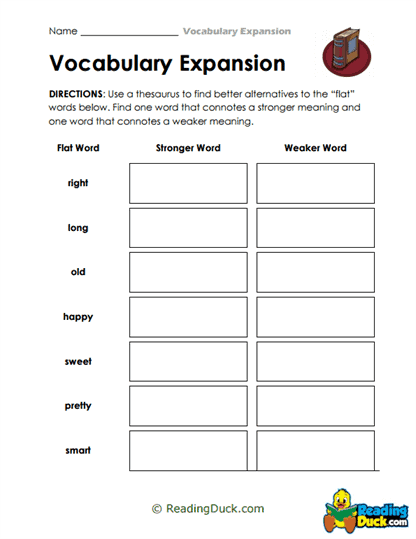
Better Words
Students replace overused or bland words with stronger alternatives. It's like giving your writing a vocabulary makeover! Helps build word choice and variety. Wonderful for editing lessons or peer review. Bonus: ask students to invent a superword (e.g., "gigantorous") and define it!
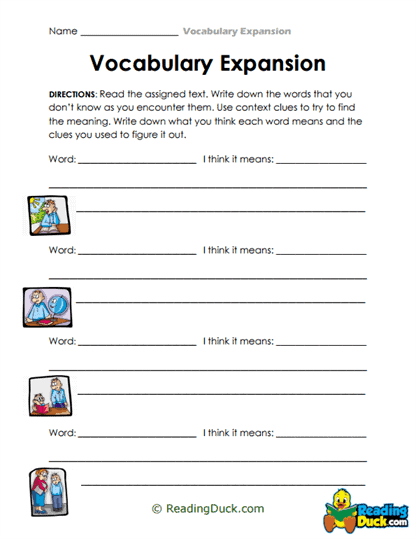
Context Clues
Learners infer word meanings using surrounding hints. It's like solving a crossword: the sentence is your clue. Builds comprehension and lexical detective skills. Great for reading activities or independent practice. Bonus: create a "clue chain" where each new context helps define the next word.
Noun Finder
Students identify nouns in texts or prompts. It's a hunt for the naming words in a sentence-like spotting stars in the sky! Strengthens awareness of naming conventions. Useful in grammar or topic sorting lessons. Bonus: categorize found nouns into "people," "places," and "things" for extra clarity.
Picture Words
Kids match words to images or describe images using rich vocabulary. It's like a picture dictionary in action! Helps build word-picture associations and descriptive accuracy. Ideal for visual learners and early writers. Bonus: have students draw their own picture and write vocabulary captions!
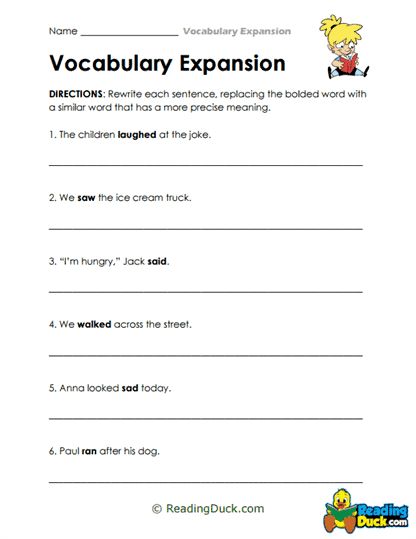
Precise Words
Students choose words that carry specific meanings rather than vague ones. Think of it as swapping "walked slowly" for "sauntered." Develops precision and clarity. Useful for focused writing tasks. Bonus: challenge students to snag the most precise vocabulary in a "Word Ninja" timelimit event.
Reading Log
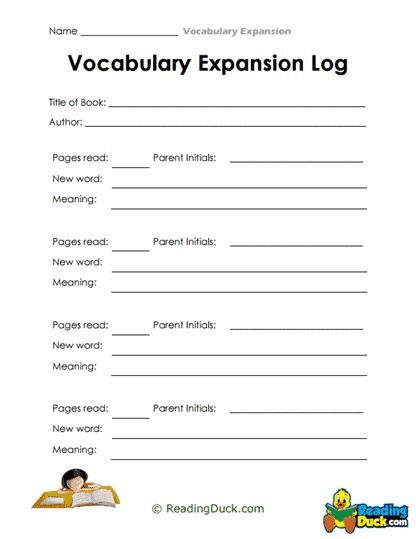
Learners record new words encountered in their reading, tracking meanings and usage. It's a word scavenger journal! Encourages reflection and retention. Perfect for independent reading routines. Bonus: have a "Word of the Week" from logs to discuss in class.
Speech Bubbles
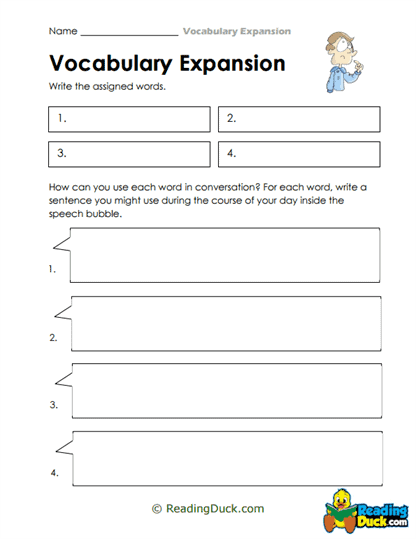
Students write dialogues using character thoughts or speech balloons, boosting expressive vocabulary. It's like comic book writing-talk bubbles full of personality! Promotes writing with voice and tone. Great for creative writing sessions. Bonus: design a mini-comic strip using vocabulary bubbles.
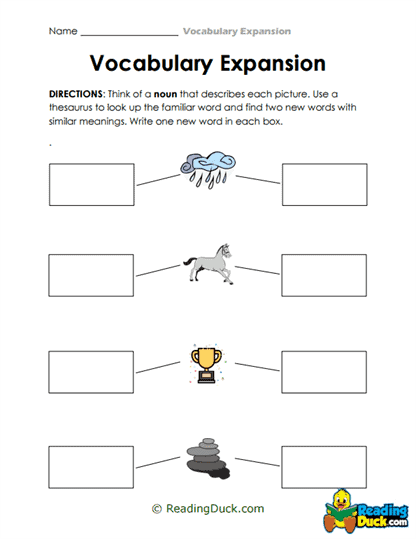
Synonym Search
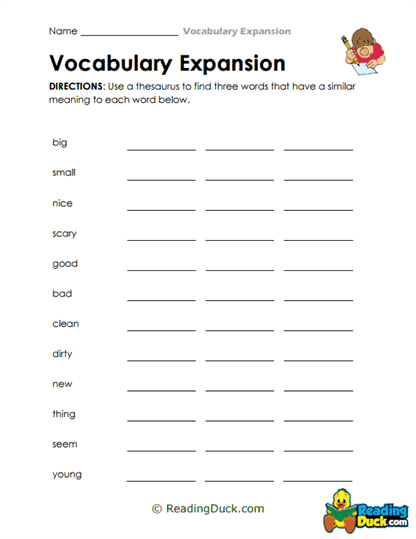
Students hunt for synonyms to replace given words. It's matching with meaning-like finding twin words! Builds awareness of nuance. Ideal for enhancing descriptive writing. Bonus: turn it into a synonym "rip-off rap" challenge: replace boring words with snazzier ones rhythmically.
Verb Explorer
Kids investigate action words and their variations. It's like venturing through a verb jungle! Builds understanding of actions and tense. Great for story writing or grammar lessons. Bonus: invite students to act out verbs dramatically before choosing the most vivid one.
Word Builder
Learners create new words using affixes or roots. It's like constructing with language Lego! Encourages morphological awareness and inventive thinking. Excellent for root-focused lessons. Bonus: facilitate a "Build-a-Word" fair where students show off their creations with meanings.
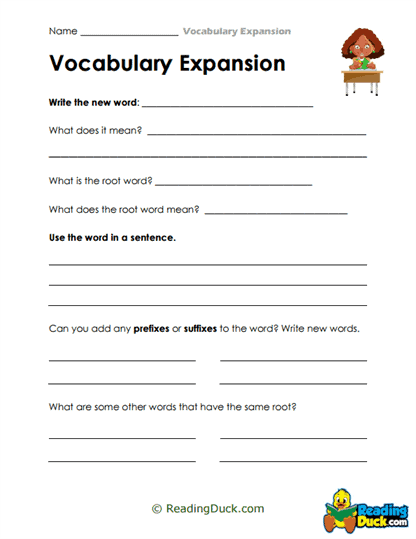
Word Explorer
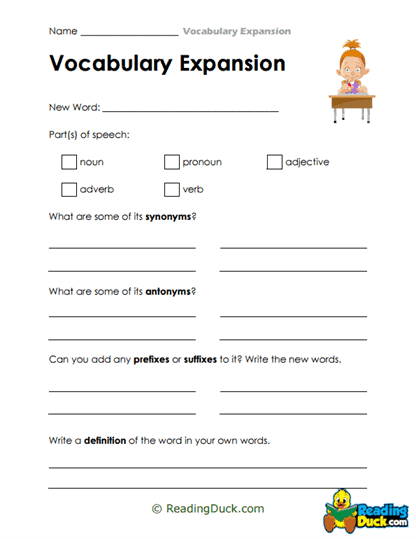
Students delve into word origins or related forms. It's a voyage into word history! Fosters etymological curiosity. Fits well into advanced vocabulary or language arts units. Bonus: students present a mini "word travelogue" detailing a word's journey from origin to modern use.
Word Power
Students practice using a set of target words in sentences or contexts. It's vocabulary flex-time-showing off new word strength! Strengthens usage in real writing. Nice for weekly word challenges. Bonus: make a "Power Word Poster" featuring students' best sentences.
Word Rooter
Learners explore root words and their derivatives. It's like unearthing the roots of language trees! Builds decoding skills and vocabulary depth. Useful for tackling complex texts. Bonus: challenge students to find as many words as possible that share a root and display them on a "Root Tree" chart.
Example Uses of Vocabulary Expansion
Example 1
Scenario: Describing a scene in writing
Sentence: The enormous tree cast a towering shadow over the garden.
Explanation: "Towering" is a more precise and vivid adjective than just "big." Choosing sharper words makes the description more powerful and engaging.
Example 2
Scenario: Explaining actions in a story
Sentence: She scurried across the room to catch the bus.
Explanation: "Scurried" is a lively verb that shows hurried movement. It paints a clearer picture than simply saying "ran," making the writing more dynamic.
Make sure to bookmark our website now.
Enjoy all our free reading worksheets.
Our materials adhere to the principles of the Science of Reading.