Guide words are the little signposts at the top of dictionary pages that quietly guide readers to the words inside. They tell you the very first and very last entry on that page, so you can quickly decide if the word you're searching for lives there. For students, learning to use guide words makes dictionary work feel less like flipping through endless pages and more like following a clear trail.
Mastering guide words is important because it helps kids grow comfortable with alphabetical order and builds independence when working with reference materials. Instead of asking for help every time they need to check a definition, students can navigate on their own, which boosts both confidence and comprehension. It's also a skill that transfers to using glossaries, indexes, and even digital word searches.
Our collection of worksheets introduces guide words in small, easy steps. Students start by finding which words fit between others, then move on to sorting, matching, and solving puzzles that build the skill over time. Each page adds a fun twist, turning what could feel like a boring dictionary task into a lively word adventure-similar to energy word activities that make learning new terms more engaging and hands-on.
Looking At Each Worksheet
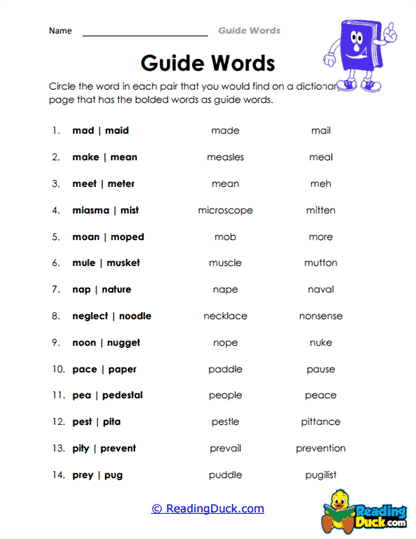
Between the Lines
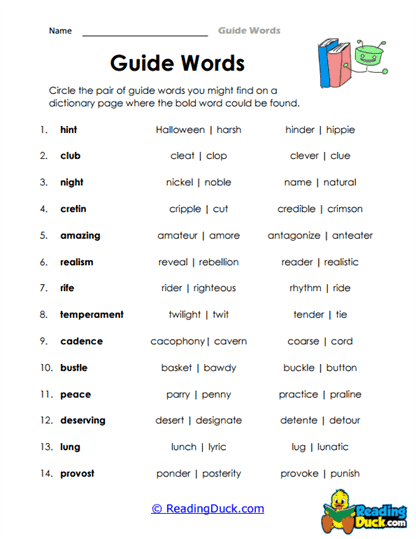
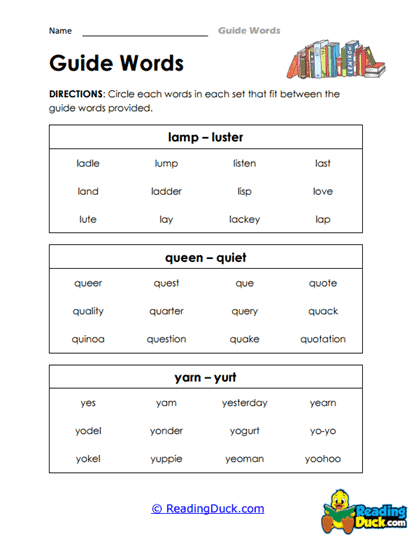
Students look at guide words and decide if a target word fits in between them. It's like playing a mini alphabetical sorting game with words. This activity builds quick thinking and confidence in navigating dictionaries.
Dictionary Boundaries
Here, learners mark whether a word belongs before, after, or between given guide words. It turns dictionary use into a map-reading exercise. It sharpens the skill of spotting where words belong alphabetically.
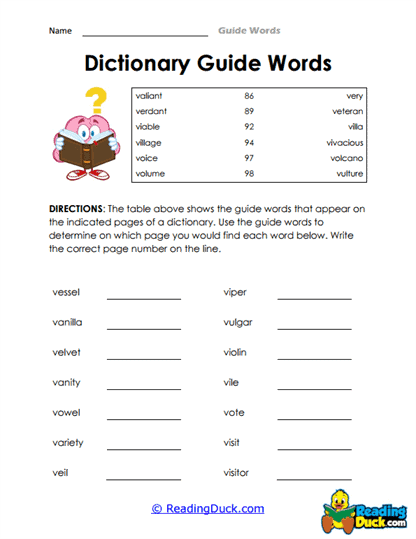
Dictionary Navigator
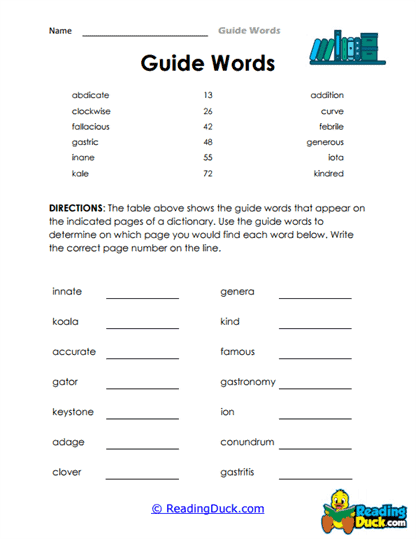
This worksheet challenges students to choose which page a word would appear on based on guide words. It's like steering through a mini dictionary maze. It makes alphabetical order feel like an exploration.
Guide Grid
Students fill in a grid of words that fit between sets of guide words. It turns vocabulary into a visual puzzle. The task makes alphabetical order both clear and playful.
Guide Pages Hunt
Learners go on a hunt through mock dictionary pages to locate words using given guide words. It's like a treasure hunt where each clue leads to a new discovery. This fun approach makes navigating dictionaries exciting.
Guide Word Match
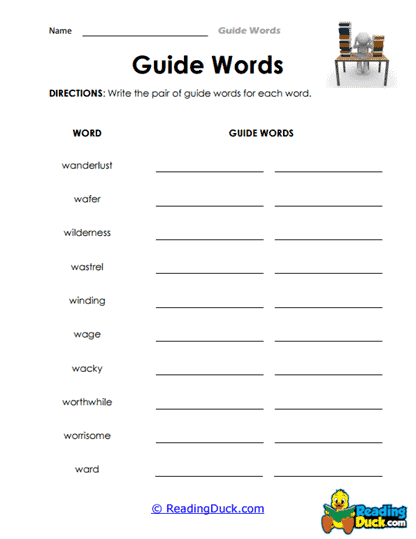
Kids match words with the correct pairs of guide words that would surround them. It's similar to pairing socks-you match the word with the right guide "neighbors." This reinforces how alphabetical order frames dictionary pages.
Hint Hunt
Students use hints about meaning or word structure to place words between guide words. It blends vocabulary with alphabetical logic. It's a sleuth-style activity that builds both insight and order skills.
Lamp-Luster Search
With guide words like "lamp" and "luster," students decide if words like "land" fit between. It's like sliding along the dictionary alphabet line. The name sparks curiosity, while the activity practices real guide word use.
Page Finder
Learners are asked to determine which page-or between which guide words-a word would be found. This feels like flipping through an imaginary dictionary with precision. It makes using guide words feel practical and natural.
Page Pointer
In this one, students point to where a word belongs by choosing the correct guide pair. It's like placing a pin on an alphabetical map. It helps students see how guide words anchor word locations.
Sorting Station
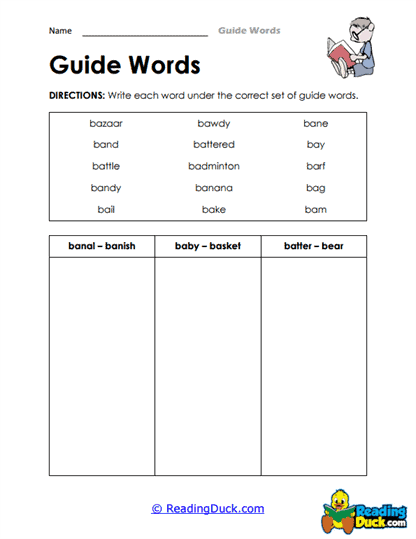
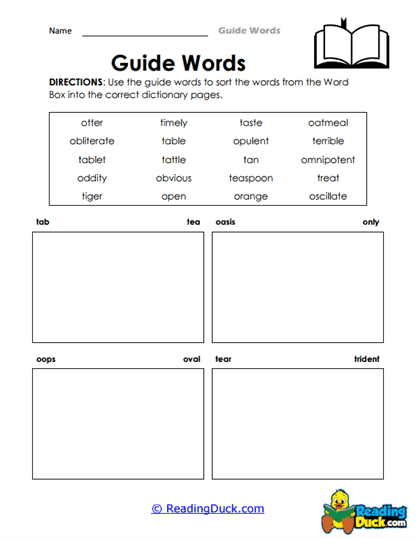
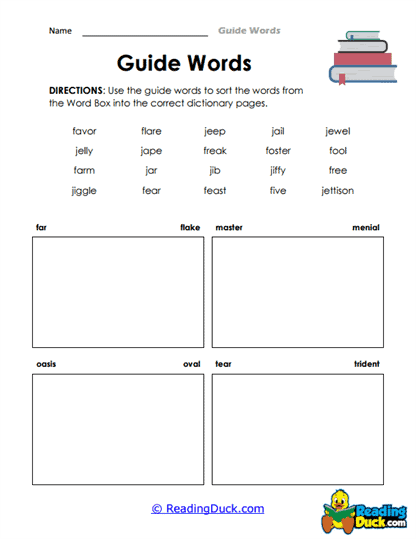
Students sort a list of words under the right guide word pairs. It works like organizing tools in labeled bins-alphabetical bins, that is. This station-style activity reinforces structure and order.
Word Box Challenge
Learners drop words into "boxes" labeled with guide word ranges. It turns dictionary use into a game of placement. The challenge builds confidence in alphabet sequencing.
Word Pairs
Here, students look at pairs of guide words and decide if certain target words fall within the pair. It's like checking if a word is invited to that specific "alphabet party." This taps into both order and word awareness.
Word Sorter
Students sort words under various guide word categories just like sorting photos into albums. It turns vocabulary organization into play. The activity sharpens categorization and dictionary skills.
Yes or No?
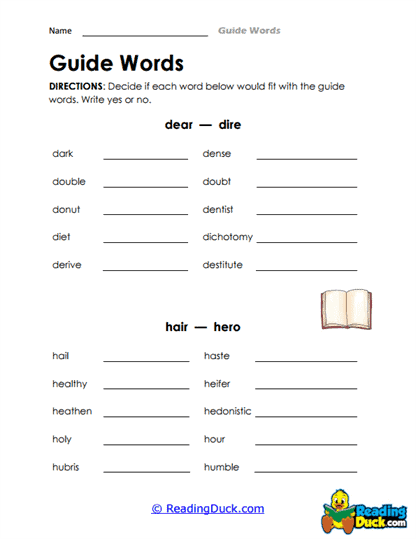
Learners decide "yes" or "no" if a word belongs between two guide words. It's a quick, binary challenge that focuses thinking. It makes alphabetical placement feel fast and efficient.
What Are Guide Words?
Guide words are the twin clues perched at the top of each dictionary page. One shows the very first entry, the other the very last, and together they create a neat boundary line that helps readers decide if the word they want is inside. They are not definitions or examples, but helpful labels that make the process of searching far smoother.
You'll see guide words at work in dictionaries, encyclopedias, glossaries, and even digital tools that organize words alphabetically. If you open to a page where the guide words are "kangaroo" and "kitten," you know instantly that "kettle" should be hiding somewhere there. This saves time, reduces frustration, and makes alphabetical navigation second nature.
Learning guide words connects directly to stronger reading and writing. When students can handle reference tools with confidence, they become more independent learners who aren't afraid of tricky vocabulary. It's an early skill that paves the way for bigger tasks-like research projects, essay writing, and lifelong curiosity about words.
Example Uses of Guide Words
Example 1
Sentence: "If the guide words are 'tree' and 'truck,' the word 'treat' would fit between them."
Explanation: Knowing that "treat" comes alphabetically after "tree" and before "truck" shows how guide words help you estimate where words belong without flipping pages.
Example 2
Sentence: "With guide words 'cat' and 'cot,' you know the word 'cup' would not be on that page."
Explanation: Recognizing that "cup" comes after "cot" teaches students how guide words quickly tell you when a word doesn't fit on a page-saving time and teaching alphabetical order.
Make sure to bookmark our website now.
Enjoy all our free reading worksheets.
Our materials adhere to the principles of the Science of Reading.