Word Study is like putting on x-ray glasses for language-you get to peek inside words to see how they're built, why they mean what they mean, and how they change in different sentences. Instead of memorizing endless lists, students learn strategies: breaking words into roots, prefixes, and suffixes; spotting patterns; and connecting meanings across families of words. It's hands-on, puzzle-y, and super satisfying-like solving a mystery with a dictionary and a highlighter.
Mastering Word Study boosts both comprehension and expression. When kids can decode unfamiliar words, choose sharper synonyms, and tell parts of speech apart, reading gets smoother and writing gets clearer. They also grow confidence: "I don't know this word...yet-but I know how to figure it out!"
This collection is structured to build skills step by step. Learners start with concrete tasks like matching meanings and identifying parts of speech, then level up to richer investigations like etymology, word dissection, and webbing ideas. Each worksheet nudges students from "recognize" to "analyze" to "apply," so vocabulary knowledge actually sticks.
Looking At Each Worksheet
Adding Action
Students turbo-charge dull sentences by swapping in vivid verbs and precise phrases. This turns "The dog went" into "The terrier bolted," showing how word choice changes meaning and mood. It's perfect for mini-lessons before narrative writing or quick warm-ups at home. Think of it like upgrading a scooter to a rocket-same rider, way more zoom. Bonus: Keep a "verb vault" where you bank spicy action words all week.
Definition Duo
Learners pair each target word with its just-right definition, testing nuance, not just general gist. The activity reinforces dictionary skills and teaches how context can tilt meaning. Use it for centers, partner checks, or homework with an answer key. It's like matching socks from a very opinionated laundry basket. Bonus: After matching, write a "wrong but hilarious" definition and explain why it's off.
Etymology Explorer
Kids travel through time to see how words were born, borrowed, and blended. By tracing roots and origins, they learn to predict meanings across related words. It ties beautifully to social studies or science vocab, too. Imagine being a word archaeologist dusting off fossils labeled "geo-, tele-, photo-." Bonus: Create a mini museum card for a favorite word with "Origin, Era, and Fun Fact."
Meaning Match
This is a fast-moving game of connect-the-dots between words and meanings (with trickster near-matches to build precision). Students practice using context clues to break ties. Great as a bell ringer, exit ticket, or speed round at home. Think "musical chairs," but with definitions instead of chairs. Bonus: Let students invent one decoy definition that almost fits.
Part-of-Speech Picker
Learners sort words into nouns, verbs, adjectives, and more, then test them in sentences to confirm. It's grammar you can see and touch-category cards, sentence frames, quick checks. Use it before writing to prevent adjective pileups and verb mix-ups. It's like organizing a closet so your verbs stop wearing your nouns' shoes. Bonus: Roll a dice to decide which part of speech must start your next sentence.
Picture Perfect
Students connect images to target vocabulary, then write short captions using the word accurately. This builds concrete meaning, recall, and usage all at once. It fits art integration and multilingual classrooms beautifully. Imagine a mini-gallery where each picture whispers, "Use me in a sentence!" Bonus: Do a caption swap-trade pictures and improve a partner's caption.
Root Discovery
Learners mine words for roots, prefixes, and suffixes, then rebuild them like LEGO® sets. They see how tele + graph or port + able carry meaning from piece to piece. It's decoding power that transfers to any subject. Like cracking a secret code that lots of words share. Bonus: Run a "Root of the Week" board with examples students spot in the wild.
Synonym Searcher
This hunt is about finding same-or-similar meaning words-but also rating strength and tone. Students learn that annoyed and furious aren't interchangeable in every sentence. Great for revising bland drafts and expanding word banks. It's a thesaurus with a personality meter. Bonus: Play "Forbidden Word": replace a too-common word (like good) everywhere it appears.
Synonym Selector
Here, context is king: students choose the best synonym for a specific situation. They compare shades of meaning to avoid awkward or overblown choices. Perfect for narrative voice and evidence writing. Think paint swatches-same color family, very different vibes. Bonus: Rank three synonyms from calmest to strongest, then justify your order.
Vocabulary Vision
Students map meanings, examples, non-examples, and visuals to build a 360° view of a word. The structure cements both definition and usage pathways in memory. Use for tier-two academic words across the curriculum. It's like giving each word its own superhero origin story (with weaknesses!). Bonus: Add a "seen in the wild" box to log sightings from books or shows.
Weekly Word
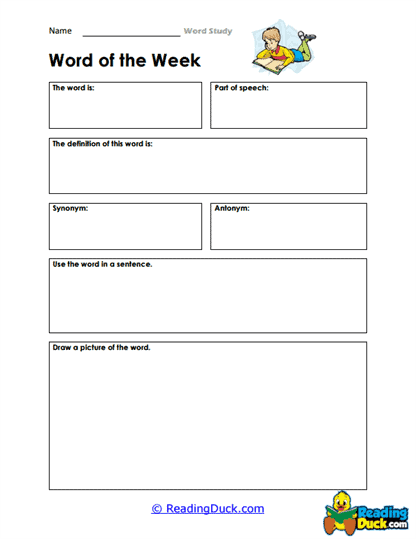
Choose one mighty word to explore all week: define it, sketch it, use it, spot it. Repeated, playful encounters move the word from "new" to "mine." Works wonderfully for morning work or homework menus. Picture a word getting a five-day makeover until it's prom-ready. Bonus: Friday flair-write a micro-story that uses the word in a surprising way.
Word Dissection
Scalpels out (metaphorically)! Students slice words into morphemes and label each part's job. This clarifies spelling, pronunciation, and meaning in one pass. It's science-lab energy for language arts. Bonus: Host a "Grand Rounds" share: present a dissected word and the diagnosis (meaning!).
Word Explorer
Learners roam through synonyms, antonyms, collocations, and connotations for a target term. They test the word in multiple sentence frames to see what fits and what flops. Great for building flexible, writerly vocabulary. It's like trying on outfits to see which ones the word actually likes. Bonus: Make a postcard "from" the word, describing where it's most at home.
Word Origins
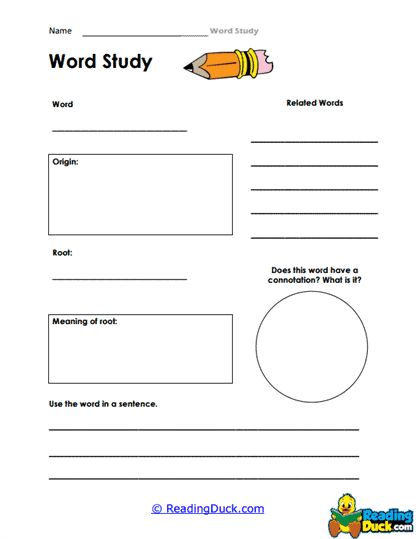
This zooms in on where modern words came from-Old English, Latin, Greek, and global borrowings. Students notice how history leaves footprints in everyday language. It pairs nicely with literature or unit themes. Imagine a travel map with pins stuck in every word you meet. Bonus: Build a family tree for one word, branching to its cousins.
Word Web
Students create mind maps that link the word to examples, categories, opposites, and images. Webbing strengthens connections so recall is faster and usage is smarter. Use it to preview units or review tricky academic terms. It's a spiderweb your memory actually likes walking into. Bonus: Color-code branches (definition, examples, context) for instant visual cues.
Make sure to bookmark our website now.
Enjoy all our free reading worksheets.
Our materials adhere to the principles of the Science of Reading.