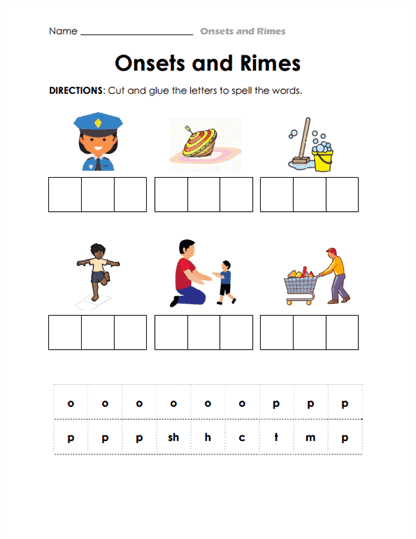
Onsets and rimes are like the building blocks of word families, helping children crack the code of how sounds fit together. The onset is the first consonant sound of a word, while the rime is the vowel and everything that follows. When learners understand how these parts connect, reading and spelling suddenly feel less like a guessing game and more like putting together puzzle pieces.
Mastering onsets and rimes makes kids more confident readers because they can quickly recognize patterns and predict new words. This skill makes sounding out books, songs, and even silly rhymes easier, boosting both fluency and comprehension. It also gives young learners a secret superpower: the ability to spot word families wherever they go!
Our Onsets and Rimes worksheets give children fun, bite-sized practice in blending sounds, swapping beginnings, and exploring rhyming words. With activities that feel more like games than lessons, kids get step-by-step practice while laughing along the way. This is more than worksheets-this is sound-to-word mastery in action!
Looking At Each Worksheet
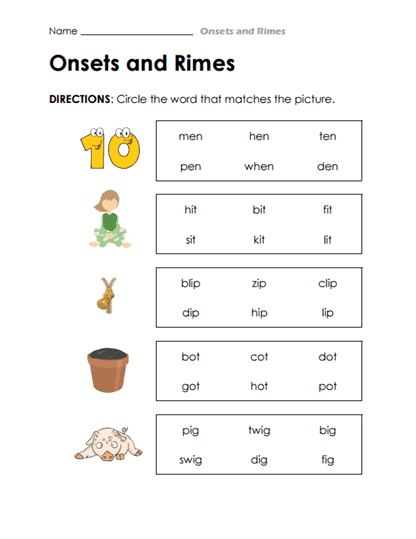
Circle the Rime
In this worksheet, kids look for rimes that match and circle them like little detectives hunting for secret codes. It's a great way to show that words like "cat," "bat," and "hat" share the same tail. Imagine kids circling word endings like they're spotting matching socks fresh from the laundry! Teachers and parents can use it for group activities or solo practice. Bonus idea: turn it into a race-who can find the rime families the fastest?
Complete the Word
Here students add missing onsets to rimes to form real words, filling in the "blanks" with giggles. It helps them see how just a single letter can transform "at" into "cat" or "bat." Think of it like giving haircuts-change the front, and the whole "look" changes! It's perfect for classroom phonics centers or home practice at the kitchen table. Bonus twist: let kids invent funny nonsense words and read them aloud for laughs.
Cut and Match
This activity has children snip apart onsets and rimes, then mix and match them to build words. It's a hands-on puzzle that proves learning phonics can involve scissors and creativity. Kids might feel like word chefs, cooking up tasty blends by combining parts. It works beautifully for small group work or independent centers. Bonus idea: challenge kids to make the silliest word possible and share it aloud!
Fill the Onset
Here, learners add the missing beginning sound to complete each word. Suddenly, "_og" becomes "dog," "fog," or "log," and the magic of word families shines through. It's like giving words their "first name" to go with their "last name." Great for worksheets, whiteboard practice, or word walls. Bonus twist: kids can act out the words they build, turning phonics into charades.
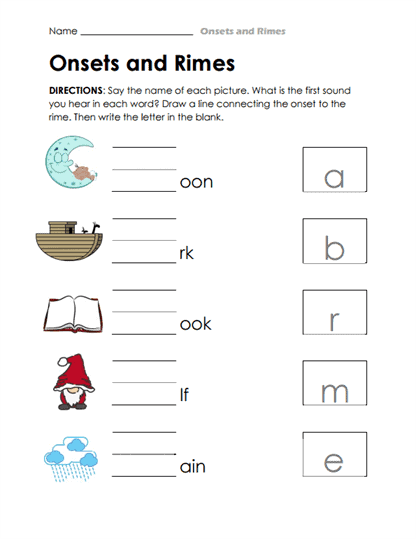
Letter Match
In this playful activity, students pair onsets with their matching rimes to create real words. It's like a giant word memory game, where letters team up to form friends. Think of it as setting up word "playdates" between letters and sounds! Teachers can use it in literacy centers or kids can practice at home with a parent's help. Bonus idea: keep score to see how many new words each player can discover in a round.
Missing Letters
This worksheet challenges children to spot the missing letter in a rime or onset, training their phonics detective skills. It shows them that every sound matters in creating a word. Imagine trying to spell "bat" but forgetting the "b"-it becomes "at," and suddenly you've lost your superhero! Perfect for spelling warmups or homework reinforcement. Bonus twist: turn it into a "word rescue" game where kids save the word by restoring its missing part.
Onset Match
Kids match beginning sounds to complete words, reinforcing how onsets change everything. "C" with "ake" makes cake, but "R" with "ake" makes rake-it's like magic with a twist of humor. Think of it as speed dating for letters and word parts! Great for classroom centers or extra practice at home. Bonus idea: let kids invent silly "mash-up" words and draw them.
Onset Split
This worksheet asks children to break apart words into onset and rime, showing how words are built in two parts. It's like pulling apart a sandwich to see the bread and filling separately. The activity makes spelling and decoding easier by focusing on patterns. Teachers can use it for guided reading or small group phonics work. Bonus twist: let kids reassemble the "sandwiches" by mixing up different onsets and rimes for funny new combos.
Onset Swap
Learners swap out different onsets to create new words with the same rime. Suddenly "cat" becomes "hat," "mat," or "sat." It's like trading hats between characters-just one change, and you've got a whole new look! Ideal for fluency drills or home flashcard practice. Bonus idea: have kids act out silly stories using all the new words they created.
Picture Rhymes
Here, children look at pictures and find matching rimes, connecting images to sounds. A picture of a cat and a hat? Perfect rhyme family! It feels like playing "I Spy" but with rhyming word pairs. Great for visual learners in both classrooms and homes. Bonus twist: kids can try to draw their own rhyming pictures afterward.
Picture Words
Students use pictures to match onsets and rimes, blending sound and sight into a fun challenge. It's like building a word puzzle with training wheels. Imagine a drawing of a dog with a missing beginning-kids get to finish it! Teachers can project it on the board, or parents can use it for at-home review. Bonus idea: have children invent silly pictures for nonsense words.
Rime Match
In this activity, kids pair rimes to see how words group into families. Suddenly, "-ake," "-cat," and "-og" all find their families and form little "clubs." It's like a word family reunion where everyone's wearing matching T-shirts! Perfect for practice with rhyming and spelling. Bonus twist: play "musical words," where kids shout the family name when the music stops.
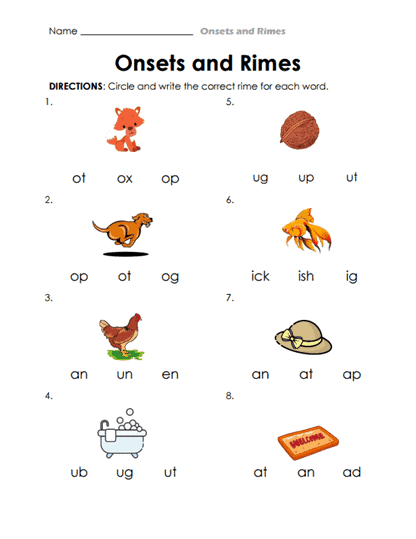
Rime Select
Children choose the correct rime to complete a word, sharpening both listening and spelling skills. It's like a "choose your own adventure," but for word endings. The wrong rime makes nonsense words, which can be hilarious. Teachers can assign it for small group work, or parents can use it for bedtime phonics play. Bonus idea: let kids invent stories using all the words they build.
Sound Start
This worksheet has kids focus on the first sound in a word, emphasizing how onsets kick off the action. It's like the drumroll before the big performance-without the start, the word feels incomplete. Kids practice matching beginnings to words they already know. Perfect for whole-group phonics warmups or quiet seatwork. Bonus twist: have kids "sing" their onsets like a choir before blending them.
Spelling Builder
Here, learners put together onsets and rimes to spell full words, practicing decoding and encoding all at once. It's like building with Lego bricks-each piece snaps into place to make something amazing. This worksheet makes spelling feel like a construction game. Teachers can use it for spelling review or parents for homework help. Bonus idea: let kids "design" a castle of words by stacking them in families.
What Are Onsets and Rimes?
Onsets and rimes are the two parts of a syllable: the onset is the starting consonant sound, and the rime is the vowel plus any letters that follow. Together, they create the chunks of sound that make reading and spelling easier. By splitting words this way, kids learn that many words are built from repeatable patterns.
You can see onsets and rimes everywhere! In books, songs, or even while reading street signs, kids notice how "-at" links cat, hat, and bat, or how "-ake" connects bake, cake, and rake. It's like uncovering a secret code that makes the world of words more predictable.
Learning onsets and rimes is crucial because it helps children read fluently, spell accurately, and feel confident with new vocabulary. It's a skill that sets the stage for understanding larger patterns like word families, rhymes, and eventually complex spelling rules. Every time a child spots a familiar rime, it's a victory that keeps reading fun!
Make sure to bookmark our website now.
Enjoy all our free reading worksheets.
Our materials adhere to the principles of the Science of Reading.