About Our Stress and Intonation Patterns Worksheets
Stress and intonation are the music of spoken language-the beat and melody that make words and sentences come alive. Word stress highlights one syllable more than the others, while intonation raises and lowers pitch to show feeling and meaning. When children practice both, they read aloud more smoothly and listeners understand them more easily. They also start to "hear" how punctuation and emphasis work together, which supports comprehension. Best of all, it turns ordinary lines into expressive speech kids are proud to share.
Mastering stress and intonation strengthens communication far beyond reading time. Students learn how stressing different words can change meaning, and how a rising or falling tone can turn the very same sentence into a question, an answer, or a surprise. These skills build empathy and clarity because kids hear how voices carry feelings as well as facts. In the classroom, that leads to confident presentations and richer discussions.
This collection guides learners step by step, from hearing the difference to marking stress, trying intonation patterns, and performing lines with flair. Activities are short, playful, and repeatable so progress feels steady. You can use them as warm-ups, small-group routines, centers, or at home with a reading buddy. The result is fluent, expressive readers who know how to make words sing.
Looking At Each Worksheet
A Stressful Choice
Students read the same sentence several times, stressing a different word each time to see how meaning shifts. It's like a tiny acting class where emphasis is the costume change. Kids discover that "I didn't take your book" can mean five different things depending on the stress. Great for partner performances or whole-class echoes. Bonus: Let learners circle the "star word" they'll emphasize, then take a bow after their line.
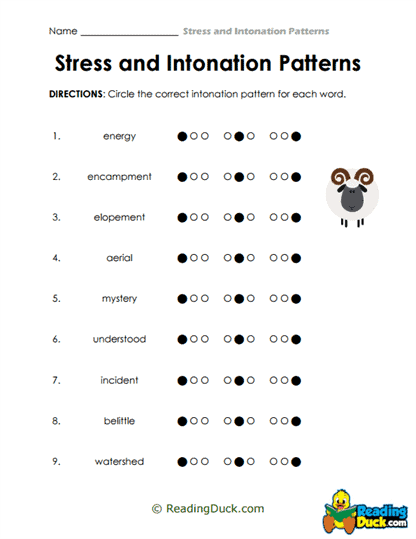
Energy Intonation
Children practice lifting and lowering their voice like a roller coaster to match emotions in short lines. They try "excited," "curious," and "certain," then label each with arrows that show pitch. It's ear training with a dash of drama class. Perfect for fluency warm-ups. Bonus: Add tiny arrow stickers ↑ ↓ above words where the pitch should rise or fall.
Intonation Fun
This page turns sentence types into a game: read questions with a rise, statements with a fall, and exclamations with lively bounce. Kids play call-and-response to feel how tone guides meaning. The silly voices keep practice light while accuracy sticks. Ideal for quick daily reps. Bonus: Spin a "voice wheel" (robot, whisper, superhero) and keep the intonation pattern correct anyway.
Noun or Verb?
Learners explore word-stress pairs like REcord (noun) vs. reCORD (verb) to hear how stress changes function and meaning. They sort, read, and act them out in mini lines. It's vocabulary, grammar, and performance rolled into one. Great for small groups and centers. Bonus: Ask students to invent a two-line skit that uses both forms correctly.
Primary Stress
Students mark the main stressed syllable in multisyllabic words and rehearse them smoothly. They learn that the "loudest" beat helps the whole word sound right. Picture a spotlight landing on just one syllable. Perfect before new vocabulary lessons. Bonus: Have learners clap the stressed syllable and finger-tap the rest.
Stress Circles
Children circle the stressed syllable in each word, then read the list like a drum pattern. The visual mark makes the beat obvious and repeatable. Short, punchy practice builds confidence fast. Great for do-nows and exit tickets. Bonus: Add a metronome clap to keep the pace steady while reading down the list.
Stress Circles
A follow-up set raises the challenge with trickier words and near-look-alikes. Kids must listen closely and trust patterns they've learned. Repetition turns spotting stress into a reflex. Ideal for intervention or second-day spiral review. Bonus: Let students add one new word and lead the class through it.
Stress Match
Learners match words or picture cues to the correct stress pattern, like O-o vs. o-O. It's a friendly puzzle that rewards careful listening. Matching makes "these go together" feel obvious. Perfect for partners or a quick station. Bonus: Require a read-aloud of each match with a confident beat.
Stress Match-Up
This game-style page adds sentence snippets so kids match stress patterns and context. They hear how the same pattern appears across different words. It's pattern power for expressive reading. Excellent for small-group rotations. Bonus: Winners must perform one matched line for the table.
Stress Pairs
Students compare pairs of words with different stress and explain how the meaning or part of speech changes. It's mini detective work with big "aha" moments. The act-it-out step cements memory. Great for discussion and quick writes. Bonus: Give each pair a "movie title" that fits the meaning shift.
Stress Patterns
Children sort a word bank into pattern columns (like O-o-o, o-O-o) and practice each column as a chant. The column rhythm makes longer words feel friendly. It's a tidy, visual way to build automaticity. Ideal for anchor-chart days. Bonus: Have students add arrows over syllables to show loud/soft beats.
Stress Sorting
This one mixes words and short phrases so kids sort by word stress vs. sentence stress. They learn to switch gears between syllable beats and emphasis in a line. Flexibility grows quickly with practice. Great for clarifying confusion. Bonus: Color-code the two kinds of stress and reread each color set.
Stress Towers
Learners stack blocks (or draw boxes) to show syllable count, then color the stressed block. Building the tower makes the beat visible and hands-on. When the "top" block is stressed, they read with power! Perfect for tactile learners. Bonus: Knock softly on the stressed block as you read to feel the emphasis.
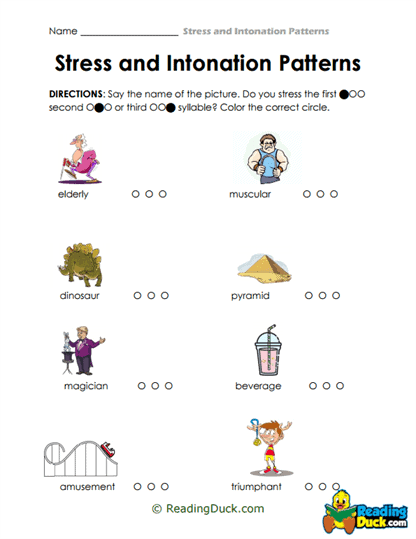
Triple Stress
Kids tackle three-syllable words and decide which syllable gets the main stress. The triple choice turns into a fun challenge with quick feedback. Soon, long words sound smooth and confident. Great for vocabulary days. Bonus: Run a "three-beat parade" where the class chants the chosen beat together.
Word Stresses
Students mark stress in a mini reading passage, then perform it with clear emphasis. They hear how stressed words carry meaning in a sentence. Performance practice turns accuracy into fluency. Excellent for end-of-week share-outs. Bonus: Record a first and second read to celebrate the smoother version.
What Are Stress and Intonation Patterns?
Stress is the extra emphasis we put on certain syllables in words and on certain words in sentences. It's the beat that guides listeners to what matters most, like the boldface of speech. When the right syllable is stressed, words sound natural; when the right word is stressed, sentences mean exactly what we intend. Kids who learn to hear and produce stress read more clearly and communicate more precisely. That clarity boosts confidence and comprehension at the same time.
Intonation is the rise and fall of pitch that gives sentences their melody. A rising tone can invite, question, or surprise; a falling tone can confirm, command, or conclude. These pitch patterns help listeners understand emotion and purpose even when the words are simple. Practicing intonation makes read-alouds lively and conversations more thoughtful. It's the secret soundtrack of strong speaking.
Together, stress and intonation turn flat lines into expressive language. They show how punctuation works, where to pause, and how meaning can shift without changing the words. These patterns appear in stories, songs, speeches, and everyday talk, making practice feel real and useful. As students build fluency with these skills, they also become more confident using energy vocabulary words and other subject-based terms with clarity and expression.
Make sure to bookmark our website now.
Enjoy all our free reading worksheets.
Our materials adhere to the principles of the Science of Reading.