Picture a country throwing the ultimate family feud, complete with cannons, speeches, and some very passionate marching songs. That's the American Civil War in a nutshell. If you've never heard of it, think of it as the United States' version of a breakup that got very loud, very messy, and ended up reshaping the entire nation. Instead of arguing about who keeps the dog, the fight was over slavery, freedom, and the future of the Union.
Now, why should you care about a war from over 150 years ago? Because its impact still echoes through every election, protest, and history class today. The Civil War shaped how Americans understand equality, rights, and government power. Learning about it helps students connect big themes like justice and freedom to real-world struggles happening even now. Spoiler alert: you'll see that debates from the 1860s haven't entirely gone away.
That's where this worksheet collection comes in. We've taken the most dramatic, powerful, and sometimes surprising stories from the Civil War and turned them into resources that students can actually enjoy. Whether it's Lincoln giving a mic-drop speech, women spying behind enemy lines, or songs that could hype up an army, these worksheets make history feel alive. For parents and teachers, that means fewer yawns and more "Wait-that actually happened?!" moments at the kitchen table or in the classroom.
Meet the Worksheets
Lincoln's Crisis - This worksheet dives into Abraham Lincoln's election in 1860 and why it split the country in two. Students learn how fears about slavery and states' rights drove the South to secede. It introduces the sparks that lit the fuse leading to war. Fun fact: Lincoln wasn't even on the ballot in many Southern states-talk about winning against the odds.
Battle Turns - Here, students follow the Civil War through its most important battles, from Antietam to Gettysburg and Sherman's fiery march. They'll see how these clashes shifted momentum and ultimately forced the South to surrender. The worksheet highlights strategy, sacrifice, and why these moments were turning points. Imagine learning that one battle was so bloody it made leaders rethink the entire war plan.
Courageous Women - This worksheet brings women out of the shadows and into the spotlight. From nurses like Clara Barton to spies like Harriet Tubman, students meet the women who carried the war on their shoulders while men fought. Some even disguised themselves as men to join the fight. History twist: Barton went on to found the American Red Cross-talk about a résumé upgrade.
Amendment Power - Students explore the three big "Freedom Amendments"-the 13th, 14th, and 15th-that ended slavery, granted citizenship, and gave Black men the right to vote. The worksheet explains how these changes rewrote America's rules and reshaped society. It also shows how these laws faced resistance, but still stood as powerful steps toward equality. Did you know the 15th Amendment didn't stop states from inventing sneaky obstacles like literacy tests?
Brave Fighters - This worksheet focuses on African Americans who fought for freedom during and after the war. Students learn how enslaved people escaped, joined the Union Army, and proved their courage in famous regiments like the 54th Massachusetts. They'll see how bravery on the battlefield collided with struggles for justice afterward. Imagine risking everything for freedom, only to face new battles after the war ended.
Gettysburg Glory - Here students zoom in on one of the most famous Civil War battles-Gettysburg. They'll see how this bloody clash became a turning point and how Lincoln's brief but powerful speech redefined America. The worksheet mixes military strategy with stirring words that still echo today. Trivia alert: Lincoln's Gettysburg Address was only about two minutes long-shorter than most TikToks!
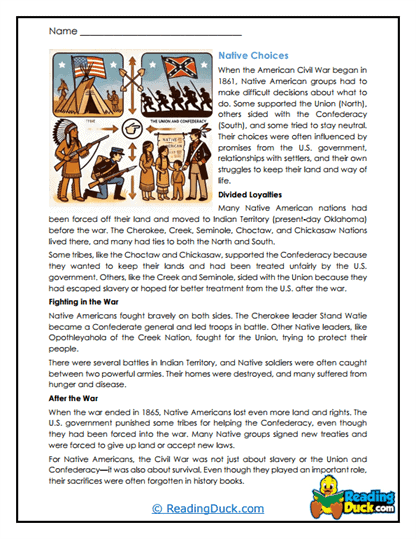
Native Voices - This worksheet covers Native American nations during the war, showing how they faced tough choices about siding with the Union, the Confederacy, or neither. Students learn how divided loyalties played out and how Native soldiers fought bravely despite losing much afterward. It highlights stories often left out of Civil War textbooks. Did you know Cherokee leader Stand Watie became a Confederate general?
Divided Lands - This worksheet explains the growing divide between North and South before the war. Students learn about factories versus plantations, abolitionists versus slaveholders, and why new states made things even more heated. The passage shows how cultural differences grew into political explosions. Ever heard of the Kansas-Nebraska Act? It practically handed out matches to light the fire.
Power Debate - Here students examine the tug-of-war between states' rights and federal power. The worksheet shows how this debate turned into a full-scale war once Lincoln was elected and states seceded. It also explains how the Union's victory strengthened federal authority for good. Fun twist: today's arguments about federal vs. state power trace right back to this 19th-century showdown.
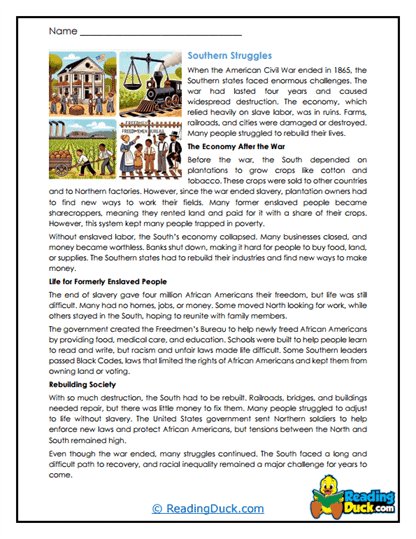
Southern Trials - This worksheet looks at the South after the war and the mess it had to clean up. Students learn about destroyed economies, freedmen searching for jobs, and the government's first attempts at rebuilding through the Freedmen's Bureau. It's Reconstruction 101, with all the hardship and resilience baked in. Imagine trying to rebuild a house while the pieces are still on fire-that was the South in 1865.
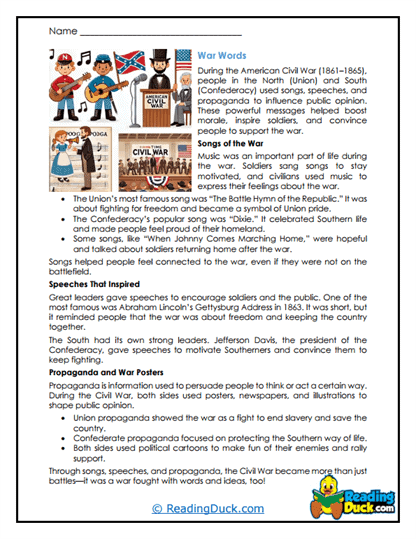
Battle Voices - Students explore the Civil War through songs, speeches, and propaganda instead of cannons. They'll see how music lifted spirits, speeches inspired courage, and posters rallied people to the cause. The worksheet shows that words were just as powerful as weapons. Did you know "Dixie" was so catchy that even Abraham Lincoln admitted to liking the tune?
Lasting Echoes - This worksheet connects the Civil War to modern America. Students learn how the war's legacy lives on through civil rights struggles, debates about symbols, and the constant push for unity. It highlights how the war ended slavery but left deep divisions still felt today. Quick thought: how would Lincoln have reacted if he saw Civil War flags at 21st-century rallies?
About American Civil War
The American Civil War was more than just a war; it was the nation's ultimate identity crisis. Fought from 1861 to 1865, it pitted the Union (North) against the Confederacy (South) over the future of slavery, states' rights, and the survival of the United States as one nation. It wasn't just a clash of armies-it was a clash of ideas about freedom, justice, and what America should be. Think of it as the country's teenage rebellion, only with muskets and bayonets.
Historically, the Civil War came after decades of growing tension. The North's factories and anti-slavery movements clashed with the South's plantations and slave-based economy. Every new state added to the Union sparked a shouting match over whether slavery would expand or stop. By the time Abraham Lincoln was elected in 1860, the fuse was lit. The war exploded soon after, changing everything.
If you're diving into Civil War vocabulary, get ready for words like "secession," "emancipation," and "Reconstruction." These aren't just fancy terms-they're keys to understanding the drama. "Secession" means breaking away (think states packing their bags and storming off). "Emancipation" means freedom (and it came with Lincoln's famous proclamation). And "Reconstruction"? That was America's long attempt to put itself back together again, Humpty-Dumpty style.
The Civil War's significance can't be overstated. It ended slavery, redefined citizenship, and cemented the idea that the federal government had ultimate authority. Its battles shaped landscapes, its leaders shaped laws, and its speeches shaped ideals. The war connected directly to the daily lives of ordinary Americans, from farmers to factory workers, and left lessons that still guide civic debates today.
And the debates? Oh, they're still alive. Arguments over state versus federal power echo in modern politics. Questions of racial equality, voting rights, and national identity trace back to Civil War struggles. Even symbols like the Confederate flag spark heated arguments today. What if the South had won? What if Lincoln had lived? The "what ifs" keep history exciting-and keep students asking questions long after the worksheets are done.
Make sure to bookmark our website now.
Enjoy all our free reading worksheets.
Our materials adhere to the principles of the Science of Reading.