The American Revolution was basically the world's most dramatic "We're breaking up!" letter - except instead of one person, it was thirteen colonies, and instead of awkward texts, it involved muskets, pamphlets, and a lot of tea in Boston Harbor. If you've never heard of it, imagine a group project gone horribly wrong: Britain thought they were in charge, the colonies thought otherwise, and suddenly everyone's throwing powdered wigs into the mix. Spoiler alert: the colonies won, and the world has never been the same.
So why does this matter today? Because the American Revolution wasn't just about tea and taxes - it was about ideas like liberty, equality, and self-determination. These concepts ripple through every civics class, political debate, and global freedom movement you'll ever hear about. Understanding the Revolution helps us grasp how ordinary people (with extraordinary courage) reshaped the world order. Without it, democracy as we know it might still be waiting in the wings.
That's where these worksheets come in. They don't just pile on dates and names - they tell stories, spark curiosity, and encourage students to think critically about why history unfolded the way it did. Teachers get ready-made lessons, parents get engaging resources, and students get to explore rebellion, resilience, and revolutionary change in ways that are lively and fun. Basically, it's like time travel - without the risk of being stuck in 1776 without Wi-Fi.
Meet the Worksheets
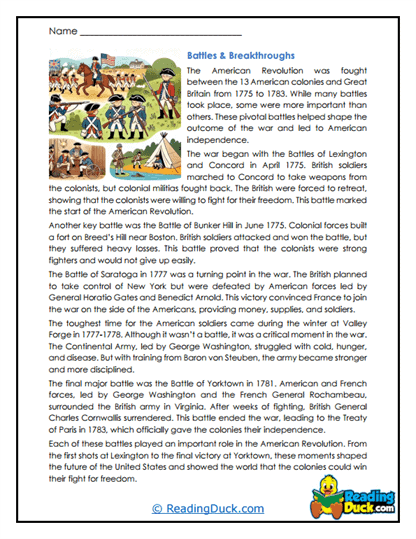
Battle Highlights - This worksheet takes students on a tour of the Revolution's most important battles, from the first shots at Lexington and Concord to the final surrender at Yorktown. Readers get to see how bravery, strategy, and a little French teamwork tipped the scales of history. It transforms maps and dates into stories of resilience and turning points. Fun fact: after the Battle of Bunker Hill, a British officer admitted, "A few more such victories would have ruined us" - talk about a backhanded compliment.
Freedom Struggles - Here, students dive into the complicated question: "Freedom for whom?" They'll explore the voices of African Americans, women, and Native Americans who faced tough choices and long odds. This isn't just about soldiers - it's about the Revolution's unfinished business of equality. Did you know some enslaved people who fought for Britain actually won freedom decades before America abolished slavery?
Nation Building - Students step into the chaotic years after independence, where the ink on the Declaration was barely dry before colonists realized, "Uh-oh, now what?" They'll learn about the Articles of Confederation, economic struggles, and the eventual creation of the Constitution. It's a crash course in trial, error, and the occasional miracle of compromise. Imagine trying to invent a whole new government while your economy's tanking - now that's multitasking.
Liberty Rebels - This worksheet shows how ordinary colonists became extraordinary troublemakers through boycotts, pamphlets, and a legendary tea-dumping party. Students see how protests and committees built unity across the colonies. The lesson makes political resistance feel less like a textbook and more like a revolution-in-progress. Ever wonder how hashtags spread ideas today? Colonists used pamphlets and taverns - same energy, different Wi-Fi speed.
Spark Flames - Students discover how America's Revolution didn't just change one country - it set the globe on fire. From France to Haiti to Latin America, revolutionaries borrowed ideas of liberty and self-rule. This worksheet shows how ideals can travel faster than ships. Fun thought: without America's rebellion, would we even have the storming of the Bastille (with bonus guillotines)?
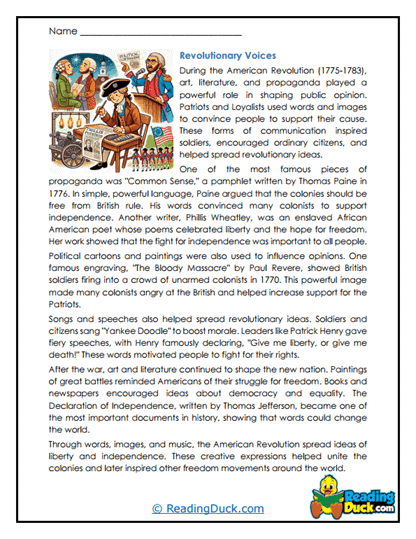
Voice Power - This one highlights how words, poems, and pamphlets could rally an army faster than muskets. Students meet Thomas Paine, Phillis Wheatley, and the persuasive power of speeches, songs, and engravings. It's a reminder that revolutions are fought with ideas as much as with cannons. And let's face it - "Common Sense" might be the catchiest book title in political history.
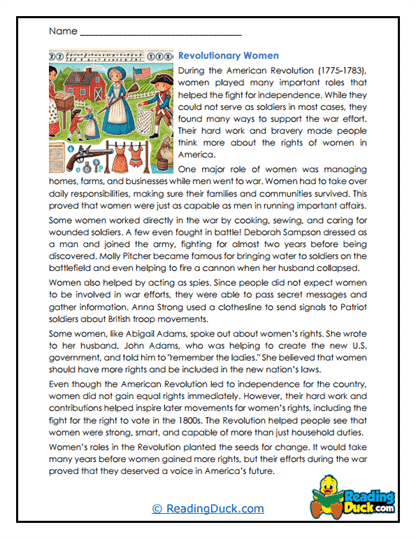
Women Warriors - Forget the sidelines - this worksheet shows how women ran farms, managed businesses, and even disguised themselves to fight. Students learn about heroes like Deborah Sampson and leaders like Abigail Adams, who asked her husband to "remember the ladies." It's history's way of proving that revolutions need multitaskers. Imagine fighting for independence by day and sewing uniforms by night - true grit in petticoats.
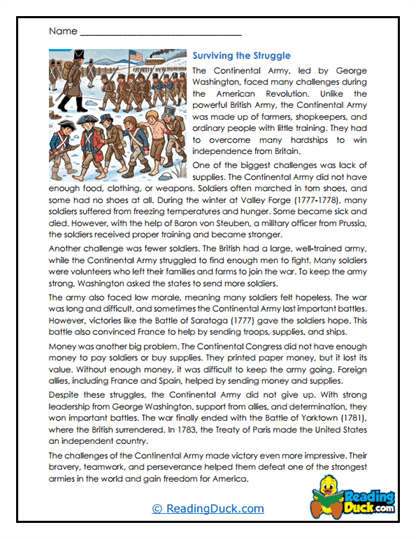
Struggle Strong - Students explore the freezing, hungry, and hope-testing winters endured by Washington's army. From ragged shoes to dwindling morale, the struggle teaches resilience as much as strategy. The worksheet connects hardship with eventual triumph, showing that determination was the secret weapon. At Valley Forge, soldiers joked about eating "firecake" - a tasteless mix of flour and water - proving even misery had a menu.
Tax Troubles - This one breaks down the Stamp Act, Townshend Acts, and Tea Act into more than just cranky colonists complaining. Students see how unfair laws sparked boycotts, riots, and eventually open rebellion. It's cause-and-effect storytelling with plenty of sparks. Ever been mad about a sales tax? Imagine being taxed for every playing card and newspaper - yikes.
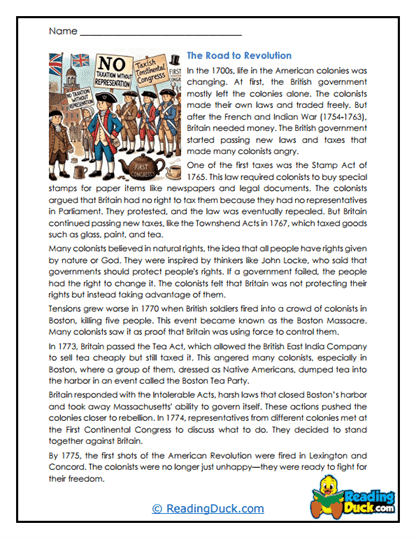
Rebel Road - The road to revolution wasn't straight - it twisted from protests to massacres to full-blown battles. This worksheet shows how events snowballed into Lexington and Concord, where muskets lit the fuse. Students connect protests to war in a way that feels like watching a slow-motion domino topple. Fun twist: Paul Revere wasn't the only midnight rider - dozens spread the alarm on horseback.
Freedom Voices - This worksheet amplifies the perspectives of enslaved people, Native Americans, and women during the Revolution. Students see how different groups weighed their choices and fought for survival or recognition. It's about who got liberty and who had to wait a lot longer. Did you know some Native nations split over whether to back Britain or the colonies? Tough choices with no easy answers.
Costly Victory - Winning independence didn't mean instant riches - this worksheet dives into debt, inflation, and tough economic realities. Students see how both Britain and the U.S. faced losses after the war, but America eventually turned struggles into strength. It's a reminder that revolutions are expensive business. Picture paying soldiers with "continentals" (paper money) so worthless they inspired the phrase "not worth a Continental."
About American Revolution
The American Revolution is the story of thirteen colonies deciding they'd had enough of imperial babysitting. At its core, it's about people demanding self-rule, tossing out monarchy, and crafting a republic. It covers battles, protests, ideas, and the messy birth of a nation. In short: it's history's most famous independence break-up, complete with fireworks.
Historically, the Revolution didn't just appear overnight. It simmered through years of taxes, protests, and British attempts at control, finally exploding in 1775 with the first battles. From 1775 to 1783, it swept through towns, fields, and even global waters, pulling in allies like France and Spain. By war's end, the Treaty of Paris in 1783 officially gave the U.S. its freedom, and the world had a brand-new player on the stage.
Along the way, students bump into words like "taxation without representation," "militia," and "republic." They'll learn about figures like George Washington, Thomas Paine, and Deborah Sampson, and ideas like liberty, sovereignty, and equality. These terms sound lofty, but they all boil down to how people organize power, protect rights, and tell their stories. Learning the language of the Revolution is like unlocking the code of democracy itself.
The Revolution matters because its echoes are everywhere. From voting rights to debates over equality, we still wrestle with the same questions colonists raised: Who gets a voice? What does freedom really mean? How do you balance unity with independence? Understanding these roots helps us see modern life not as random chaos, but as a continuation of conversations that began in 1776.
And yes, there are still debates! Did the Revolution truly deliver liberty for all, or just some? Would America exist today if France hadn't shown up with ships and baguettes? What if the colonies had lost - would we all be sipping afternoon tea with a British accent? These questions keep history alive, proving that the Revolution is more than old muskets - it's a story still being written.
Make sure to bookmark our website now.
Enjoy all our free reading worksheets.
Our materials adhere to the principles of the Science of Reading.