Imagine living in a world where you couldn't sit in certain restaurants, go to certain schools, or even drink from certain water fountains simply because of your skin color. That's the world the Civil Rights Movement set out to change, and trust me-it's more exciting than any superhero comic, because the heroes were real people. Instead of capes, they carried signs and sang songs, but their superpower was courage, persistence, and a deep belief in justice. Civil Rights isn't just history-it's a story of people demanding to be treated fairly and making the impossible possible.
So, why should we care today? Because the Civil Rights Movement didn't just change the past-it keeps shaping our present. Every time we vote, attend integrated schools, or watch leaders of all backgrounds rise to power, we're living in the world those activists fought for. Learning about Civil Rights helps us see how protests, laws, and everyday bravery can transform society. It's not just history; it's a crash course in how to stand up, speak out, and make things better.
That's where our worksheets come in. These resources take big, important topics and break them into bite-sized, engaging lessons for students, teachers, and even curious parents. Whether you're reading about Rosa Parks' quiet defiance, Martin Luther King Jr.'s soaring speeches, or the unsung women who kept the movement alive, each worksheet turns history into a conversation. Together, they prove that learning about Civil Rights doesn't have to be heavy-it can be inspiring, relatable, and even fun.
Meet the Worksheets
Movement Voices - This worksheet explores how different groups-African Americans, white allies, politicians, and even opponents-responded to the Civil Rights Movement. Students learn that while some pushed for justice, others resisted change, creating a complex struggle for equality. The reading highlights leaders, laws, and social divisions that shaped the era. Fun fact: not everyone agreed with Martin Luther King Jr.'s peaceful methods-some thought change required a louder, fiercer fight.
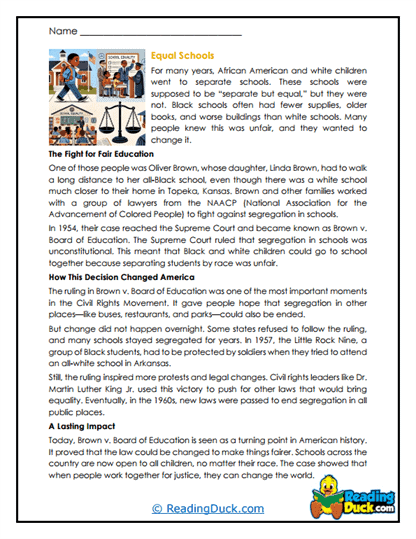
School Struggles - Here students discover the unequal world of segregated schools and the landmark case of Brown v. Board of Education. They'll see how families like the Browns took their fight all the way to the Supreme Court, changing history for millions of children. The passage shows how one case sparked a nationwide debate about fairness in education. Did you know Linda Brown's long walk to school became one of the most powerful symbols of inequality in America?
Wage Wars - This worksheet dives into the economic side of the Civil Rights Movement, from unfair wages to job discrimination. Students learn how activists like A. Philip Randolph and Dr. King fought not just for civil rights, but also for fair pay and opportunities. It shows how the struggle for equality extended to workplaces and paychecks. Imagine working the same job as someone else but being paid less just because of your race-this sheet makes students ask, "How fair is that?"
Battle Equality - Students discover how African Americans fought in World War II only to return home to segregation and discrimination. The passage highlights their contributions, the famous Tuskegee Airmen, and leaders like Randolph who demanded change. It shows how their bravery abroad clashed with injustice at home, fueling momentum for Civil Rights. Did you know over one million African Americans served in the U.S. military during the war, even while being forced to eat, sleep, and train separately?
Silent Strength - This worksheet celebrates the often-overlooked women of the Civil Rights Movement-people like Rosa Parks, Ella Baker, and Fannie Lou Hamer. Students learn how women organized boycotts, gave speeches, and fought tirelessly for justice. The reading shows that their role was just as essential as the men's, even if history books didn't always say so. Rosa Parks wasn't just "tired" on that bus-she was a trained activist ready to spark change.
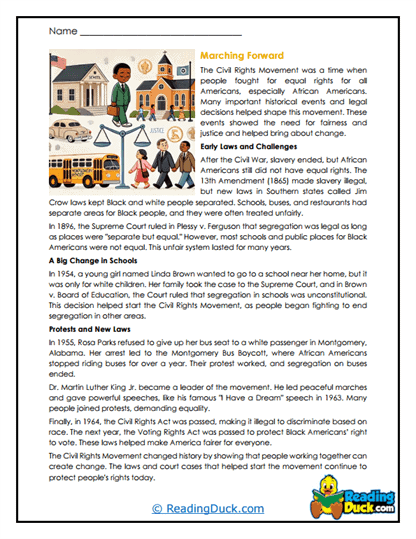
Freedom Laws - Here students explore the big victories: the Civil Rights Act of 1964, the Voting Rights Act of 1965, and the Fair Housing Act of 1968. They'll learn how these laws dismantled segregation, protected voting rights, and opened doors to fair housing. The worksheet explains how protests, speeches, and marches turned into lasting legal change. Picture it: a single speech on the steps of the Lincoln Memorial helped inspire a law that reshaped the nation.
Justice Acts - This worksheet zooms in on the same landmark laws but shows why they mattered in everyday life. Students see how legal protections opened schools, workplaces, and neighborhoods that were once off-limits to African Americans. It connects legislation directly to real-life fairness. Did you know Dr. King was assassinated just days before the Fair Housing Act was signed, making the law a bittersweet victory?
Justice Journey - This passage highlights how the fight didn't end in the 1960s-Civil Rights challenges continue today. Students learn about ongoing debates over voting rights, equal treatment in schools and jobs, and the growing representation of African Americans in government. It shows that progress is real but incomplete. Barack Obama becoming president in 2008 is a powerful reminder of just how far the journey has come.
Calm Courage - This worksheet dives into peaceful protests like the Montgomery Bus Boycott and the March on Washington. Students see how nonviolent strategies-boycotts, marches, and even songs-changed laws and inspired millions. The lesson emphasizes the surprising power of calm resistance. Ever think singing a song could help change a nation? In the Civil Rights era, it absolutely did.
Freedom Songs - Students discover how music, literature, and art gave the Civil Rights Movement its soundtrack and spirit. From protest songs like "We Shall Overcome" to poetry by Langston Hughes, creative voices fueled hope and courage. This worksheet shows that words and music can be as powerful as marches and laws. Sam Cooke's hit "A Change Is Gonna Come" wasn't just a chart-topper-it became an anthem for equality.
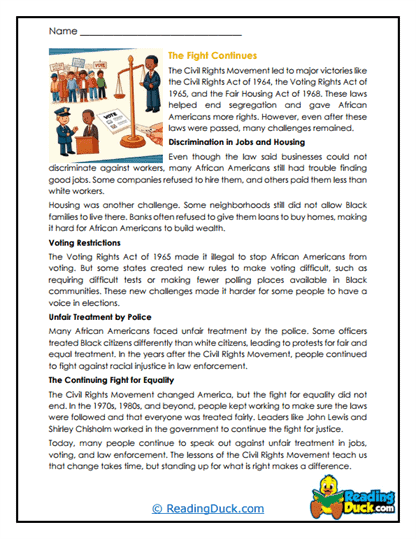
Equal Struggle - This reading shows how, even after landmark laws passed, discrimination continued in jobs, housing, and policing. Students learn about the ongoing battles faced by African Americans and how leaders kept pushing forward. The worksheet emphasizes persistence in the face of obstacles. Did you know some states tried sneaky tricks-like poll taxes or literacy tests-to keep African Americans from voting even after laws said they could?
Justice Journey (Still Fighting) - Students learn how the Civil Rights Movement's lessons still shape our world today. The passage covers equal treatment in schools, peaceful protests, and leadership in government. It shows that Civil Rights is not just history but an ongoing movement. What do you think-will future leaders look back at our time as another turning point in equality?
About Civil Rights
Civil Rights is the story of people demanding fair treatment under the law, no matter their race, gender, or background. At its core, it's about equality-the belief that everyone deserves the same opportunities in school, at work, and in daily life. Think of it as history's ultimate group project, where ordinary citizens teamed up to rewrite the rules of society. When students dive into Civil Rights, they're not just reading about the past; they're learning how justice is fought for, protected, and sometimes delayed.
Historically, the Civil Rights Movement rose to prominence in the 1950s and 1960s, though its roots go back much further. After slavery ended, African Americans still faced segregation through Jim Crow laws that divided schools, buses, and even water fountains. The movement exploded when brave individuals like Rosa Parks and Martin Luther King Jr. inspired millions to march, protest, and demand change. The courage of everyday citizens combined with powerful leadership reshaped the nation's laws and consciousness.
Key concepts in Civil Rights include words like "segregation," which means separating people unfairly, and "integration," which means bringing them together. Students will also encounter "boycott," where people refuse to use a service until it's fair, and "suffrage," which is simply the right to vote. These terms might sound formal, but in practice, they describe very real battles over schools, buses, ballots, and jobs. Learning the vocabulary of Civil Rights equips students to read history and recognize echoes of it today.
The significance of Civil Rights cannot be overstated-it affects how we go to school, where we live, and who we see in positions of leadership. Civil Rights isn't just about history; it shapes how we think about fairness, opportunity, and justice in our communities right now. It connects to daily life every time someone votes, speaks up against unfair treatment, or joins a protest for a cause they care about. Teaching students about Civil Rights is like handing them the instruction manual for building a more just society.
Today, Civil Rights continues to spark debates and activism. Issues like voting access, policing, housing fairness, and equal pay remain in the headlines. Students might wonder: what if Rosa Parks had given up her seat without a fight? Or what if Dr. King had never delivered his "I Have a Dream" speech? These "what if" questions show how much individual courage matters. The story of Civil Rights is still being written-and students who learn about it might just become the authors of its next great chapter.
Make sure to bookmark our website now.
Enjoy all our free reading worksheets.
Our materials adhere to the principles of the Science of Reading.