Imagine living in a world without Wi-Fi, pizza delivery, or even a light switch. Welcome to Colonial America-a time when survival meant farming your own food, stitching your own clothes, and hoping your neighbor didn't accidentally set the barn on fire. It was a period of grit, determination, and a lot of questionable hairdos. But beyond the bonnets and breeches, it was a foundational era that shaped the future United States.
Understanding Colonial America matters because it explains how freedom, democracy, and even rebellion took root. The colonies were more than just old wooden houses; they were the testing ground for ideas about rights, government, and society. When students learn about this period, they aren't just memorizing dates-they're uncovering the origins of the freedoms (and struggles) that still influence us today. Plus, it helps connect dots between geography, economics, and cultural diversity.
That's where this worksheet collection comes in. Each activity blends storytelling with learning so kids don't just read about tobacco farms-they smell the sweat of hard work (figuratively, of course). Parents will love how approachable the readings are, and teachers will appreciate the way history becomes both clear and fun. Colonial America might have been tough back then, but here, it's exciting, engaging, and maybe even a little entertaining.
Meet the Worksheets
Faith Shift - This worksheet takes students into the Great Awakening, when fiery preachers told colonists to feel their faith like never before. They'll learn how religion became emotional, personal, and revolutionary, changing both churches and society. The resource explains how this revival even influenced the push for American independence. Fun fact: Some services were so passionate that people fainted right in the middle of sermons!
Power Struggles - Here, students discover how Spain, France, and Britain wrestled for power in North America. They'll see how alliances with Native tribes, wars, and rivalries set the stage for the French and Indian War. The worksheet shows how these conflicts reshaped the colonies and eventually fueled revolution. Curious question: Did you know Britain's massive war debt from the French and Indian War pushed them to tax the colonists-sparking cries of "no taxation without representation"?
Daily Struggles - This worksheet explores the social classes of Colonial America, from wealthy landowners to enslaved people. Students will see how daily life varied wildly depending on one's role and status. The reading makes clear that even hardship played a part in shaping the colonies' future. Strange but true: Wealthy kids sometimes had tutors from England while poorer children learned survival skills at home.
Self Rule - Students meet the Mayflower Compact, a simple piece of paper that packed a democratic punch. They'll read how the Pilgrims agreed to govern themselves, paving the way for self-rule in America. The worksheet connects this moment to later documents like the U.S. Constitution. Quick fact: Only men signed the Compact-but its spirit of cooperation shaped American democracy for everyone.
Unity Mix - This worksheet dives into the melting pot of Colonial America. Students will discover how settlers from many backgrounds, plus enslaved Africans, blended cultures, foods, and traditions. It highlights how religious freedom and diversity made the colonies unique. Question to ponder: What would early America have looked like without German pretzels or Dutch windmills?
Labor Chains - Students explore how labor, especially enslaved labor, fueled the colonial economy. The reading explains the transatlantic slave trade, the Middle Passage, and the harsh realities of plantation life. It shows how forced work created wealth but also deep inequality. Sobering fact: Some enslaved people were skilled artisans-building ships or working as blacksmiths-even while being denied freedom.
Treasure Quest - This worksheet explains why explorers risked everything to cross the ocean in search of gold, glory, and God. Students will learn how Spain, France, and England sought wealth, power, and the chance to spread Christianity. They'll see how exploration opened trade but also created lasting conflict. Did you know Christopher Columbus thought he'd reached Asia-but instead stumbled upon the Caribbean?
Region Roots - Students discover how geography shaped the three colonial regions: New England, Middle, and Southern colonies. They'll learn why New Englanders became shipbuilders, why the Middle Colonies earned the "Breadbasket" nickname, and why the South thrived on plantations. The reading connects natural resources to everyday jobs and culture. Fun twist: Imagine being a New England farmer trying to plow rocky soil with nothing but oxen and grit!
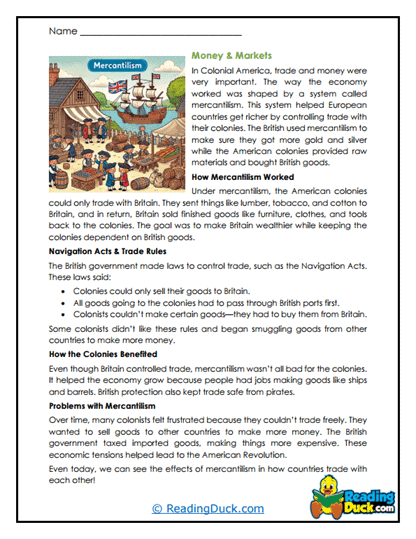
Trade Ties - This worksheet explains mercantilism-the economic system that bound the colonies to Britain. Students see how strict trade laws kept colonists dependent while making Britain rich. It shows how colonists grew frustrated and began resisting, fueling revolution. Curious fact: Some colonists smuggled goods past British patrols like 18th-century rebels with secret cargo!
Tribal Defiance - Students explore how Native American tribes resisted colonization through both adaptation and fighting. They'll learn about alliances, conflicts like King Philip's War, and the Powhatan Confederacy's fierce defense. The resource highlights resilience and cultural survival despite massive challenges. Did you know some tribes used European horses to adapt their hunting techniques?
Bloody Conflicts - This worksheet focuses on two of the deadliest wars between settlers and Native Americans: the Pequot War and King Philip's War. Students will learn about causes, battles, and the devastating consequences for Native tribes. It shows how mistrust shaped colonial relations for generations. Sobering fact: King Philip's War killed a higher percentage of the population than even the Civil War centuries later.
Cash Crop - Students trace the rise of tobacco in Virginia and its role in saving Jamestown from collapse. They'll see how John Rolfe's crop transformed the economy but also increased demand for labor, leading to indentured servitude and slavery. The worksheet explains how tobacco shaped Southern society and created deep inequalities. Odd truth: Tobacco was once so valuable that colonists used it as money to pay debts.
About Colonial America
Colonial America is the story of how thirteen ragtag colonies grew into something much bigger. At its simplest, it's about people leaving their homelands, braving an ocean, and carving out new lives in a wilderness. But it's also about trade, religion, conflict, and compromise-all the messy ingredients that baked the early American pie. Think of it as the pilot episode to the series we now call the United States.
Historically, Colonial America spanned from the early 1600s to the late 1700s. It started with small, shaky settlements like Jamestown and Plymouth and grew into bustling ports, sprawling farms, and powerful colonies. Along the way, colonists clashed with Native Americans, wrangled with European rivals, and eventually picked a fight with Britain itself. These centuries were full of grit, survival, and the beginnings of rebellion.
To understand this era, students need to meet key terms like "mercantilism," "plantations," "indentured servants," and "self-government." Each word unlocks a piece of the colonial puzzle, showing how economies functioned, how society was structured, and how people saw their rights. Learning the vocabulary isn't just memorizing-it's learning the language of survival, resistance, and independence. Without these terms, the story of the colonies is just a blur of bonnets and muskets.
The impact of Colonial America stretches into our daily lives. Ideas about democracy, equality, and religious freedom were born here, even if not everyone enjoyed them at the time. The economic habits of farming and trade shaped industries that still exist today. And the conflicts-whether between colonists and Britain or settlers and Native tribes-set patterns of struggle and compromise that continue in civic life. To study this era is to study the DNA of the United States.
Of course, debates still swirl. Were the colonists freedom fighters or opportunists? Could independence have happened without enslaved labor propping up the economy? What if the French had won the French and Indian War-would we all be eating croissants instead of hamburgers? These "what ifs" keep Colonial America fascinating and relevant. It's not just a chapter in history-it's a conversation starter for classrooms, kitchens, and maybe even dinner tables across the country.
Make sure to bookmark our website now.
Enjoy all our free reading worksheets.
Our materials adhere to the principles of the Science of Reading.