Imagine you've never heard of the Electoral College. No, it's not a Hogwarts spinoff or a fancy university for politicians - it's the quirky system America uses to pick its president. Instead of just tallying up votes like a school election for class president, it involves electors, state-by-state strategies, and enough drama to fuel history lessons for years. Think of it as democracy's group project, where not everyone pulls the same weight, but everyone still gets a grade.
So why does this system matter today? Because the Electoral College shapes who campaigns where, which states get attention, and even who ends up leading the country. It explains why your TV is flooded with campaign ads if you live in Ohio, but blissfully quiet if you live in California. Understanding it helps us see how power is distributed and why elections can be so close (or so confusing). Whether you agree with it or not, the Electoral College still plays referee in America's biggest political game.
That's where these worksheets come in. Instead of dry textbooks, we've got bite-sized, story-driven passages that explain everything from the Founding Fathers' debates to the chaos of the 1800 election. Students get to wrestle with questions of fairness, strategy, and compromise - while teachers and parents get resources that make civics feel alive. It's history, government, and critical thinking rolled into one fun (and sometimes dramatic) package.
Meet the Worksheets
Leader Choice - This worksheet takes students back to 1787, when the Founding Fathers debated how to elect the first president. It explains their concerns about fairness, uninformed voters, and balancing power between states. Students discover how the Electoral College emerged as a compromise solution. Fun fact: the same leaders who worried people didn't know enough about candidates had no idea what Twitter debates would look like.
Voting Voices - Here students step inside the Constitutional Convention to hear the arguments about whether Congress or the people should choose the president. The reading highlights different viewpoints and the compromise that created the Electoral College. It shows how balancing small and large states was key to the final decision. Quirky thought: imagine trying to make this decision in a modern group chat - would anyone ever agree?
Historic Votes - This worksheet dives into three of America's most dramatic elections: 1800, 1876, and 2000. Students learn how ties, political deals, and Supreme Court decisions shaped who became president. The reading shows just how powerful the Electoral College can be when results are razor-thin. Did you know one election was decided by a single state's recount that never finished?
Vote Tangle - Here, students revisit the chaotic election of 1800, where Jefferson tied with Burr. They follow the twists and turns that forced the House of Representatives to pick a winner. The passage shows how this mess led to the 12th Amendment. Question to ponder: how many tie-breaking votes would you sit through before finally saying "enough is enough"?
System Impact - This worksheet explores how the Electoral College shaped American politics for over 200 years. Students see how it encouraged the rise of the two-party system and shifted attention to swing states. They also weigh pros and cons of whether the system makes elections fairer or less equal. Here's a twist: without it, U.S. politics might not be stuck with just two major parties.
Amendment Aid - Students explore how the 12th Amendment fixed problems with early elections. They learn about the Jefferson-Burr tie and why separating votes for president and vice president was necessary. The reading shows how this change made elections smoother and strengthened political parties. Quick trivia: before this fix, rivals sometimes ended up awkwardly sharing the White House.
Vote Dispute - This worksheet presents the big arguments for and against the Electoral College. Students see why some support it as protection for small states, while others criticize it for being unfair. It encourages critical thinking about representation, fairness, and equality. Here's a thinker: should a candidate be able to win the presidency without winning the most votes?
Voting Dilemma - Students learn why the Founding Fathers designed the Electoral College in the first place. The worksheet highlights their fears about uninformed voters, power-hungry lawmakers, and neglected small states. It explains how electors became the middle ground. Picture it: the Founders inventing a system to solve 1787's problems - and still making us debate it today.
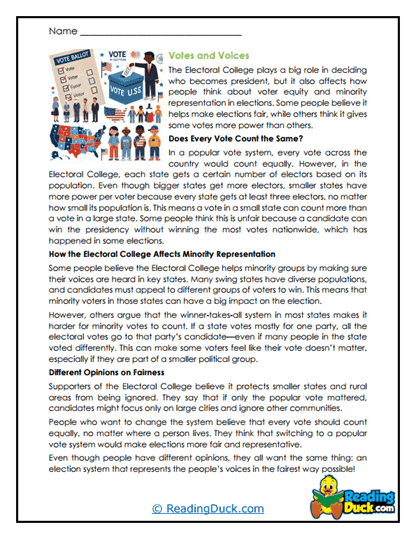
Ballot Balance - This worksheet asks whether every vote really counts the same in the Electoral College. Students explore how small states and minority groups gain influence, while critics say some votes are worth more than others. It challenges students to think about fairness and equality in democracy. Strange but true: a vote in Wyoming can carry more weight than a vote in California.
Fair Vote - Here, students examine whether the Electoral College is the fairest way to pick a president. They learn how it protects small states but also pushes candidates to focus on swing states. The passage highlights both supporters' and critics' arguments. Curious fact: if you live in a swing state, you might see candidates more often than your local weather forecaster.
State Power - This worksheet introduces the concept of safe states versus swing states. Students discover how campaigns spend money and attention based on where votes matter most. The reading explores how this can discourage or motivate voter turnout. Fun to imagine: what if every state were suddenly a swing state - would candidates ever sleep?
Strategy Game - Students explore how the Electoral College shapes campaign strategies. They see why candidates focus on battleground states instead of spreading their efforts equally. The passage shows how both large and small states still matter in the race to 270 electoral votes. Here's a quirky note: the map of "must-win" states changes every few decades, like fashion trends for democracy.
About the Electoral College
The Electoral College is the United States' unique way of choosing its president. Instead of just adding up all the votes nationwide, it relies on electors assigned to each state. Whoever wins a state usually gets all of its electoral votes, and the first candidate to 270 wins the presidency. It's not a school, despite the name, but it's definitely a system with lessons worth studying.
The system was born in 1787 during the Constitutional Convention, when the Founding Fathers argued endlessly about how to balance power. Some feared giving too much control to the people, while others worried Congress would hog it all. The Electoral College emerged as a compromise that reflected both democracy and caution. Its first big test came in the election of 1800, which showed just how messy things could get without clear rules.
To understand the Electoral College, students need to know terms like "electors," "swing states," "safe states," and "amendments." These words may sound like political jargon, but they're really the keys to understanding how campaigns and elections play out. Knowing this vocabulary helps demystify what happens every four years. It also gives students the language to join civic conversations with confidence.
The impact of the Electoral College is everywhere in American politics. It shapes where candidates campaign, how much states matter, and even who wins when the popular vote says otherwise. It explains why some states feel like the center of the political universe, while others get ignored. Whether you love it or hate it, the system influences the very way democracy operates.
Today, debates about the Electoral College are as heated as any political argument. Some want to keep it to protect smaller states, while others want to replace it with a direct popular vote. The controversies spark questions like: what if every vote really counted the same? What if swing states didn't decide everything? Whether it changes or not, the Electoral College remains one of the most fascinating quirks of American democracy.
Make sure to bookmark our website now.
Enjoy all our free reading worksheets.
Our materials adhere to the principles of the Science of Reading.