About Our Emancipation Proclamation Reading Worksheets
If you've never heard of the Emancipation Proclamation, think of it as the 1863 version of a viral announcement - except instead of trending on TikTok, it declared enslaved people in Confederate states free. Abraham Lincoln signed it during the Civil War, turning the war from a "let's keep the band together" reunion tour into a "let's end slavery once and for all" movement. Spoiler alert: not everyone clapped at first, but it changed the game forever. It was a mic-drop moment in American history that still echoes today.
Understanding the Emancipation Proclamation matters because it shows how one decision can shift the entire course of a nation. It's not just about history class; it's about recognizing how leadership, justice, and social movements collide. From shaping later civil rights struggles to influencing global politics, the Proclamation connects directly to how people fight for freedom and equality today. Think of it as the historical domino that toppled into everything from Juneteenth celebrations to modern conversations about justice.
That's why this worksheet collection exists: to make the Emancipation Proclamation approachable, exciting, and maybe even a little fun. Each worksheet takes a different angle - from soldiers on the battlefield to abolitionists with fiery speeches - giving students, parents, and teachers plenty to explore. Whether you're a history buff, a reluctant reader, or just someone who enjoys a good "aha!" moment, these activities will bring Lincoln's bold decision to life. Learning about freedom has never been this engaging.
Meet the Worksheets
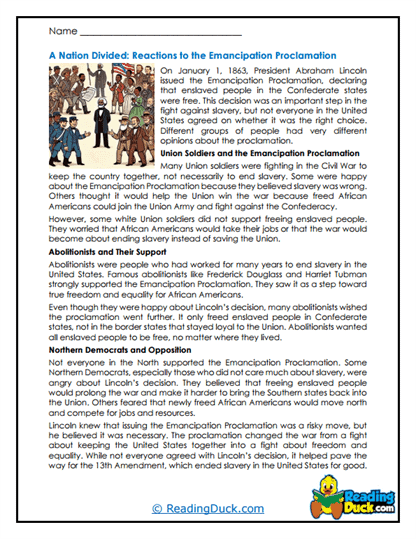
Union Voices - This worksheet introduces students to the different reactions people had to the Emancipation Proclamation, from Union soldiers to abolitionists to nervous Northerners. It highlights how motivations varied, whether people wanted to win the war, end slavery, or simply keep the country intact. By examining multiple perspectives, students see history not as a single story but as a chorus of voices. Did you know that some Union soldiers worried freed African Americans would "take their jobs"? That's history meeting workplace gossip.
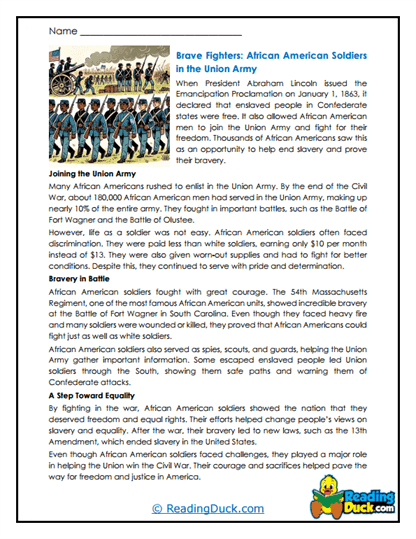
Brave Soldiers - Here, students dive into the story of African American soldiers who fought for the Union after Lincoln's Proclamation. They'll learn how nearly 180,000 Black men joined the fight despite discrimination, poor pay, and dangerous conditions. The passage emphasizes bravery, especially that of the 54th Massachusetts Regiment, which became legendary. Fun fact: these soldiers' courage was so great that even hostile newspapers in the South admitted their valor.
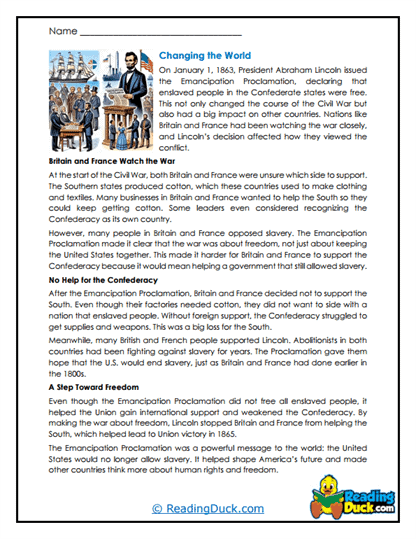
Global Impact - This worksheet explores how Britain and France reacted to the Proclamation and why their choices mattered. Students will see how global politics intersected with America's war, with foreign leaders debating whether to back the Confederacy. The Proclamation turned slavery into the defining issue, making it hard for countries opposed to slavery to support the South. Imagine if Britain had sided with the Confederacy - the U.S. might look very different today.
Bold Escape - Students learn about the creative and courageous ways enslaved people resisted slavery, from the Underground Railroad to work slowdowns and cultural traditions. The passage highlights Harriet Tubman's daring rescues and the everyday acts of defiance that kept hope alive. By the Civil War, many joined the Union Army, turning resistance into direct action. Did you know Tubman personally guided about 70 people to freedom - and inspired hundreds more through her example?
Border Choices - This worksheet explains why Lincoln didn't free enslaved people in the loyal border states right away. Students discover Lincoln's tricky balancing act: keep the Union together while still striking at slavery. The passage shows how strategy sometimes means compromise, even in a fight for freedom. Question for curious learners: What would have happened if the border states had left the Union?
Freedom Shift - Here, students see how Lincoln's goals evolved as the Civil War dragged on. At first, he focused on preserving the Union, but over time he realized the war had to tackle slavery directly. The Emancipation Proclamation transformed the fight into one for freedom, not just unity. Think of it as the Civil War's ultimate plot twist - the "season two" surprise reveal.
Lasting Freedom - This worksheet connects the Proclamation to later civil rights struggles, showing how it set the stage for leaders like Martin Luther King Jr. Students learn about its legacy in schools, jobs, and Juneteenth celebrations. The passage proves that one document can influence generations. Fun thought: without Lincoln's pen stroke in 1863, would we still be talking about equality marches in the 1960s?
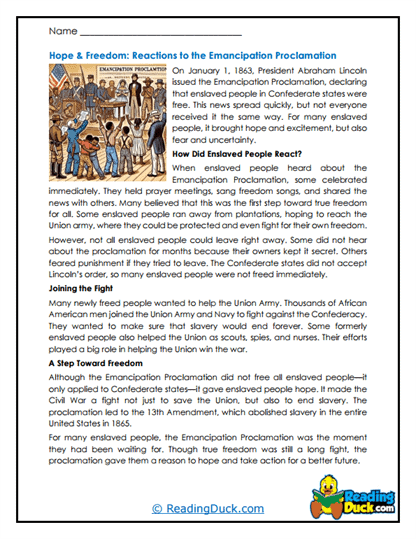
Hope Rising - Students explore how enslaved people themselves reacted to the Proclamation, from singing songs to joining the Union Army. The passage emphasizes that while freedom didn't arrive overnight, the Proclamation gave hope and courage to act. It highlights the mix of celebration and risk that defined the moment. Imagine hearing that you were "free" - but knowing your master hadn't accepted it yet. What would you do?
Lincoln's Choice - This worksheet examines why Lincoln made his decision in 1863, tying together political, economic, and social pressures. Students see how abolitionists, foreign powers, and enslaved people themselves influenced his hand. It's a lesson in leadership under fire and how one choice can reshape a nation. Did you know Britain and France were this close to recognizing the Confederacy before Lincoln's big announcement?
Liberty Fight - Here, students meet the nearly 200,000 African Americans who fought for the Union after the Proclamation. Despite discrimination, they proved themselves as fearless soldiers, helping to redefine the meaning of freedom. The 54th Massachusetts Regiment gets special spotlight for its heroism. Curious fact: African American troops made up about 10% of the Union Army by the end of the war.
Battle Shift - This worksheet connects the bloodiest single day in American history - the Battle of Antietam - with Lincoln's timing for the Proclamation. Students learn how this battle gave Lincoln the leverage he needed to act. The passage explains how one event can shift an entire war's direction. Did you know over 22,000 soldiers were killed, wounded, or missing in just one day at Antietam?
Freedom Voices - Students meet Frederick Douglass and other abolitionists who pushed Lincoln to act boldly. The passage highlights their speeches, writings, and relentless activism against slavery. It shows how grassroots pressure can influence even the highest office in the land. Here's a thought: without Douglass's fiery speeches, would Lincoln have signed the Proclamation when he did?
About Emancipation Proclamation
The Emancipation Proclamation is a historic document issued by Abraham Lincoln in 1863 that declared enslaved people in Confederate states free. At its simplest, it was both a military strategy and a moral statement, transforming the Civil War into a fight about slavery as well as unity. Though limited in immediate effect, its symbolic power was enormous, reshaping the meaning of freedom in America. Think of it as both a legal decree and a turning point in the nation's identity.
Historically, the Proclamation came at a desperate moment in the Civil War. The Union needed a boost, and Lincoln used the opportunity after the Battle of Antietam to announce it. While enslaved people were already resisting and abolitionists were pressuring for change, this single act put the U.S. firmly on the side of ending slavery. Internationally, it made it nearly impossible for Britain and France to support the Confederacy. It was, in short, Lincoln's strategic and moral gamble that paid off.
Key terms tied to the Proclamation include "abolitionist" (someone who wanted slavery gone), "Confederacy" (the seceded Southern states), "Union" (the Northern states fighting to preserve the U.S.), and "amendment" (a change to the Constitution). Students also encounter "freedom," "equality," and "civil rights," which continue to shape modern conversations. Understanding these words isn't just vocabulary work - it's about unlocking the language of justice.
The Proclamation's significance lies in how it connected law, politics, and human lives. It turned enslaved people into active participants in the Union cause, opened the door for African Americans to serve in the military, and shifted global views of the U.S. Its echoes stretch to the 13th Amendment, the civil rights movement, and even today's struggles for equality. In many ways, it's the blueprint for how bold leadership can change society.
Today, debates continue: Was Lincoln motivated more by strategy than morality? Did the Proclamation truly free people, or was it just a step toward the 13th Amendment? What would have happened if Britain had backed the Confederacy instead? These questions keep the topic fresh, showing that history isn't dusty facts but living discussions. By asking "what if," students not only learn the past but also sharpen their curiosity about the present.
Make sure to bookmark our website now.
Enjoy all our free reading worksheets.
Our materials adhere to the principles of the Science of Reading.