About Our Federalists And Anti-Federalists Reading Worksheets
Picture this: It's the late 1780s, powdered wigs are all the rage, and America's leaders are bickering like siblings over who gets the TV remote. Only instead of television, it's the U.S. Constitution, and instead of siblings, it's fiery Federalists and suspicious Anti-Federalists. These folks weren't just arguing about government-they were laying the foundation for how Americans would live, vote, and grumble about taxes for centuries to come. Think of it as the original reality show, except with parchment and quill pens.
Why should we care about these arguments today? Because the same issues-like how much power the government should have or who gets to decide what's fair-still pop up in debates, laws, and even the news you scroll past on your phone. Learning about Federalists and Anti-Federalists isn't just dusty history; it's a front-row ticket to understanding democracy, freedom, and why people still argue about government budgets at family dinners. Without their debates, we might not have the Bill of Rights, checks and balances, or that magical phrase: "We the People."
That's where these worksheets come in. Instead of yawns and glazed eyes, students get short readings, quirky historical tidbits, and easy-to-digest lessons about these passionate debates. Teachers will love the clear connections to civics, parents will appreciate the mix of fun and rigor, and students will secretly enjoy learning about heated arguments that shaped the U.S. These worksheets turn serious history into something relatable, witty, and-dare we say-downright fun.
Meet the Worksheets
Constitution Clash - This worksheet dives into the 1787 showdown when the Articles of Confederation flopped and the Constitution was born. Students learn how Federalists wanted strong national power, while Anti-Federalists worried about lost freedoms. The reading highlights the fiery arguments, the persuasive essays, and the eventual compromise that added the Bill of Rights. Did you know Alexander Hamilton wrote so many essays defending the Constitution that his friends probably begged him to take a nap?
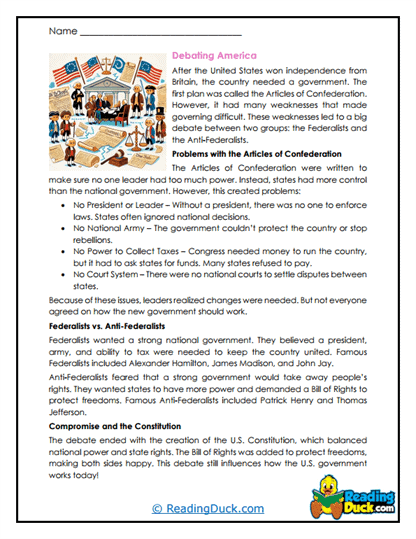
America's Debate - Here, students explore why the Articles of Confederation were too weak to hold the new country together. They'll read about the problems-like no president, no army, and no power to tax-and the push for something stronger. Anti-Federalists fought back, fearing a return to monarchy-style power, but compromise saved the day. Imagine running a country with no way to collect taxes-how long before someone suggests a bake sale to fund the army?
Loyalty Lines - This worksheet shows how different groups-like merchants, farmers, bankers, and workers-picked sides in the Federalist vs. Anti-Federalist debate. Students discover how social class and economic interests shaped political loyalties. They'll see why bankers loved strong government but small farmers feared it. Ever wonder why politics can feel like a tug-of-war between different groups? Turns out, that's nothing new.
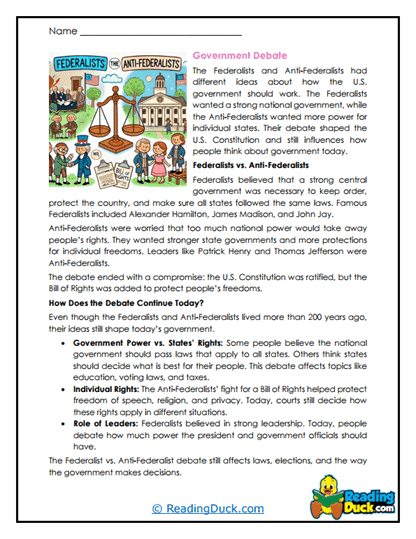
Debate Divide - Students learn how the Federalists and Anti-Federalists clashed over the Constitution, with Federalists pushing for unity and Anti-Federalists fighting for individual rights. The reading explains how the Bill of Rights emerged as a compromise. It also connects these early debates to modern issues like states' rights, civil liberties, and presidential power. Spoiler alert: America's oldest arguments still haven't been settled at the dinner table.
Money Matters - This worksheet explores the financial mess left after the Revolution, when America was drowning in debt. Students read about Hamilton's push for a national bank, federal taxes, and trust in government finances. They'll also see why Anti-Federalists resisted, fearing banks would favor the rich. The debate gets surprisingly relatable-imagine your country owing money but arguing over who should pay the bill.
Voices Clash - Here, students step into the shoes of the Anti-Federalists, who passionately opposed the Constitution. The reading explains their fear of wealthy elites running the country and their demand for a Bill of Rights. Essays, speeches, and letters brought their concerns to life, and in the end, they won a major victory. Think of it as the ultimate "we told you so" moment in American history.
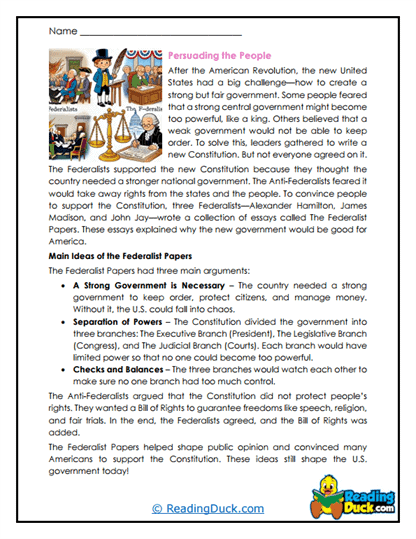
People Persuasion - This worksheet highlights the Federalist Papers, a collection of essays designed to win over skeptical Americans. Students learn the three big ideas: strong government, separation of powers, and checks and balances. They'll see how these arguments convinced people to back the Constitution. Fun fact: Alexander Hamilton was so prolific, you'd think he was getting paid by the word.
Party Origins - Students trace how the Federalist vs. Anti-Federalist feud blossomed into America's first political parties. They'll meet the Federalists, who wanted banks and big government, and the Democratic-Republicans, who fought for states' rights. The reading shows how arguments about the Constitution set the stage for centuries of party politics. Ever wonder why the U.S. still has political drama? Blame these founding frienemies.
Power Politics - This worksheet connects the Federalist and Anti-Federalist fight to later debates over states' rights. Students will see how these arguments fueled events like the Civil War and the Civil Rights Movement. The text makes clear that the debate didn't just end with the Constitution-it echoed through history. It's like the political version of a family argument that never quite goes away.
Revolution Roots - Students learn how experiences from the American Revolution shaped the Federalist vs. Anti-Federalist debate. Federalists saw the war's chaos as proof a strong government was needed, while Anti-Federalists feared tyranny. The passage explains how both sides used their war experiences to argue for or against the Constitution. Imagine fighting a revolution together, then immediately arguing about what comes next-awkward!
Rights Matter - This worksheet focuses on the Anti-Federalists' demand for a Bill of Rights. Students learn how the Federalists resisted at first, claiming freedoms were already protected, but eventually agreed to add amendments. The reading explains the freedoms guaranteed by the Bill of Rights, like free speech and fair trials. Without the Anti-Federalists, we might not have the right to complain about the government on social media today.
Forgotten Voices - Students confront the uncomfortable truth that enslaved people and Indigenous groups were left out of the Federalist vs. Anti-Federalist debate. They'll see how slavery, land disputes, and broken treaties were ignored while leaders argued over government power. The passage connects these excluded voices to the long fight for freedom and rights in America. It's a sobering reminder that history's loudest debates often leave the quietest voices unheard.
About Federalists And Anti-Federalists
Federalists and Anti-Federalists were the OG political sparring partners of the United States. On one side, you had Federalists like Hamilton and Madison waving the "strong national government" flag. On the other, Anti-Federalists like Jefferson and Henry were yelling, "Not so fast!" worried that too much power in one place would squash individual freedoms. This tug-of-war over government power wasn't just entertaining-it defined how the U.S. Constitution was written and how Americans still argue about politics today.
Historically, the debate began after the Revolution, when the Articles of Confederation proved too weak to hold the states together. Picture a team where everyone insists on being captain-that was early America. The Constitutional Convention of 1787 was supposed to fix things, but instead it sparked a passionate fight over whether the new plan gave the government too much muscle. The Federalists wanted strength and stability; the Anti-Federalists feared a new monarchy in disguise. Out of this chaos came one of the most important compromises in U.S. history.
The key terms here are worth memorizing-"ratification," "checks and balances," and "Bill of Rights" aren't just fancy phrases. Ratification means officially approving the Constitution, checks and balances keep the branches of government from pulling power plays, and the Bill of Rights guarantees freedoms like speech and religion. Students who master these terms don't just ace tests-they understand the language of democracy. Even the word "federalism" itself is about balancing local and national power, like deciding who gets to pick the movie on family night.
The impact of this debate still shapes daily life. Every time someone talks about states' rights, presidential power, or government spending, they're echoing the arguments of 1787. Civic life, court cases, and even school policies connect back to these ideas. Understanding this history helps students become better citizens, voters, and debaters (whether in Congress or just at the lunch table). It's proof that history isn't stuck in the past-it keeps showing up in your news feed.
And of course, the debates continue. Should states make their own rules on issues like healthcare and education? Should the president have sweeping powers in times of crisis? What freedoms are absolute, and which can be limited? These are modern echoes of the Federalist vs. Anti-Federalist quarrel. If Hamilton, Madison, Jefferson, and Henry could time-travel to today, they'd probably feel right at home-though they might ask why everyone's staring at glowing rectangles instead of parchment.
Make sure to bookmark our website now.
Enjoy all our free reading worksheets.
Our materials adhere to the principles of the Science of Reading.