If you've never heard of the executive branch, don't panic-it's not a new gym workout routine or a fancy office chair. It's the part of the U.S. government that makes sure laws aren't just written down in dusty books but actually carried out. Think of it as the "doer" branch of government, with the president at the helm and a whole team of helpers making sure things get done. Without it, Congress could pass laws all day, but nothing would happen-like writing a recipe and never cooking the meal.
So why should we care? Because the executive branch shapes everything from what kids eat at school to how the nation responds to emergencies. It helps us understand what leadership looks like, why balance matters, and how decisions ripple into daily life. Knowing how the executive branch works makes us smarter citizens, better voters, and more informed thinkers about the world around us. Whether you're a student, teacher, or just someone who likes watching political dramas, this is the real-life stuff that explains what's going on behind the headlines.
And here's the fun part: these worksheets don't just explain the executive branch-they make it come alive. Through stories of presidents past and present, quirky facts about vetoes, and real debates over power, students will laugh, think, and maybe even argue (in a good way) as they learn. Teachers get ready-made lessons, parents get conversation starters, and kids get an engaging peek into government without the boring textbook blues. This collection proves civics can be entertaining, meaningful, and yes-sometimes even funny.
Meet the Worksheets
Power Puzzle - Students step into the shoes of the Founding Fathers as they argue about how much power the first president should have. They'll explore debates about elections, term lengths, and presidential powers, all while discovering how leaders avoided creating a king. The worksheet makes students see how checks and balances keep leaders in line even today. Did you know George Washington could have been president for life but said "no thanks"?
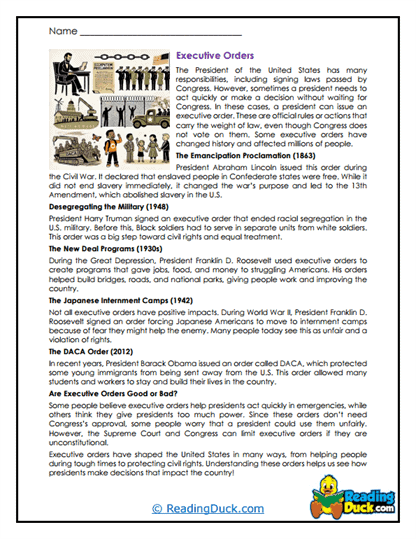
Order Power - This worksheet introduces students to executive orders and shows how presidents use them to act quickly. From Lincoln's Emancipation Proclamation to Truman desegregating the military, it's a whirlwind tour of big moments where one decision changed lives. But it also asks students to think critically about when executive orders go too far. Fun fact: Franklin Roosevelt signed more than 3,700 of them-talk about paperwork overload.
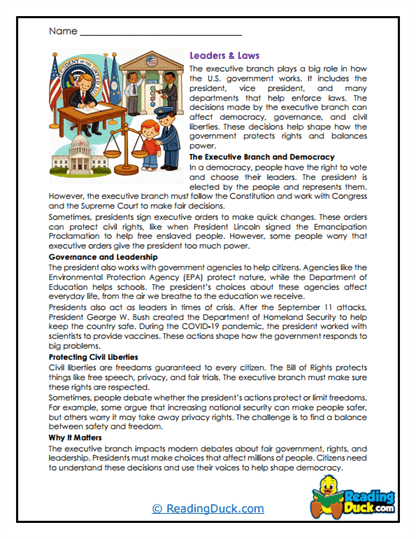
Law Leaders - Here, students dive into how the executive branch enforces laws and works with Congress and the courts. They'll see how agencies protect citizens, how presidents balance rights, and what civil liberties really mean. The content asks students to think about the line between protecting people and protecting freedoms. Question: Would you rather have total safety or total freedom-and can a government really deliver both?
Branch Birth - This worksheet tells the story of how the executive branch came to be during the Constitutional Convention. Students learn why leaders decided the new nation needed a president after struggling without one under the Articles of Confederation. They'll explore presidential powers, responsibilities, and the checks that prevent abuse. Did you know the Founders almost skipped creating a president altogether? Imagine America with no White House!
First Steps - George Washington takes the spotlight here as students discover how he set the tone for the presidency. The worksheet explains how Washington created the Cabinet, limited himself to two terms, and modeled leadership that future presidents followed. It also shows how other early leaders added their own traditions and decisions. Would America look different today if Washington had decided to be "President for Life"?
Opinion Power - This worksheet highlights the role of media in shaping public opinion of presidents. Students explore how newspapers, radio, TV, and social media influence what people think about leaders. They'll consider how presidents like FDR and modern leaders use media to connect directly with citizens. Did you know Roosevelt's "Fireside Chats" were so popular that families would plan their evenings around listening?
Policy Power - Students examine how presidential policies shape everyday life-from Roosevelt's New Deal to Johnson's Civil Rights Act and Bush's No Child Left Behind. The worksheet connects these big government decisions to things students experience, like schools, healthcare, and clean air. It makes clear how one leader's priorities can affect millions of Americans. Quirky fact: The Civil Rights Act was signed using more than 70 pens so lawmakers could each keep one as a souvenir.
Power Shifts - This worksheet explores how presidential powers have grown over time. Students look at constitutional powers like commander-in-chief and vetoes, then see how leaders expanded them during crises like the Civil War and Great Depression. It shows why debates about too much presidential power never seem to end. Here's a thinker: If presidents can act quickly in emergencies, who decides what counts as an "emergency"?
Party Power - Students discover how political parties shape the role of the president. They'll compare how Democrats and Republicans view presidential power differently, using examples from FDR, Reagan, and Obama. The worksheet makes politics feel less abstract and more like an ongoing tug-of-war over leadership. Did you know FDR vetoed over 600 bills while Reagan pushed to shrink government as much as possible?
Safety Power - This worksheet explains how presidents protect the country through agencies like the FBI, FEMA, and TSA. Students see how presidents respond to crises like 9/11 and COVID-19 while balancing safety with personal freedoms. It connects national policies to everyday experiences like airport screenings and health guidelines. Ever wonder why you have to take your shoes off at the airport? Thank the executive branch.
Opinion Shifts - Here, students track how public opinion of presidents has shifted during crises and over time. They'll learn how Lincoln, Roosevelt, and Bush faced both praise and criticism depending on their actions. The worksheet ties past examples to today's social media-driven landscape. Imagine if Lincoln had to defend the Emancipation Proclamation on Twitter-yikes!
Veto Voice - Students explore the presidential veto and how it keeps Congress in check. They'll follow examples from Andrew Jackson to George W. Bush to see how vetoes shaped laws about banks, schools, and healthcare. The worksheet explains why vetoes matter, how Congress can override them, and what this tug-of-war means for democracy. Did you know Franklin Roosevelt holds the record with 635 vetoes during his presidency?
About The Executive Branch
The executive branch is one of the three powerhouse branches of the U.S. government, alongside Congress and the courts. It's the "action branch," tasked with making sure laws actually happen instead of just gathering dust in legal books. At its center is the president, but it also includes the vice president, Cabinet, and countless agencies. In plain terms: if Congress writes the rules and the courts interpret them, the executive branch is the one rolling up its sleeves and getting stuff done.
Historically, the executive branch was born out of necessity. Under the Articles of Confederation, the young United States had no president, and things quickly spiraled into chaos-like a group project with no leader. So, in 1787, the Founding Fathers created the presidency through the Constitution, giving the nation a strong but limited leader. Washington's example set the stage: powerful enough to lead, humble enough to step aside. Since then, every president has added their own flavor to the job.
Key ideas in the executive branch include terms like "veto," "executive orders," and "checks and balances." These aren't just fancy words-they're tools that decide how much power the president has and how that power interacts with Congress and the courts. Students will also hear about agencies like the FBI or EPA, which enforce laws in real life. Learning this vocabulary unlocks an understanding of how government actually functions, beyond just the headlines.
The significance of the executive branch shows up in everyday life. From civil rights to disaster response, presidential decisions ripple out into classrooms, grocery stores, hospitals, and even airports. Knowing how this branch works makes people better voters, sharper thinkers, and more informed citizens. It also helps students appreciate how much history is shaped not just by laws but by the people who carry them out. In short: it's the difference between theory and practice in government.
Of course, debates about the executive branch are never-ending. Does the president have too much power? Should executive orders be limited? Could social media change the presidency forever? These are the kinds of questions that keep civics lively, relevant, and endlessly fascinating. And honestly-without a little debate, would it really feel like American democracy?
Make sure to bookmark our website now.
Enjoy all our free reading worksheets.
Our materials adhere to the principles of the Science of Reading.