Authors purpose is the reason a writer creates a text-typically to inform, persuade, entertain, or express feelings or ideas. Understanding purpose helps readers anticipate how a text will be organized, which details will matter most, and what tone or techniques the author might use. This awareness strengthens comprehension and analysis because students learn to ask, "What is the writer trying to do to me as a reader?" It also supports fluency by guiding attention toward the most relevant features of the text.
This collection offers a wide range of activities-from quick categorizing and matching tasks to deeper investigations that require citing evidence from passages. Students practice reading short texts, labels, ads, and informational snippets, then connect what they see to the author's intent. Many worksheets also include checklists, graphic organizers, and game-like elements to make practice engaging and repeatable. The variety ensures that learners revisit the same core skill in multiple ways, which builds both accuracy and confidence.
Students can use these worksheets to preview a text's likely purpose before reading, monitor for confirming clues during reading, and reflect on purpose after reading. They'll learn to notice signal words, text features, tone, and structure, then justify their conclusions with proof. Over time, they'll transfer the habit to real-life reading-spotting persuasive techniques in ads, recognizing informative structure in articles, and detecting entertainment cues in stories. With steady practice, purpose becomes a lens they bring to any text, improving both comprehension and critical thinking.
Looking At Each Worksheet
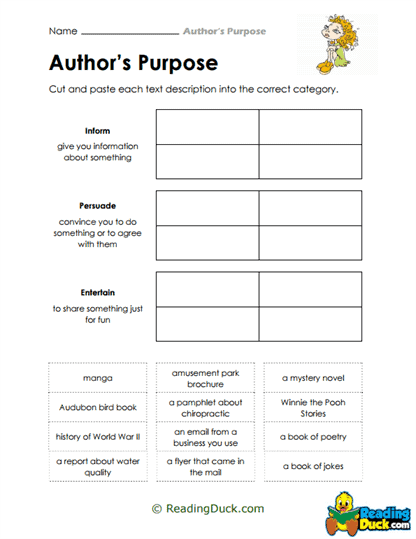
Categorize and Clip
Students cut and sort text examples into "inform," "persuade," and "entertain," physically grouping items to show how purpose shapes a text. This hands-on routine ties directly to authors purpose by making the categories concrete and visible. The act of sorting builds conceptual clarity and makes it easier to recognize patterns later in real passages. Students learn to apply the same logic to labels, articles, and stories they encounter daily. Tip: Have learners explain one example out loud as they place it to reinforce reasoning.
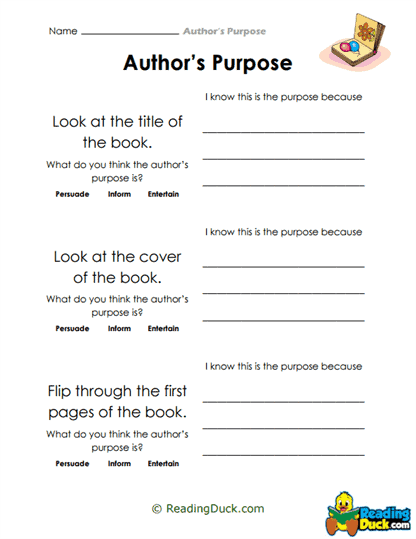
Cover Clues
Learners examine titles, images, and blurbs to predict the purpose before reading. By using external text features, they practice making an evidence-based hypothesis about authors purpose. This builds metacognition-students learn to preview with intention rather than diving in blindly. They can transfer the skill to book selection, media literacy, and test passages. Tip: Ask students to underline the one feature that most strongly influenced their prediction.
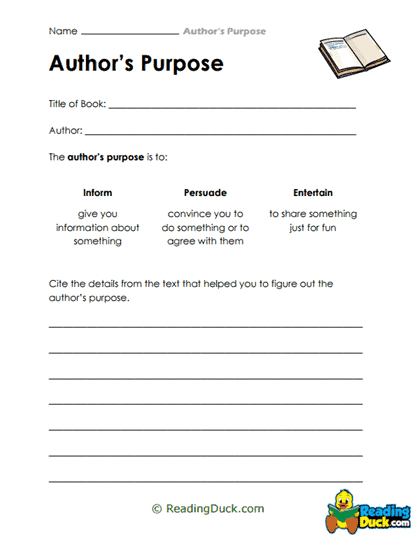
Evidence Explorer
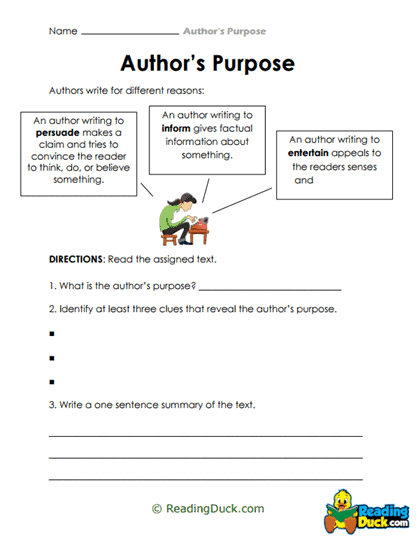
Students read brief passages and highlight or annotate the lines that reveal the author's intent. The activity directly links authors purpose to textual evidence, not just a "guess." It trains students to justify conclusions with quotes, data points, or persuasive language cues. This habit strengthens open-response answers and everyday reasoning. Tip: Require at least two pieces of proof for each decision to promote thorough reading.
Match the Purpose
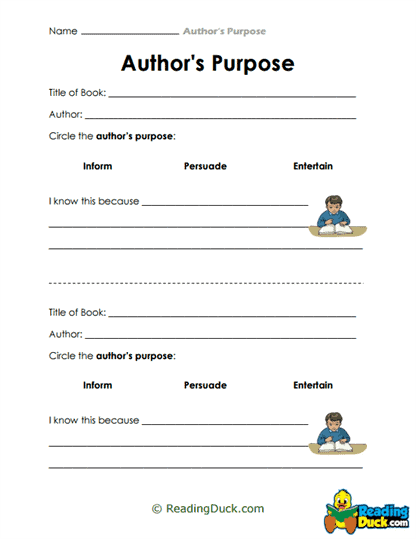
Learners match short excerpts to the correct purpose category. This rapid practice reinforces the differences among inform, persuade, and entertain in quick, digestible bursts. Matching builds speed and accuracy, which prepares students for longer tasks. In daily reading, they'll more readily recognize an author's goal from a few lines. Tip: After matching, have students rewrite one excerpt to fit a different purpose.
Passage Purpose
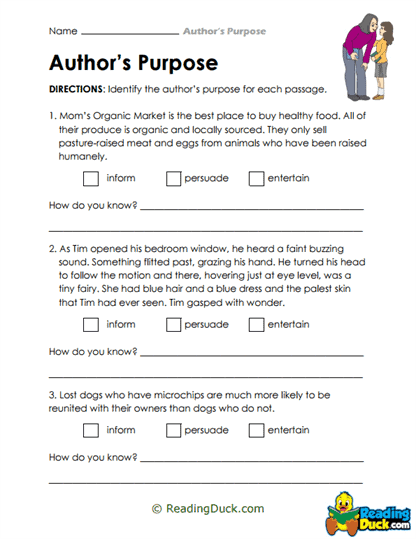
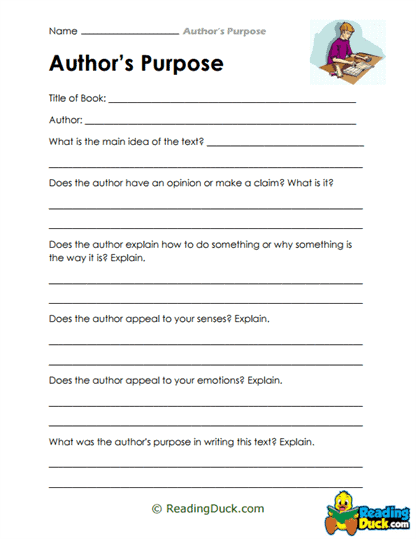
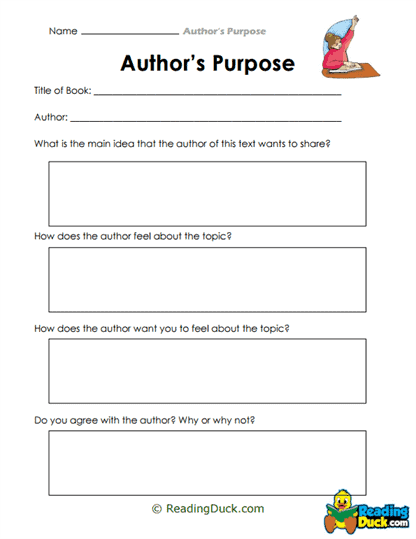
Students read a focused passage and decide its purpose, then justify their choice in writing. The task connects purpose to structure, tone, and details within a complete text. It builds endurance and deeper analysis because students must explain how the writing achieves its goal. In real reading, they'll summarize purpose alongside main idea and key details. Tip: Provide sentence starters for citing specific lines or features.
Purpose Checklist
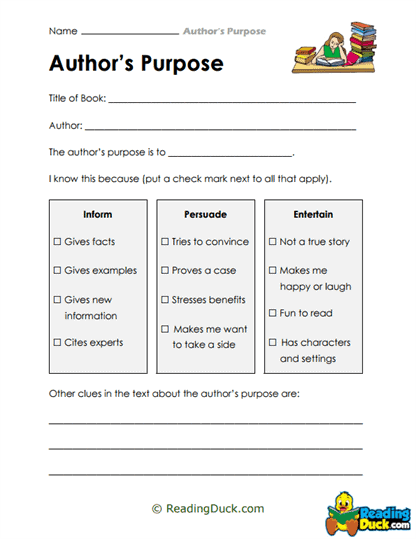
Learners use a checklist of signals (facts, statistics, calls to action, humor, narrative elements) to diagnose purpose. This makes authors purpose systematic rather than mysterious. Checklists help students slow down, scan wisely, and gather multiple indicators before deciding. The routine transfers to test prep and research reading. Tip: Encourage students to circle two different indicators before finalizing their answer.
Purpose Detective
Students "collect clues" such as modal verbs, value-laden words, anecdotes, or step-by-step explanations. The detective frame makes the abstract concrete and fun while sharpening evidence-gathering. It turns purpose into a solvable case built on proof, not hunches. Outside the worksheet, learners can spot the same clues in advertisements and opinion pieces. Tip: Have students create a "case file" listing three clues and a verdict.
Purpose Investigator
This activity pushes deeper by comparing two texts on the same topic to see how purpose differs. Students analyze how genre, tone, or structure shifts when the writer's goal changes. It builds flexible thinking and demonstrates that purpose drives craft decisions. In real life, students can contrast a news article and an editorial about the same event. Tip: Use a T-chart to record parallel features before concluding.
Purpose Picker
Learners choose a purpose first and then plan a short piece of writing to match it. This reverses the process, showing how writers make deliberate choices to achieve an effect. It cements the connection between authors purpose and audience, details, and organization. Students can apply this anytime they draft a paragraph, email, or presentation. Tip: Require a quick outline that lists three purpose-aligned moves (e.g., facts for inform).
Purposeful Text Type
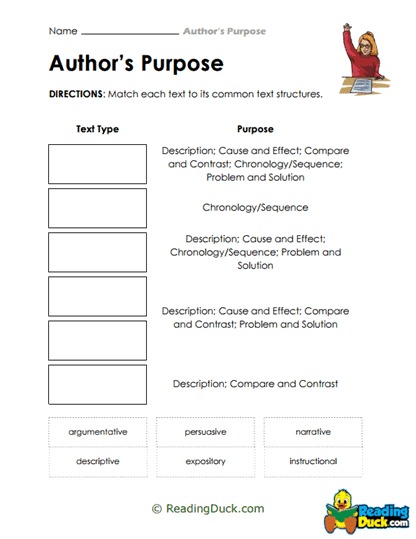
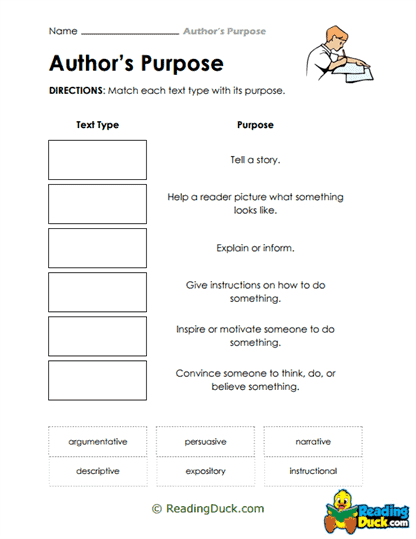
Students connect common text types (recipes, fables, ads, instructions, news briefs) to likely purposes. The classification reveals patterns between form and intent. It helps learners recognize purpose at a glance by leveraging genre knowledge. In everyday reading, they will anticipate what each text will demand of them as a reader. Tip: Ask students to add one original example for each category.
Spinner of Intent
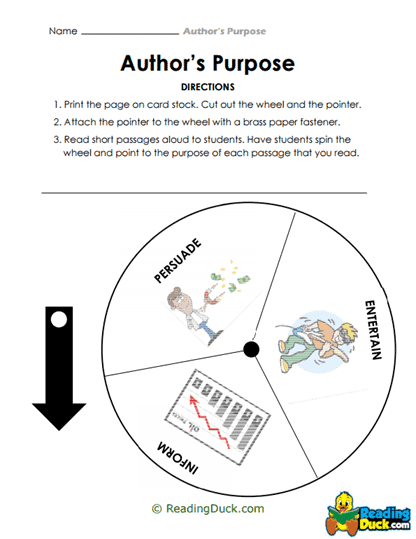
A spinner or randomizer assigns a purpose or audience, and students adapt a message accordingly. The playful constraint trains flexibility and tight purpose-audience alignment. It builds the habit of selecting features that match the goal, not just writing generically. Beyond class, students will adjust tone and detail depending on who they're addressing. Tip: After spinning, have learners identify two features they will definitely include.
Text Structure Sleuth
Students look for structures like sequence, compare-contrast, problem-solution, or cause-effect to infer purpose. The activity shows how structure and purpose work together to shape meaning. It strengthens comprehension by giving students a roadmap for what to expect next. In real-world reading, they'll decode organization faster and with more confidence. Tip: Color-code signal words for each structure to make patterns pop.
Topic Tuner
Learners see how the same topic can be written for different purposes by revising a base passage. This highlights the craft choices that shift tone, detail selection, and organization. It deepens understanding of how authors purpose drives every writing decision. Students can use the approach when tailoring emails, essays, or speeches. Tip: Have students annotate the exact words added or removed to change the effect.
True-False Purpose
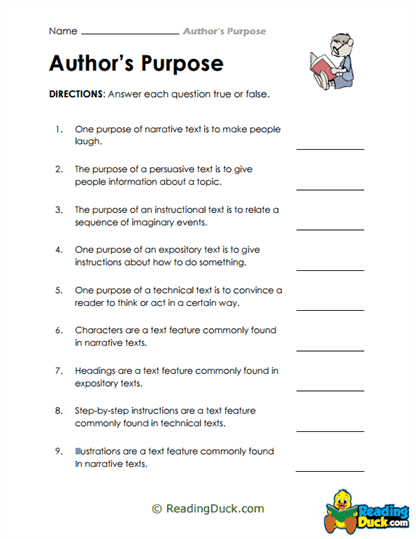
Students evaluate statements about a passage's intent as true or false, then correct the false ones. The exercise confronts common misconceptions head-on and requires precise justification. It strengthens critical reading by demanding careful attention to evidence. Learners can apply the habit to claims they see in media and discussions. Tip: Always include a "because..." sentence after each judgment.
Web of Purpose
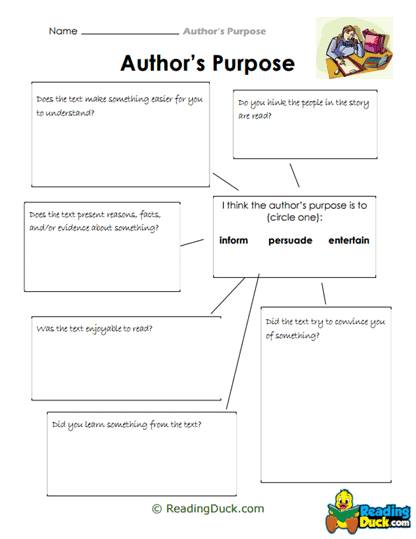
Learners build a concept map linking a text's purpose to tone, structure, details, and audience. Visual mapping makes the relationships among features explicit and memorable. The web helps students see that purpose is not a label but a network of choices. They can replicate the organizer when planning their own writing. Tip: Encourage arrows with brief notes explaining how each feature serves the purpose.
A Look At An Author's Purpose
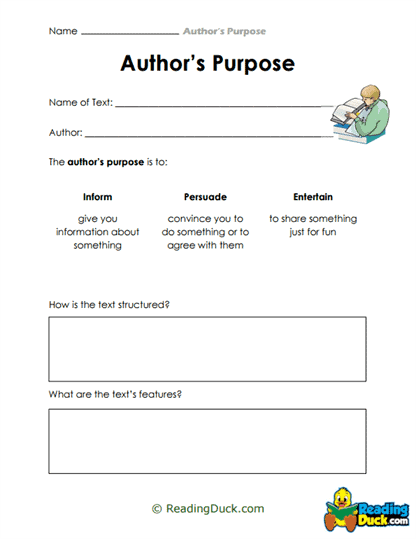
Authors purpose refers to the reason a writer creates a text, most commonly to inform, persuade, entertain, or express. Each purpose guides the writer's choices about structure, tone, and the types of details included. Recognizing purpose helps readers set expectations before they begin. It also clarifies why certain features-like statistics or anecdotes-show up in different kinds of writing.
This skill matters because it directly improves comprehension and critical thinking. When readers know what a writer is trying to achieve, they can evaluate whether the techniques used are appropriate and effective. It also helps students read skeptically, especially when encountering persuasive claims. Over time, they become more confident and efficient readers across subjects.
You can often recognize purpose by looking for patterns. Informative texts feature clear organization, definitions, explanations, and neutral tone. Persuasive texts include claims, reasons, evidence, calls to action, and evaluative language. Entertaining texts lean on narrative elements, humor, vivid description, or plot. Expressive texts highlight personal reflections, feelings, or opinions.
Common challenges include confusing topic with purpose, assuming a single sentence reveals everything, and overlooking tone or text structure. Students may also rely on gut feeling rather than gathering multiple clues. To overcome these hurdles, encourage slow rereads, use of checklists, and explicit citation of evidence. Comparing two texts on the same topic with different purposes can also sharpen judgment.
Mastering authors purpose pays off far beyond a single assignment. It streamlines note-taking, supports main idea identification, and improves test performance. It also makes students stronger writers, since they'll plan with audience and goal in mind. Ultimately, it equips learners to navigate real-world texts-from news and ads to instructions and stories-with insight and independence.
Example
"Sign up today to protect your data with ShieldGuard-our latest security app that blocks threats in seconds. Don't wait until it's too late-download now!"
This passage is persuasive because it uses a call to action ("sign up today," "download now"), evaluative language ("blocks threats in seconds"), and urgency to influence the reader.
Make sure to bookmark our website now.
Enjoy all our free reading worksheets.
Our materials adhere to the principles of the Science of Reading.