Inferences are the conclusions readers draw from clues in the text combined with their own knowledge-understanding what's implied rather than stated outright. The Inferences Worksheets train students to use evidence from passages to read between the lines, building critical thinking and deeper comprehension. Available in easy-to-use PDF format with answer keys, these resources are flexible enough for classroom, remote, or hybrid learning environments.
These worksheets teach students to interpret emotional cues, context, and subtle hints to infer characters' feelings, motives, setting nuances, or plot developments. They integrate textual clues with students' background knowledge to form well-reasoned interpretations. These tools are essential not only for comprehension but also for enriching writing, empathy, analysis, and everyday interpretation of implicit meaning.
Looking At Each Worksheet
Animal Guessing Game
Students read clues describing characteristics and behaviors of animals-without naming them-and infer which animal is being described. This playful activity sharpens both inference and deductive reasoning. By matching clues to known traits, students practice forming conclusions based on partial information. The game-like format keeps engagement high while reinforcing evidence-based thinking. Tip: Have students circle the key clue words and say aloud how each led them to their guess.
Character Clues
Learners receive description fragments-like habits, expressions, or actions-and must infer a character's personality, feelings, or motivations. This deepens understanding of indirect characterization. It teaches them to look beyond explicit statements to interpret traits. The task strengthens empathy and interpretation in both fiction and real-world contexts. Tip: Encourage annotating clues ("shivered," "fists clenched") and writing one inference per clue.
Classroom Clues
In this worksheet, students interpret hints from a classroom scenario-visual or textual-to infer mood, behavior, or context (e.g., excitement before a test). It hones situational inference within familiar environments. The task fosters observational skills and social reasoning. This kind of inference translates easily to interpreting real-life cues or social media contexts. Tip: Ask students to jot "clue → inference" pairs in the margin.
Guitar Whisperer
A poetic or descriptive prompt about someone playing guitar-perhaps spine-tingling notes or silent rehearsal-serves as the basis for inference about mood, intent, or emotion. This calls for interpreting figurative language and sensory detail. It builds flexibility in reading lyrical or descriptive texts. Students practice inferring intangible ideas like mood or motivation from small cues. Tip: Have learners underline descriptive words and write an inferred feeling next to each.
Inference Detective
Students act like detectives, examining clues in a short passage-such as tone, dialogue, or context-to draw hidden meanings or predict outcomes. This encourages active and critical reading. The metaphor makes inference thinking both structured and fun. It boosts attention to nuance and author intent. Tip: Offer a checklist-"tone clues," "dialogue hints," "background facts"-to guide the detective work.
Inference Tracker
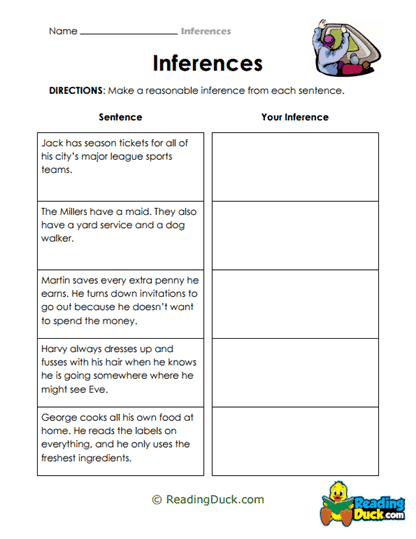
Learners follow inferences through multiple clues-tracking how each contributes to forming an overall understanding of character or scene. This develops integrative thinking: building big ideas from small pieces. It reinforces organization of thoughts and evidence. Acting as a tracker, students learn to check each clue's role in reaching the inference. Tip: Use a two-column chart-"Clue" and "What I infer"-to visually record their process.
Inference Trio
Students receive three separate clues from a text and must infer a common theme or character attribute. This exercise strengthens pattern recognition and synthesis. It shows how multiple discrete details combine to make meaning clear. It also supports advanced inferential reading in more complex texts. Tip: Label each clue with a different color and then highlight the overlapping idea shared by all three.
Inference Web
This web-style organizer starts from a central inference and branches out to connected clues or supporting details. It visually maps the relationship between implied meaning and textual support. This format encourages both spatial reasoning and analytical clarity. Making a web helps students see the structure and evidence behind their inference. Tip: Encourage using arrows and labels like "supports" or "leads to" on each branch.
Mystery Location
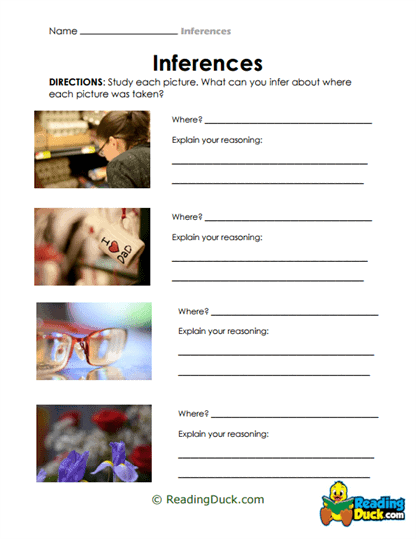
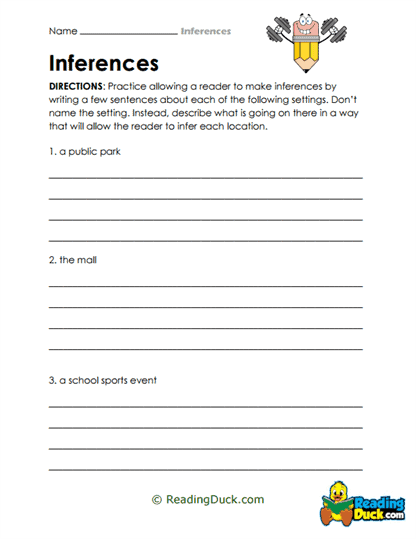
Through subtle environmental hints-descriptions of weather, textures, sounds-students infer where a scene takes place (e.g., cozy cabin, beach, cityscape). It deepens setting inference from indirect context. This sharpens sensory reading and spatial visualization. It also builds transfer skills for interpreting scenes in media or real life. Tip: Have students note sensory clues under categories like "sight," "sound," and "smell" before inferring the location.
Picture Perception
A visual prompt-such as a photo or illustration-is used for inference: students analyze visual details to infer the situation or emotion. This bridges visual literacy with textual inference. It encourages attention to nuance in imagery and nonverbal cues. The exercise supports inference skills across formats, not just text. Tip: Ask students to list three visible details, then state one inference supported by those details.
Quick Clues
Short bursts of text or single sentences include a hint (e.g., "The window rattled during the thunderous downpour") prompting a quick inference-like mood or setting. This fast-paced format improves inference fluency. It trains students to make quick, accurate interpretations under time constraints. The habit builds reading stamina and critical response speed. Tip: Encourage one-word inferences to start ("scary," "stormy") then expand in a sentence.
Scene Scavenger
Students hunt for inference clues within a longer scene, identifying multiple authors' hints about mood, character feelings, or changes. It combines exploration with analysis. This scaffolded approach strengthens careful reading of multi-sentence passages. It nurtures patience and focus in gathering evidence. Tip: Use colored sticky tabs to mark each clue type-dialogue, description, action-for later discussion.
Sentence Sleuth
At the sentence level, students analyze a single line to infer deeper meaning-tone, purpose, or unspoken context. This sharpens micro-level inference skills. It helps learners slow down and think deeply, sentence by sentence. The close reading approach strengthens precision in interpretation. Tip: Encourage rewriting the sentence in "plain speak" before inferring.
Setting Sleuth
A blend of visual and textual clues guides students to infer both where and when a scene is set-through indicators like clothing, lighting, or background items. This merges setting and inference practice. It deepens understanding of context and temporal clues. The sleuth framework supports layered thinking in reading. Tip: Have students label clues ("hat," "yellowed wallpaper") and guess their decade or location.
Time Teller
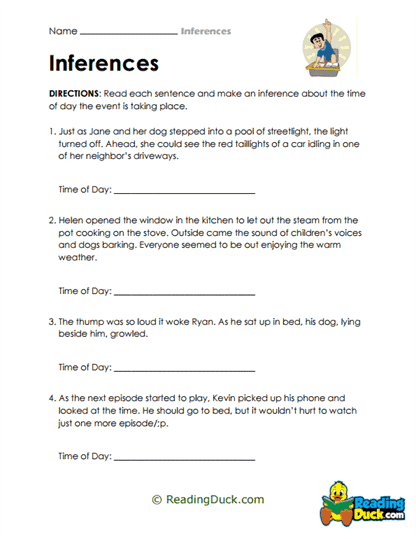
Clues related to time-like shadows, clocks, seasonal descriptors-support inference of when the scene occurs (time of day, era, season). This trains students to notice subtle temporal indicators. It builds awareness of detail's impact on mood and context. Time inference is key in literature and informational reading alike. Tip: Ask students to write "Time: early morning," or "Era: 1930s," based on the clues and then justify each choice.
What Are Inferences?
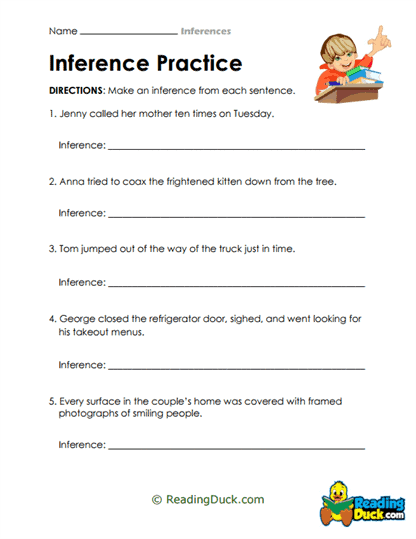
Inferences worksheets are targeted exercises designed to help students draw logical conclusions from text or visual clues rather than explicit statements. They teach students to combine context, descriptive detail, and prior knowledge to infer meaning-whether it's character emotion, setting, or underlying message.
This skill is essential because much of reading-and everyday communication-depends on reading between the lines. Strong inference skills support comprehension, empathy, analytical thinking, and richer writing. By practicing inferences, students become more engaged, flexible interpreters of text and media.
You can recognize "Inferences" activities by prompts asking "What can you tell about...?", "How does the character feel?", "Where does this take place?", or "What's implied here?" Worksheets often include descriptive clues, detective metaphors, visuals, or structured organizers to support inference thinking.
Common challenges include jumping to conclusions without evidence, misunderstanding subtle clues, or relying too heavily on prior knowledge. To overcome this, strategies like clue annotation ("clue → inference"), using organizers, and asking "How do I know?" help ground inferences in text.
Mastering inference builds strong, active readers-students who think critically, appreciate subtlety, infer motives, and create deeper, more insightful writing. It unlocks deeper comprehension of both fiction and non-fiction across all subjects.
Example
Consider the line: "Raindrops tapped her window; she pulled the blankets closer and stared at the gray sky."
A student might infer: "She feels sad or thoughtful." They'd justify it by noting the rain, closing in, and her body language-all serving as clues to her mood.
Make sure to bookmark our website now.
Enjoy all our free reading worksheets.
Our materials adhere to the principles of the Science of Reading.