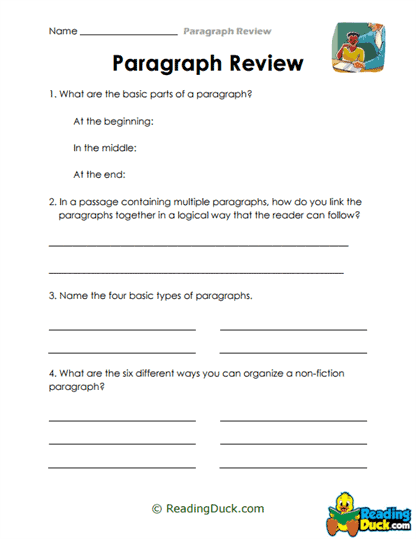
The Paragraph Review Worksheets are thoughtfully developed to help students analyze paragraphs with clarity and purpose. These resources guide learners in recognizing main ideas, identifying supporting details, and evaluating overall structure and coherence. Each worksheet is provided in downloadable PDF format, complete with answer keys, making them practical for classroom, tutoring, or home learning scenarios. They offer structured practice in critical reading and writing-building a foundation that supports both comprehension and composition. Whether used as standalone exercises or woven into broader literacy instruction, these worksheets enhance students' confidence and skill in navigating paragraph-level texts.
Looking At Each Worksheet
Basic Building
Students practice identifying the core components of a paragraph-topic, detail, structure-serving as a foundational tool. It helps them break down and understand how strong paragraphs are built. Tip: Ask students to highlight the topic sentence and key supporting details.
Compare Contrast
Learners compare and contrast two paragraphs-examining how ideas, structure, or tone differ. This encourages analytical thinking and structural awareness. Tip: Invite students to map similarities and differences using a simple chart.
Descriptive Delight
Focuses on descriptive writing elements-sensory details, vivid language, and imagery-in a paragraph. It reinforces how effective description enhances meaning. Tip: Have students add one sensory detail to each sentence to enrich the writing.
Expository Explorer
Presents paragraphs focused on explanatory or informational writing, prompting students to spot how ideas are introduced, developed, and concluded. Tip: Ask learners to label the paragraph's purpose (e.g., to explain "how," "why," or "what").
Narrative Nook
Features storytelling paragraphs where students analyze narrative flow, character action, or pacing. It strengthens comprehension of story structure. Tip: Prompt students to rewrite the paragraph's opening using a different verb to shift tone or pace.
Organized Order
This worksheet helps students recognize paragraph organization-like sequence, cause-and-effect, or compare/contrast patterns. It supports logical reading and composition. Tip: Ask students to outline the structure in simple bullet points.
Paragraph Picker
Learners choose the best paragraph to complete or support a given prompt or context. It reinforces purpose-driven writing and selection. Tip: Challenge students to explain why their choice fits better than the others.
Perfect Paragraph
Encourages critique of paragraphs for clarity, coherence, and unity, prompting revision for improvement. It teaches self-editing and stronger writing habits. Tip: Let students rewrite one sentence to strengthen the main idea.
Persuasive Power
Focuses on persuasive writing, asking students to identify persuasive techniques like opinion, evidence, or emotional appeal within a paragraph. It builds skills in recognizing argument structure. Tip: Ask students to add one fact or example that would make the argument stronger.
Question Quest
Includes paragraphs framed around or concluding in a question-students identify how the prompting question guides information flow. It enhances comprehension of author's intent. Tip: Encourage students to write their own follow-up question to extend inquiry.
Sentence Completion
Presents paragraphs with missing sentences that students must choose or craft-the task develops coherence and context awareness. Tip: Encourage crafting a sentence that both links and advances the paragraph's main idea.
Structure Starter
Highlights how paragraphs begin-whether with a hook, topic sentence, or context-and asks students to analyze the effectiveness. It supports stronger paragraph openings. Tip: Let students rewrite the opening to make it more engaging or clear.
True-False Tally
Pairs a paragraph with statements that students mark as true or false. This checks comprehension, inference, and detail recognition. Tip: Ask students to justify one of their answers with a short phrase from the paragraph.
Type Match
Students match paragraphs to types-descriptive, narrative, expository, persuasive-honing genre awareness. Tip: Invite students to write a heading for each paragraph that reflects its type.
Word Fill Fun
Involves filling missing words in a paragraph-focusing on cohesion, vocabulary, and context. It reinforces sentence flow and word choice. Tip: Challenge students to replace one missing word with a synonym that changes tone slightly.
What Are Paragraph Review Worksheets?
Paragraph Review Worksheets feature focused, single-paragraph texts accompanied by prompts that guide students to analyze and understand structure, coherence, and clarity. They often ask learners to identify the main idea, evaluate how supporting details contribute, or critique the paragraph's organization.
These exercises invite active engagement, encouraging students to unpack how paragraphs function-spotting topic sentences, tracing logical flow, and recognizing effective transitions.
Students sometimes find paragraphs tricky when they struggle to distinguish between main ideas and extra details or when structure feels unclear. These worksheets scaffold that learning by providing clear examples and guided questions to sharpen awareness.
Being adept at paragraph analysis translates directly into stronger reading comprehension and writing. When students know what makes a paragraph clear and effective, they can read with better understanding and write with more clarity and purpose.
Example
Consider this sample paragraph:
"Coral reefs are essential to marine ecosystems. They provide habitat for a diverse range of species, protect coastlines from storm damage, and support fishing industries. Losing coral reefs would have deep ecological and economic impacts."
A question might ask: What is the main idea, and how do the details support it?
A solid answer: The main idea is that coral reefs are vital, as the details explain how they support marine life, protect coastlines, and sustain economies.
Make sure to bookmark our website now.
Enjoy all our free reading worksheets.
Our materials adhere to the principles of the Science of Reading.