About Our Identifying Claims and Evidence Worksheets
The Identifying Claims and Evidence worksheets equip students with tools to critically analyze arguments by distinguishing a writer's main claim-the central argument-from the supporting evidence that backs it up. These exercises are essential in helping learners evaluate reasoning, assess evidence quality, and strengthen persuasive and analytical reading. Offered as downloadable PDFs with answer keys, these resources are convenient for classroom, homework, or hybrid instruction.
These worksheets guide students through unpacking persuasive and informational texts-identifying the claim, isolating evidence (like facts, statistics, or expert quotes), and evaluating how effectively the evidence supports the claim. They build foundational skills in argument analysis and evidence-based thinking, which are vital for persuasive writing, research tasks, and informed discussion.
Looking At Each Worksheet
Author's Blueprint
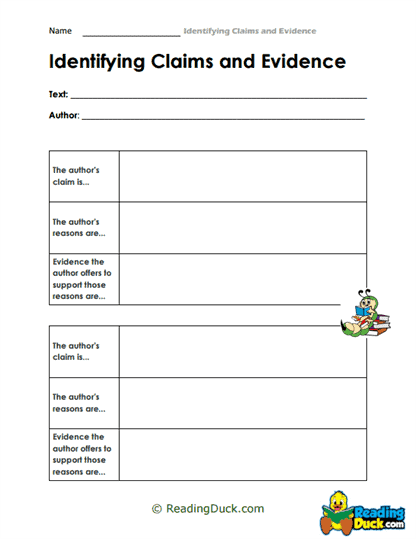
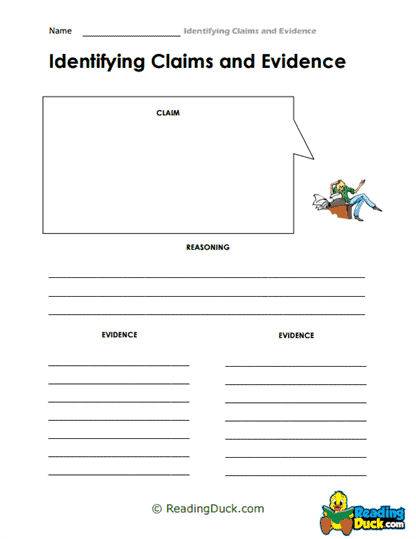
Students outline the author's main claim and map how the text is structured to support it. This "blueprint" approach helps learners visualize argument flow and connections between claim and evidence. It provides clarity on how arguments are assembled, promoting stronger comprehension. These skills support sophisticated reading and help with analytical writing tasks. Tip: Students can sketch boxes labeled "Claim," "Evidence A," "Evidence B," etc., to see structure at a glance.
Claim Clarifier
This worksheet asks students to restate the author's claim in their own clear, precise wording. Practicing paraphrasing a claim builds deeper understanding and helps students avoid simply copying text. Explaining a claim in simple terms improves comprehension and makes it easier to remember the main idea across different subjects. Tip: Encourage students to replace complex words with everyday language while keeping the original meaning.
Claim Detective
Learners scan passages to find the author's main claim amid supporting details and distractions. This sharpens their ability to distinguish between central ideas and supporting or irrelevant content. It teaches careful reading and selective highlighting-critical for comprehension under time or text complexity pressure. The detective metaphor gamifies close reading and focus. Tip: Tell students to circle key verbs like "argues," "believes," or "states" to locate claims more quickly.
Claim Explorer
Students read multiple segments and investigate how each supports, extends, or contrasts with the main claim. This develops sensitivity to nuance and how evidence interacts with the argument. It fosters awareness of shades of meaning, scope, and text progression. Such exploration mirrors research reading and deeper critical thinking. Tip: Have students color-code support (green), extension (blue), and contrast (red) to track relationship types visually.
Documentary Decoder
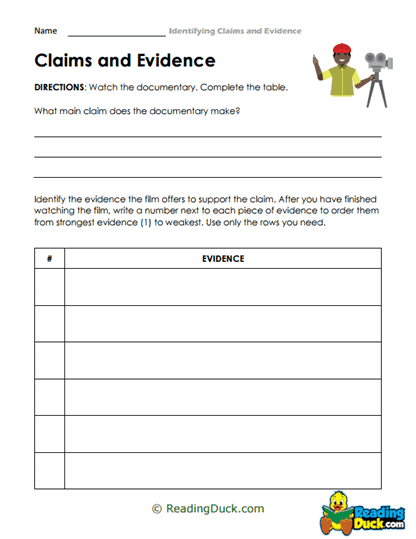
This worksheet provides excerpts (e.g., from documentaries or speeches) where students identify the claim and categorize evidence types (e.g., expert opinion, anecdote, statistic). It trains them to recognize evidence genres and judge their credibility. Understanding variety in evidence strengthens evaluative judgment. Learning this helps in media literacy and discerning persuasive techniques. Tip: Ask students to annotate margins like "Type: statistic; Why: solid data."
Dual Claims
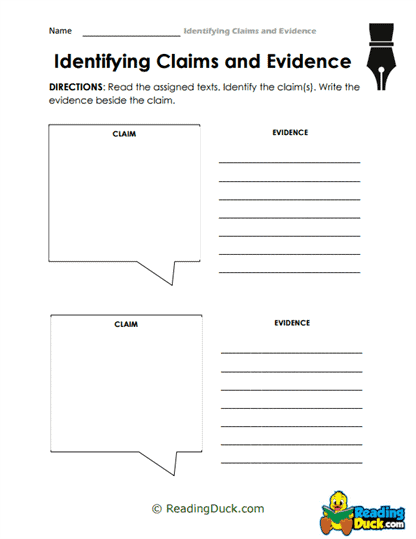
Here, students analyze texts that present two claims-often in comparison or opposition-and evaluate how each is supported. This builds advanced understanding of balanced argument and contrast. It helps students see complexity in opinions or arguments, not just single positions. The skill is useful in debates, contrast essays, and editing. Tip: Suggest creating a two-column chart with claim, evidence, and strength for each.
Evidence Checker
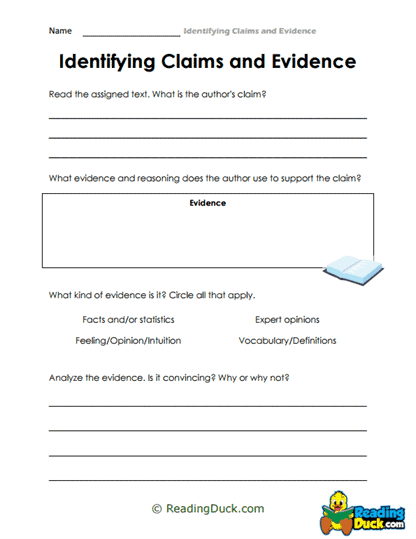
Learners highlight evidence in support of a given claim and then assess whether it's strong, weak, or irrelevant. It teaches critical evaluation of evidence quality and relevance. The exercise supports skepticism and discernment rather than passive acceptance. These skills are foundational in research and persuasive writing. Tip: Encourage students to label evidence as "strong," "OK," or "weak," and justify with one-word reasons (e.g., "recent," "irrelevant").
Gettysburg Guide
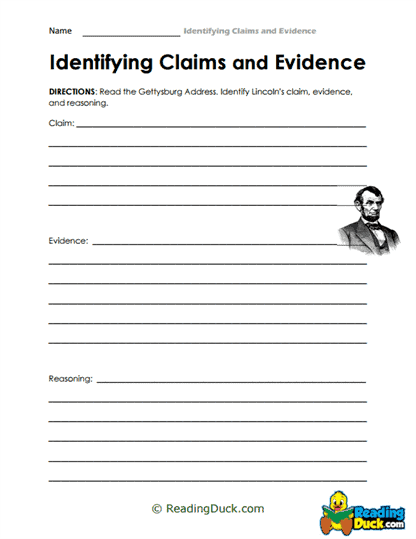
Using a famous historical speech (like Lincoln's Gettysburg Address), students identify claims and examine wording or rhetorical strategies that enhance them. It blends content and rhetorical awareness, enriching both reading and civics learning. The task enhances understanding of persuasive language, context, and purpose. It brings history alive through close reading. Tip: Have learners note any phrases that feel powerful and ask why they stand out.
Mockingbird Analysis
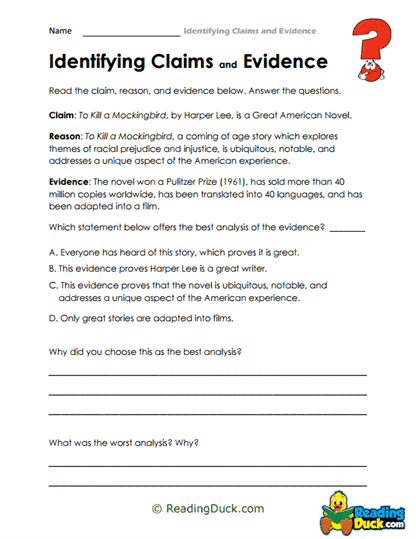
This worksheet invites students to analyze claims and evidence in To Kill a Mockingbird, connecting argument to character and theme. It supports literary as well as analytical thinking-showing how claims matter in stories. By identifying arguments in context, students grasp thematic depth and author intent. This genre-blending boosts engagement and comprehension. Tip: Suggest students quote the claim directly and then circle supporting lines around it.
News Analyzer
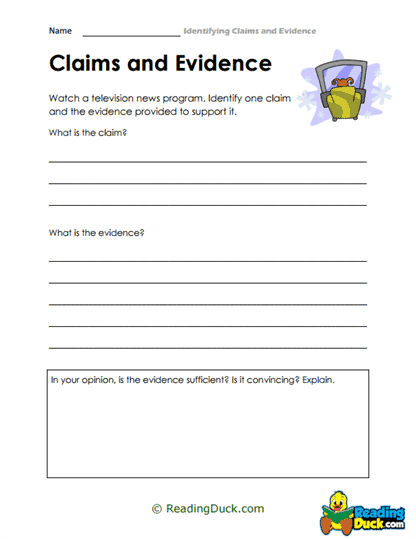
Learners dissect news articles-identifying the central claim and what facts or sources back it. This is a real-world application of claim-evidence skills and builds media literacy. It helps students become savvy consumers of information in a complex media landscape. It's practical, timely, and essential skill-building. Tip: Encourage students to check if the evidence is from credible sources and note that next to it.
Opposition View
This worksheet presents a claim and asks students to find or predict opposing evidence or counterclaims. It teaches them to think beyond the author's perspective and anticipate argument weaknesses or alternatives. This builds nuanced critical thinking and strengthens persuasive writing. Considering multiple viewpoints is key in debate, research, and dialogue. Tip: Split the page: one side "Claim/Evidence," other side "Possible Counterclaim."
Proof Sorter
Here, students sort statements into "claim," "evidence," and "opinion." The sorting task reinforces definitions and distinctions through active categorization. It helps build foundational clarity in argument analysis. The strategy scales to more complex texts later. Tip: Turn it into a matching game-mixed-up cards to sort quickly under time!
Strength Selector
Students rank pieces of evidence from strongest to weakest in supporting a claim, justifying their order. This promotes evaluative judgment, not just identification. Ranking cultivates nuanced thinking about quality, relevance, and sufficiency of support. It's valuable for writing essays or judging arguments. Tip: Use a numeric scale (1 strongest-5 weakest) and ask "Why is 1 stronger than 2?"
Tocqueville Thinker
Using excerpts from Alexis de Tocqueville or similar thinkers, learners extract claims and evidence rooted in observation or philosophy. This links argument literacy to historical and political thinking. It builds understanding of how evidence and claims interplay in complex nonfiction. It supports critical reading in social studies and humanities. Tip: Encourage students to summarize the overall claim in one sentence before examining support.
Triple Claims
The worksheet presents three overlapping claims and asks students to note how each is supported uniquely. This deepens understanding of nuanced claims and layered argument. It cultivates appreciation for complexity in persuasive texts. This prepares learners for evaluating multi-faceted arguments in academic reading. Tip: Ask students to list one shared piece of evidence and one that's unique per claim.
How Do You Identify Claims vs. Evidence?
Identifying Claims and Evidence worksheets are targeted exercises that help students distinguish an author's key argument (the claim) from the textual support (evidence), whether in a persuasion, informational writing, media piece, or even literature. Students practice skills like: identifying the claim, classifying evidence types, evaluating the strength of evidence, comparing opposing claims, and recognizing enough support.
This skill matters profoundly in both academic and real-world contexts-reading media, evaluating arguments in writing, forming persuasive essays, and participating in informed discussions. By mastering claim vs. evidence, students become critical thinkers and convincing communicators.
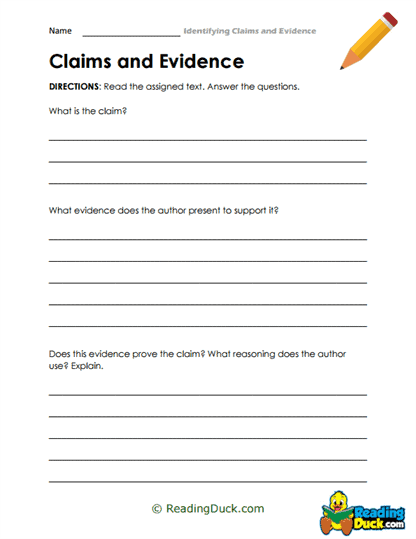
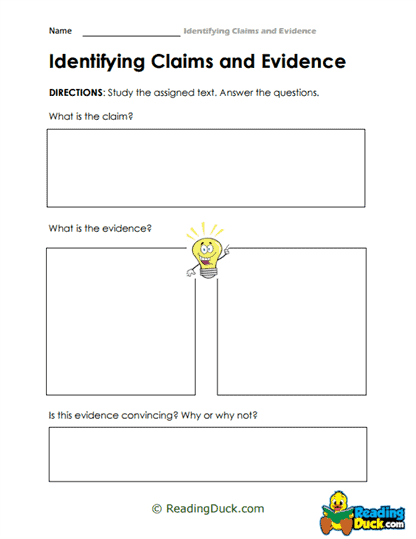
You can recognize "Identifying Claims and Evidence" tasks by prompts like "What is the author's claim?", "What examples or facts support it?", "Is this evidence strong?", or "What counters this claim?" Worksheets often include templates like charts, highlighting tasks, or matching exercises.
Students often struggle with vague claims, weak or unrelated evidence, and author bias. Strategies like annotation, evidence ranking, paraphrasing, and seeking counterexamples can help develop discernment skills. Practice across genres builds transferability.
Mastering this skill empowers students to read with skepticism, write with confidence, and think with clarity-preparing them for research, debate, civic literacy, and thoughtful consumption of information. Their ability to dissect and construct sound arguments becomes a lifelong asset.
Example
Suppose students see a short paragraph: "School uniforms help students focus; a survey showed 80% felt less distracted, and attendance improved by 10%."
They might identify the claim ("Uniforms help students focus"), highlight the survey statistic and attendance improvement as evidence, then say: "Evidence is recent and quantitative-strong support for the claim."
Make sure to bookmark our website now.
Enjoy all our free reading worksheets.
Our materials adhere to the principles of the Science of Reading.