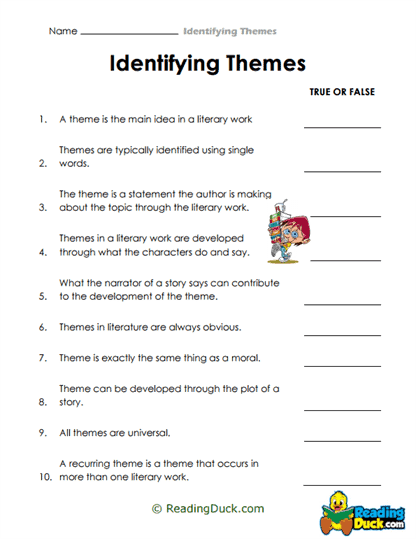
Themes are the deeper messages or central ideas that writers weave into stories and texts-concepts like friendship, perseverance, justice, or growth. Understanding themes helps students go beyond what happens in a story to explore what it means. The Identifying Themes worksheet collection guides students to spot and analyze these underlying ideas, strengthening their critical reading and writing habits. Offered in PDF format with answer keys, these worksheets are designed to be versatile and accessible for classroom, hybrid, or remote learning.
These worksheets support students in distinguishing between topics and themes, recognizing recurring ideas, and connecting those themes to broader human experiences. They also help learners anchor their interpretations with textual evidence and reflect on universal messages across different texts.
Looking At Each Worksheet
Concept Clash
Students compare two contrasting concepts-often related ideas like freedom vs. responsibility-and explore which one the text supports more. This sharpens their ability to detect nuanced themes. The exercise promotes deeper reflection on how a story's message might lean one way or balance multiple themes. It encourages critical thinking and thematic awareness. Tip: Ask students to write a sentence articulating how each concept is shown and which is stronger.
Double Theme Quest
Learners seek out two different themes within a single text, identifying evidence for each. This shows them that texts can carry complex or layered messages. The quest metaphor makes the search active and focused. It helps readers think beyond the obvious. Tip: Encourage drawing two separate evidence webs-one for each theme.
Equality Exploration
Focusing on stories that deal with equality-across gender, race, or opportunity-students identify how equality is portrayed and what message the author conveys. This brings important real-world values into thematic study. It builds empathy and analytical connection between text and social issues. Students learn to see theme as a pathway to discussion. Tip: Have learners write a modern-day example that echoes the text's theme.
Island Insights
This worksheet uses island settings as metaphors-asking students to infer themes like isolation, survival, and belonging from setting cues. It blends setting analysis with theme discovery. The imagery of an island makes the exercise memorable. It reinforces how environment can symbolize idea. Tip: Invite students to annotate descriptive words that signal symbolic meaning.
Story Essentials
Students unpack the essential messages in a story-what the author wants readers to carry away. This helps them distill theme from narrative pile. The task reinforces critical analysis over surface summary. It encourages clarity and retention. Tip: Ask students to write the theme in one clear, complete sentence.
Theme Builder
Learners piece together clues-characters, plot events, symbols-to build the theme of a text. It's a constructive approach, like building a puzzle. This hands-on metaphor reinforces how themes emerge gradually. The activity supports analysis and critical assembly. Tip: Provide building blocks labeled "Character," "Conflict," "Setting," and let students fit them to theme.
Theme Connector
Students draw connections between a theme in the text and a real-world issue or personal experience. This bridges literature and life. It strengthens comprehension and relevance. The activity fosters deeper engagement. Tip: Ask learners to write a brief paragraph titled "This reminds me of..."
Theme or Not
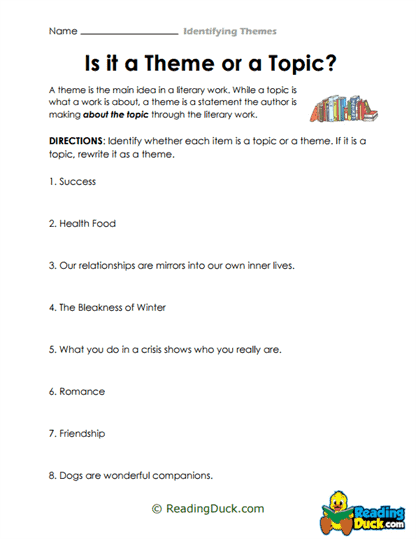
This worksheet arms students with theme statements or topic sentences, and they must judge whether each expresses a true theme. The practice sharpens their ability to distinguish theme from mere summary. It builds scrutiny and critical filtering. The format supports formative feedback. Tip: Have students explain why a false statement fails as a theme.
Theme Repeater
Learners mark repeated words, phrases, or images in a text and reflect on how repetition contributes to theme. This trains them to see patterns. It builds sensitivity to author technique. It also reinforces evidence-gathering skills. Tip: Suggest highlighting three repeats and explaining the connection to theme.
Theme Spotter
In this activity, students actively search for the implied theme in a short passage, using context clues and inference. It hones reading between the lines. The spotter role encourages close attention. Readers practice extracting meaning without explicit signals. Tip: Ask them to underline the sentence that hints most strongly at the theme.
Theme Tracker
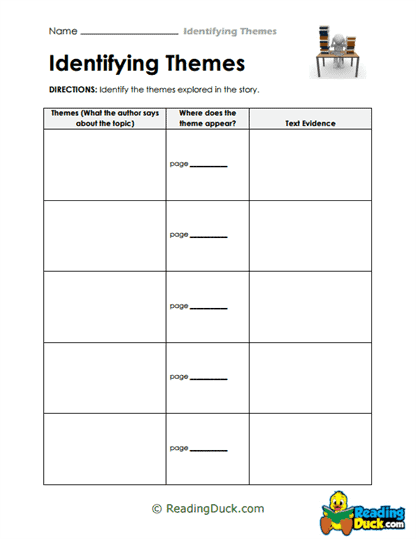
Here, students trace how a theme develops over the course of a story-beginning, middle, to end-through events or character growth. It helps them see theme as dynamic, not static. It supports plot analysis and synthesis skills. It deepens understanding of narrative structure. Tip: Use a three-box chart labeled Start / Middle / End, and fill in theme-related notes.
Topic or Theme?
Students distinguish between broad topics (like "war" or "friendship") and the deeper theme ("the futility of war," "the strength of unity"). This clarifies analytical thinking. It prevents common confusion. It anchors students in higher-level comprehension. Tip: Have two columns: "Topic" and "Theme," and list pairs for practice.
Triple Theme Dive
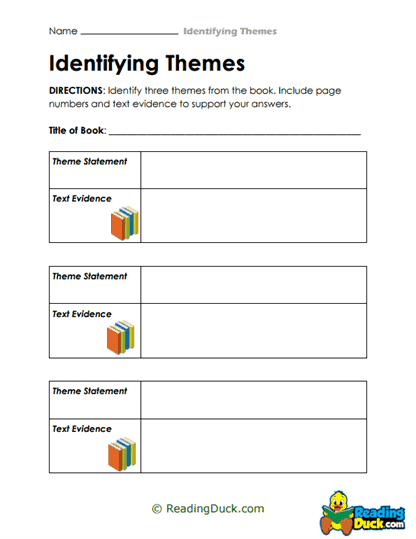
Learners identify and explore three themes in a complex text, examining how they interrelate and support the overall message. This proves texts often convey multi-layered ideas. It challenges students to prioritize and synthesize. It strengthens analytical depth and thematic complexity. Tip: Encourage creating a Venn diagram showing theme overlap.
Truth Tracker
Students seek out a "truth" or universal message within a story and support it with textual proof. The truth metaphor frames theme as meaningful insight. It builds evidence-based interpretation. It encourages reflective reading. Tip: Ask learners to write their theme as a "truth statement" ("Truth: ...").
Universal Insights
This activity asks readers to connect the text's theme to broad human experiences-like love, fear, or change-highlighting the universality of literature. It expands thematic thinking beyond the page. It fosters empathy and broader comprehension. Tip: Have students list one example of this theme in history or media.
How Do You Identify Themes In A Story?
Identifying Themes worksheets are specially crafted tools to help students move beyond plot and characters to discover the deeper messages that authors embed in texts. They guide learners in spotting themes amidst topics, recurring ideas, and symbolic cues-and anchoring those interpretations with textual evidence.
The skill matters because interpreting themes trains students to think critically and meaningfully about texts and the world. It helps them craft richer analytical writing and better understand literature, media, and everyday communications.
You can recognize "Identifying Themes" tasks by prompts such as "What is the message of this story?", "Which ideas repeat throughout?", or "How does setting or character hint at the theme?" Worksheets often include comparison charts, pattern tracking visuals, paraphrase prompts, or connection tasks.
Students sometimes struggle by naming topics instead of themes (e.g., saying "love" instead of "love conquers fear"), or by not providing evidence for their interpretations. Helpful strategies include framing theme as a "truth sentence," listing repeated ideas, comparing texts, or linking themes to personal experience.
Mastering theme recognition deepens reading comprehension, fuels insightful writing, encourages empathy, and connects academic learning to life. It transforms students from passive readers to meaning-makers.
Example
In a short story where a young tree pushes through concrete to reach sunlight, a student might identify the theme as: "Determination and resilience overcome obstacles." They support this by pointing to phrases like "broke through the cracks" and "reached for the sky," showing how the image and language reinforce the theme.
Make sure to bookmark our website now.
Enjoy all our free reading worksheets.
Our materials adhere to the principles of the Science of Reading.