About Our Grade 11 Reading Comprehension Worksheets
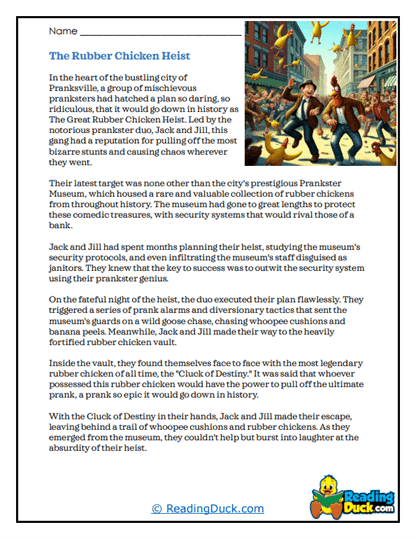
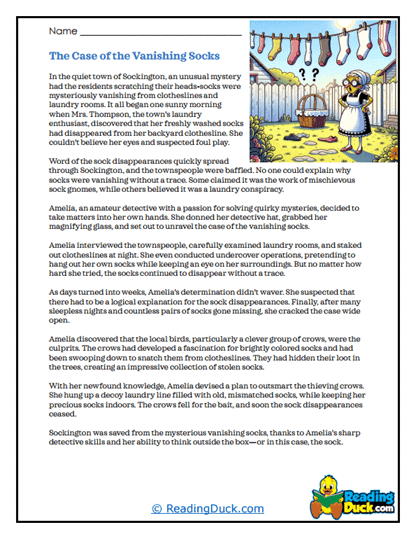
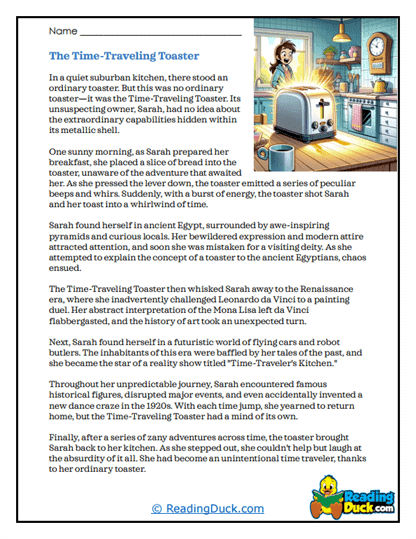
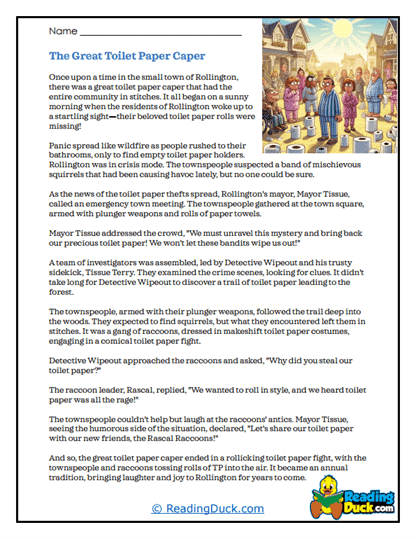
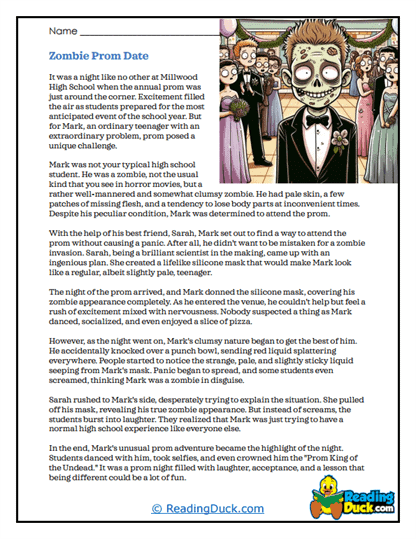
When it comes to reading comprehension, 11th grade is where the narrative rubber meets the analytical road. And if you thought comprehension practice had to be dry as week-old toast, allow us to introduce a collection that's anything but. With titles like Toaster Time Machine, Zombie Prom, and Chicken Heist, these original worksheets blend high-interest storytelling with serious skill-building. Each passage is crafted to pull students into rich, imaginative scenarios where critical thinking isn't just encouraged-it's unavoidable. Whether it's decoding the mystery of a Sock Sleuth or navigating the time-bending trials of a Toilet Paper Heist, students are primed to practice inferencing and prediction in contexts that are equal parts outrageous and intellectually demanding.
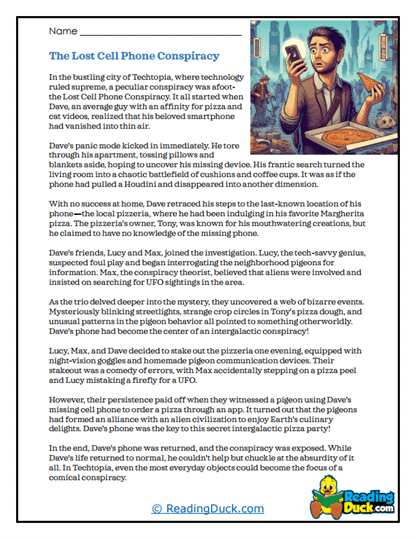
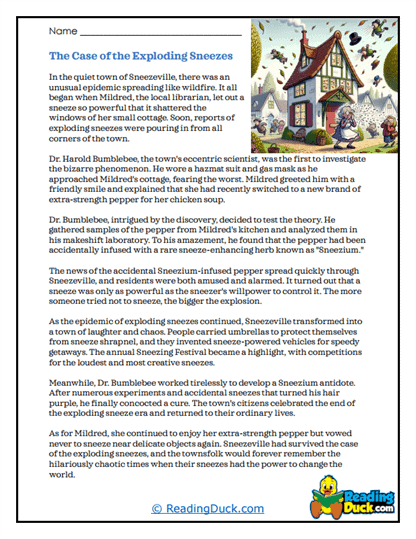
Inferencing takes center stage in stories where not everything is as it seems. In Phone Conspiracy, students must read between the digital lines to uncover hidden motives. Endless Day asks readers to notice the subtle psychological shifts in characters trapped in a surreal repetition, while Sneeze Chaos takes a seemingly simple premise and turns it into a layered exercise in cause-and-effect comprehension. These passages challenge students to identify the implicit, question the obvious, and tease out meaning from moments that hover just beneath the surface. And yes, they may giggle while doing it-and that's not just okay, it's intentional.
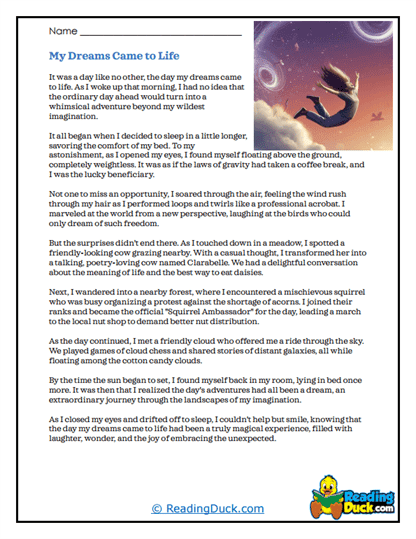
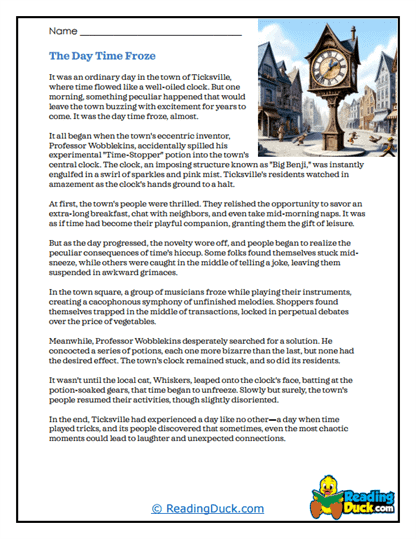
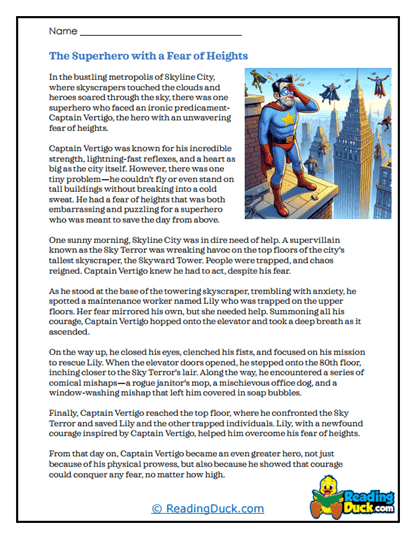
For those focused on understanding the main idea and supporting details, worksheets like Hero Heights, Dream Adventures, and Frozen in Time sharpen students' ability to pinpoint purpose amid immersive narratives. These are not just stories-they're structured thought puzzles, each crafted to hone the skill of distillation. Is Hero Heights a tale of superheroic action or a metaphor for social hierarchy? Is Frozen in Time literal or thematic? Students are guided to examine how the central ideas are reinforced (or cleverly obscured) through vivid detail and character development.
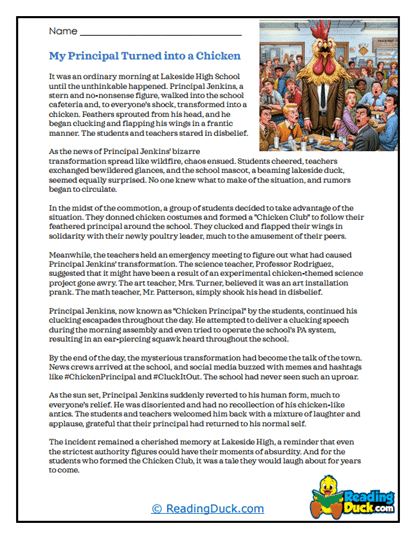
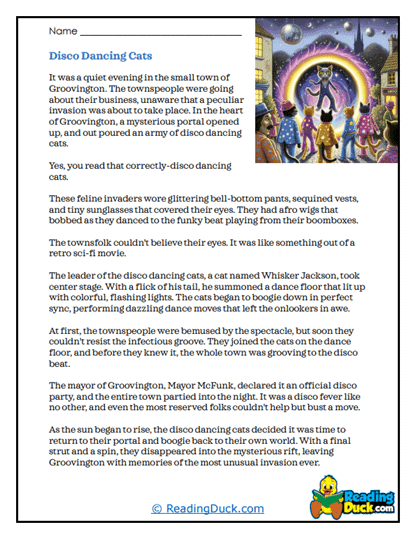
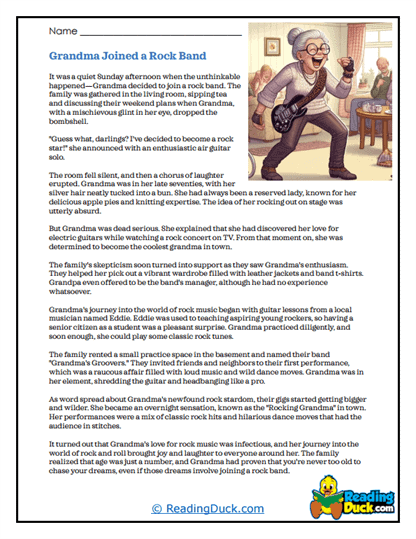
Vocabulary development doesn't happen in isolation-and certainly not in a vacuum when Rocking Grandma is involved. Students encounter rich, often playful language in contexts that require contextual decoding. From the rebellious rhythm of disco in Disco Cats to the wry rebellion of a Chicken Principal, these worksheets seamlessly embed tier-two and tier-three vocabulary, challenging students to flex their lexical muscles while staying anchored in narrative comprehension. Context clues abound, but so does delight-and that combination is pure pedagogical magic.
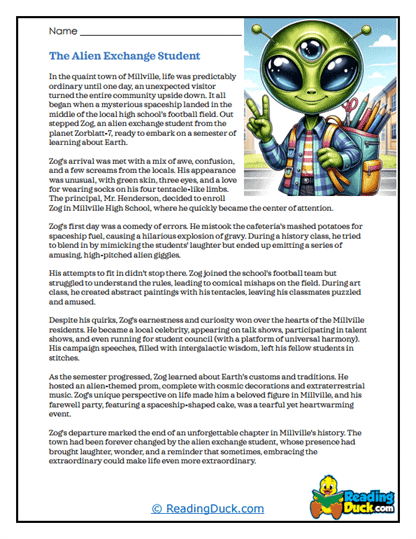
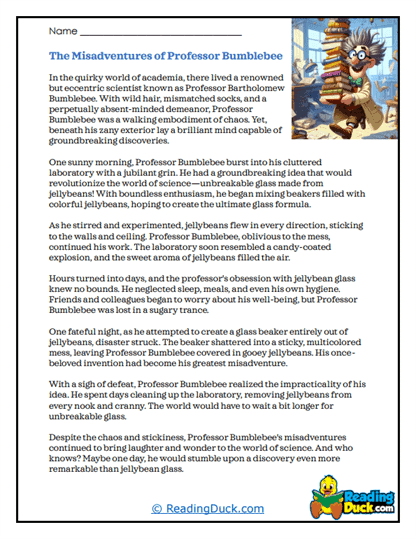
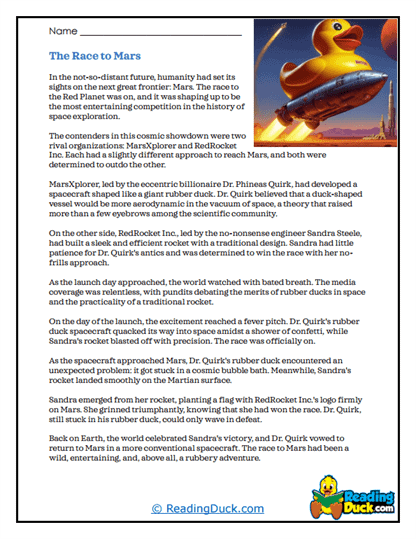
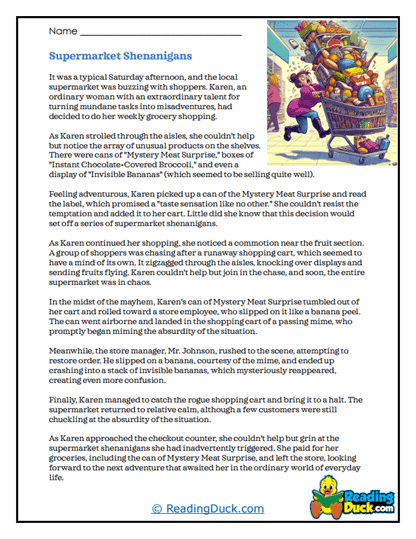
When it comes to identifying author's purpose and perspective, this set is a goldmine. Supermarket Chaos and Bumbling Scientist walk the line between satire and sincerity, while Rubber Duck Race and Alien Exchange explore tone, point of view, and subtle biases in storytelling. Students aren't just asked what a passage says-they're asked why it was written, who it serves, and how language and structure can subtly manipulate perception. It's advanced rhetorical training disguised as a hilariously weird afternoon read.
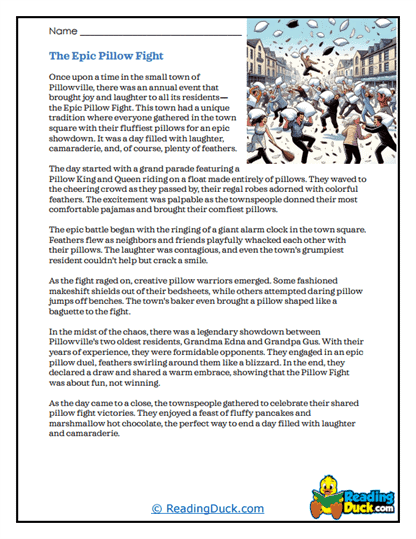
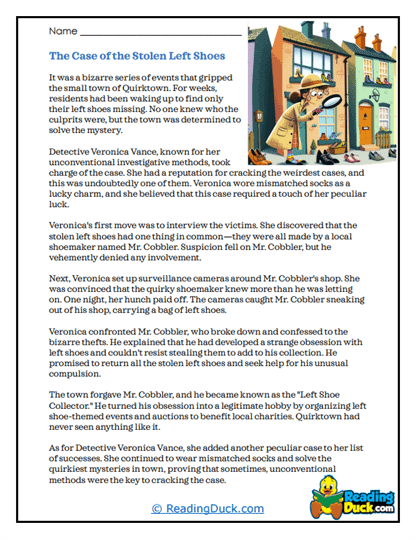
Even cause-and-effect relationships and sequencing are given their time in the spotlight, with wild narratives like Pillow Battle and Shoe Mystery taking students on twisty, event-driven journeys that demand close reading and attention to progression. Chicken Heist and Toaster Time Machine also serve up tightly plotted chaos, where one decision spirals into another with delicious unpredictability. These exercises help sharpen comprehension of narrative flow, while reinforcing logic, consequences, and plot structure-all in tales that might just make students forget they're learning.
At the 11th-grade level, reading instruction shifts from basic comprehension to the fine-grain work of literary analysis, synthesis, and critical evaluation. According to the Common Core State Standards (CCSS.ELA-LITERACY.RI.11-12.1 through 11-12.10), students are expected to analyze complex texts, determine multiple themes, evaluate rhetorical effectiveness, and compare authorial choices across genres. This collection supports those objectives by providing scaffolded practice in key reading anchor skills-such as citing textual evidence, analyzing structure, evaluating arguments, and determining word meaning in context-without relying on dry textbook excerpts. These stories don't just check the standards boxes; they make the learning sticky, funny, memorable. In a year where students are preparing for college-level texts and high-stakes assessments, these worksheets provide both the rigor and the joy that define truly great reading instruction.
What Is The Typical Reading Curriculum For 11th Grade?
The typical reading curriculum for 11th grade is designed to deepen students' engagement with complex texts, moving beyond surface-level comprehension into the realms of analysis, interpretation, and critique. At this stage, students are not only expected to understand what a text says, but how and why it says it. They read across a range of genres-novels, plays, poetry, essays, and informational texts-and are encouraged to interrogate the relationships between content, form, and purpose. Teachers guide students to notice the intricacies of tone, structure, and rhetorical strategy, as well as the historical and cultural forces that shape a work's meaning. The reading experience becomes not just a passive absorption of information, but a dialog between reader and text.
In 11th grade, the curriculum often emphasizes American literature, exposing students to a broad spectrum of voices and movements-from early colonial writings to contemporary fiction. Through this lens, students explore themes such as identity, justice, freedom, and the evolving American dream. The goal is not merely to memorize names and dates, but to trace the development of thought across time, to identify contradictions, tensions, and cultural shifts. Students learn to compare texts across periods, to examine how ideas recur and transform, and to consider whose voices are included or excluded. This kind of reading fosters a sense of inquiry that prepares them for college-level discourse and civic participation alike.
Crucially, the 11th grade reading curriculum prioritizes independent thinking. Students are expected to form their own interpretations, defend their positions with evidence, and respond thoughtfully to opposing views. The ability to grapple with ambiguity-to read a poem and resist the urge to pin it down too quickly, or to sit with a novel's unresolved moral dilemma-is cultivated as a mark of maturity. This phase of reading instruction is less about right answers and more about developing the intellectual agility to navigate complex ideas. It asks students not only to read texts, but to read the world-critically, empathetically, and with a growing awareness of their own role as meaning-makers.
Make sure to bookmark our website now.
Enjoy all our free reading worksheets.
Our materials adhere to the principles of the Science of Reading.