If hard work had six legs and a mission, it would be an ant. These tiny engineers live everywhere from backyard cracks to jungle floors, building bustling underground cities and working together with clockwork precision. An ant colony runs smoother than most human neighborhoods-every ant has a job, a plan, and zero time for naps. They're proof that small size and big teamwork can literally move mountains (or at least crumbs the size of one).
Learning about ants means uncovering the secret blueprint of nature's most efficient society. They farm, fight, recycle, and even use chemical "text messages" to coordinate their world. Each species has its own tricks-some cut leaves to grow fungus gardens, others herd aphids like cows. Studying ants opens the door to biology, chemistry, and maybe even a few lessons in leadership.
Our Ant Worksheets turn the underground hustle into fun, fact-filled reading adventures. Students explore anatomy, communication, teamwork, and ecosystems while building reading comprehension and science vocabulary. It's the ultimate mix of nonfiction learning and natural wonder-tiny creatures, gigantic ideas.
Meet the Worksheets
Ant Basics
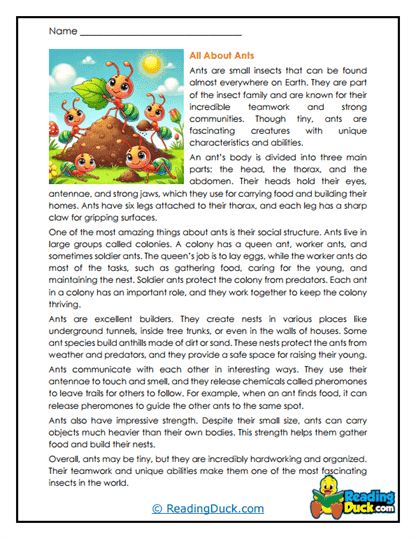
Students meet ants as small but mighty insects with big social skills. The passage introduces body parts, colony roles, and the teamwork that keeps everything running. It strengthens comprehension and vocabulary through vivid scientific descriptions. Fun fact: ants can carry up to 50 times their own body weight-nature's true heavy lifters!
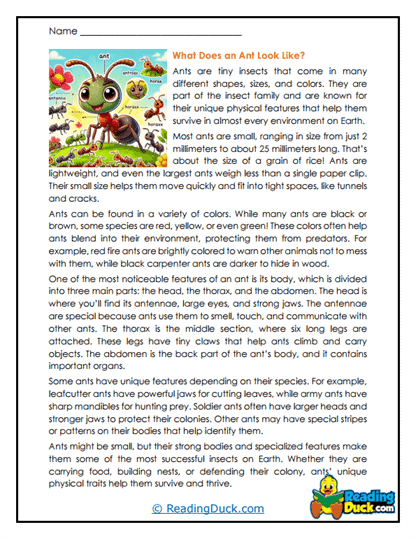
Tiny Traits
This worksheet zooms in on ants' incredible diversity-different colors, sizes, and super-strong jaws. Students connect structure to survival by comparing adaptations across species. It builds descriptive language and scientific reasoning. Wild twist: some tropical ants have heads shaped like shields that literally plug their nest entrances-door security, ant-style.
Habitat Hunters
Students explore the wide world of ant habitats, from forest floors to desert dunes. The passage connects environment to adaptation and survival. It sharpens geography and environmental comprehension. Surprise: Antarctica is the only continent without ants-clearly, even bugs hate the cold.
Food Finders
This reading reveals how ants are omnivorous scavengers, leafcutters, and seed hoarders extraordinaire. Students practice cause-and-effect reasoning through examples of teamwork in food gathering. It strengthens vocabulary and analytical comprehension. Tasty tidbit: leafcutter ants don't eat leaves-they grow edible fungus gardens from them. Smart and sustainable!
Busy Behaviors
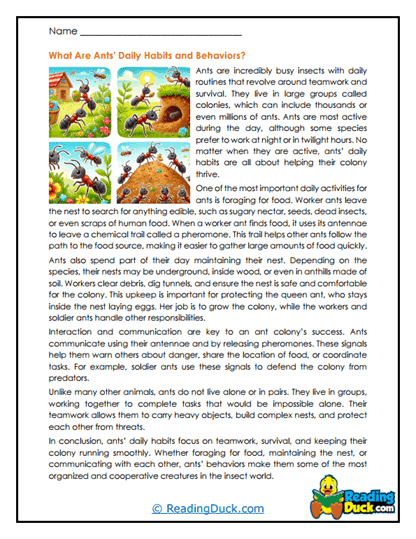
Students dive into a day in the life of ants-building, cleaning, feeding, and guarding the colony. The passage explores communication, pheromones, and division of labor. It develops sequencing and observation skills. Cute detail: ants "high-five" with their antennae to share news-part greeting, part GPS update.
Colony Creation
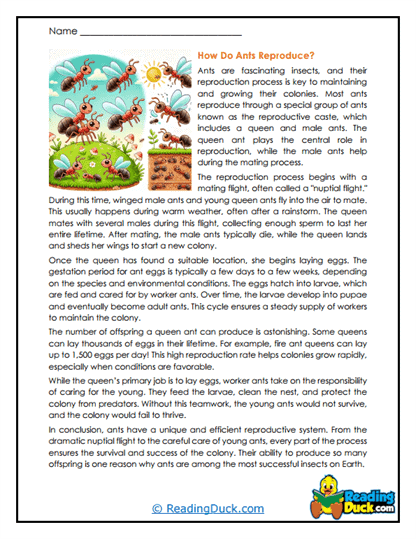
This worksheet explains the incredible life of the queen, from mating flights to egg-laying marathons. Students follow the life cycle of colonies through step-by-step detail. It supports sequencing and biological vocabulary. Jaw-dropping fact: some queen ants can live for decades-longer than most dogs!
Life Journey
Readers track the complete ant life cycle: egg, larva, pupa, and adult. Students learn how each stage supports the colony's growth. It enhances summarization and process comprehension. Fascinating truth: ants go through metamorphosis just like butterflies-only less flashy and way busier.
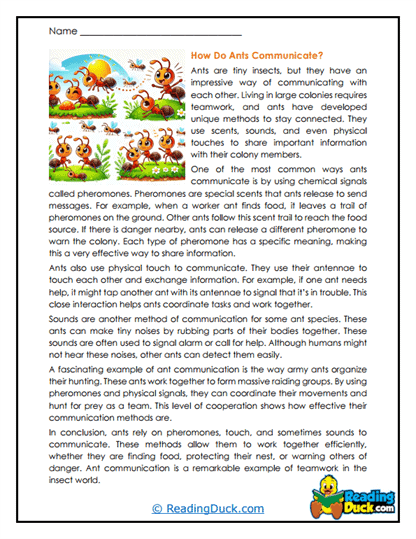
Signal Systems
Students learn how ants "talk" through scent trails, sounds, and touch. The passage builds inferential thinking and vocabulary around communication. It highlights cause-and-effect links between signals and behavior. Fun fact: army ants create living bridges out of their own bodies so others can cross gaps-teamwork at its finest!
Danger Detectives
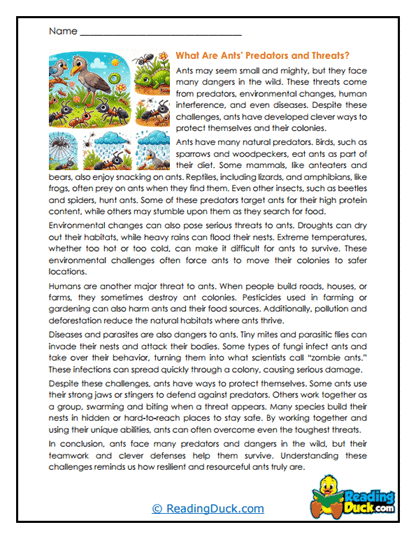
This worksheet introduces the perils of ant life, from predators to pollution. Students practice problem-solution comprehension through real-world examples. It builds environmental vocabulary and empathy for tiny ecosystems. Interesting twist: fire ants survive floods by forming floating rafts made entirely of ants-unsinkable teamwork!
Eco Helpers
Students discover how ants shape the planet by aerating soil, spreading seeds, and recycling nutrients. The passage builds systems thinking and ecological literacy. It encourages synthesis of cause and effect in nature. Bonus: scientists estimate that all the world's ants combined weigh more than all the world's humans-ant power indeed!
Motion Masters
Readers explore how ants move-running, climbing, swimming, and hauling massive loads. The passage connects anatomy (legs, claws, joints) to function and adaptation. It reinforces sequencing and descriptive comprehension. Cool note: ants can run the insect equivalent of a human sprint-over 200 body lengths per second!
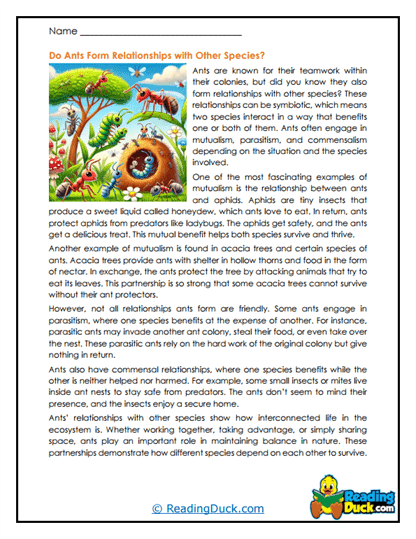
Nature Partners
This reading explores ants' relationships with other species, from helpful to harmful. Students classify mutualism, commensalism, and parasitism through real-life examples. It sharpens analytical reading and vocabulary. Fun fact: ants "farm" aphids for sweet honeydew, protecting them like tiny dairy cows with six legs.
All About the Ant
Where It Lives
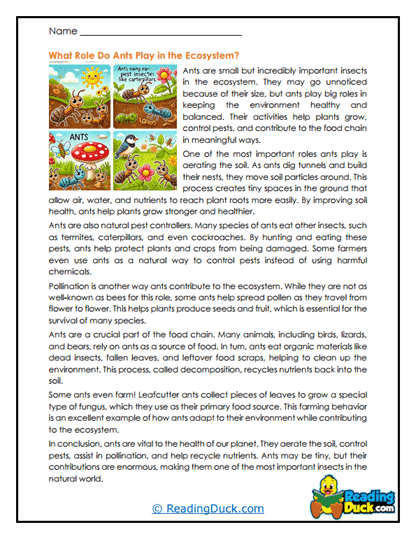
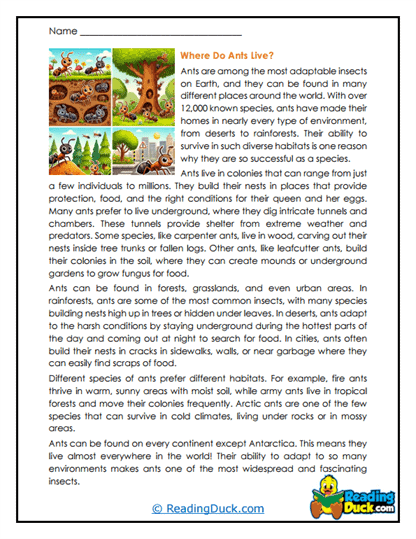
Ants live everywhere-forests, deserts, cities, grasslands, even your kitchen if you're not careful. They build elaborate tunnels, mounds, and chambers that aerate the soil and shelter millions. Each colony is a world within a world. From jungle giants to sidewalk scouts, ants have conquered the globe-minus Antarctica.
What It Eats
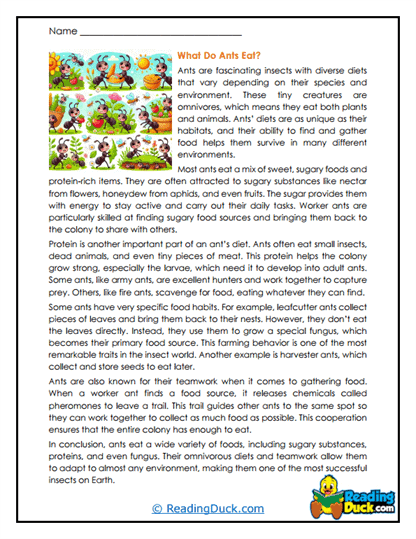
Ants are the ultimate opportunists. They eat fruits, seeds, insects, fungi, and even sugary snacks from picnics. Each species has its own favorite flavor, but all help recycle organic matter. Every bite they take keeps nature's cleanup crew running smoothly.
How It Acts
Ants live by one rule: teamwork. Workers gather food, soldiers guard, and the queen keeps the next generation coming. Their communication system is more efficient than Wi-Fi-fast, reliable, and chemical-based. Watching an ant colony is like seeing a living machine made of perfect cooperation.
How It Survives
Adaptability is the ant's superpower. They build flood-proof homes, farm food, and fight predators with numbers and coordination. Some ants even enslave other colonies or grow fungus gardens for food. In the insect world, innovation has six legs.
How It Raises Babies
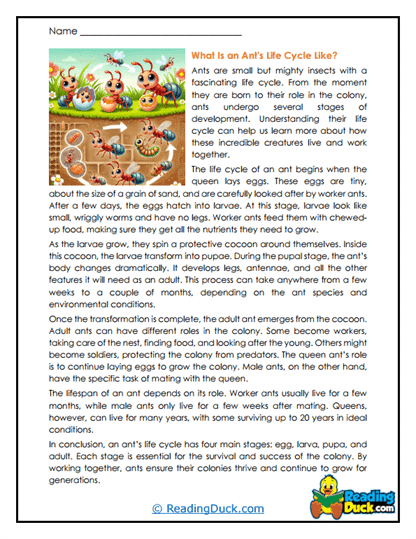
Ant queens lay eggs that hatch into larvae cared for by loyal workers. Pupa metamorphose into adult ants, ready to join the colony workforce. Every generation learns by instinct what role to fill. The nursery may be underground, but it's the heart of the empire.
Is It in Danger?
Though ants are among the world's most successful species, they face challenges from habitat loss, pesticides, and pollution. Some invasive species also disrupt local ecosystems. Protecting ants means protecting soil, plants, and the countless species that depend on them. After all, saving the planet might just start with saving the smallest citizens.
Make sure to bookmark our website now.
Enjoy all our free reading worksheets.
Our materials adhere to the principles of the Science of Reading.