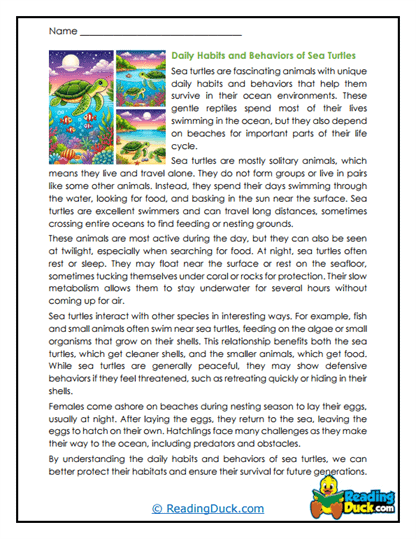
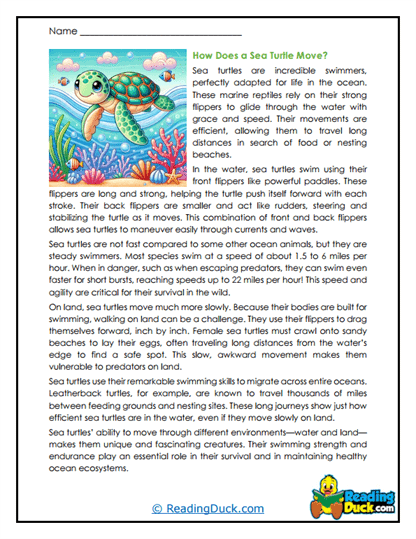
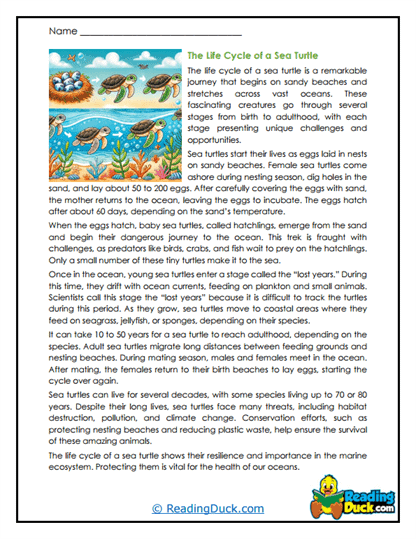
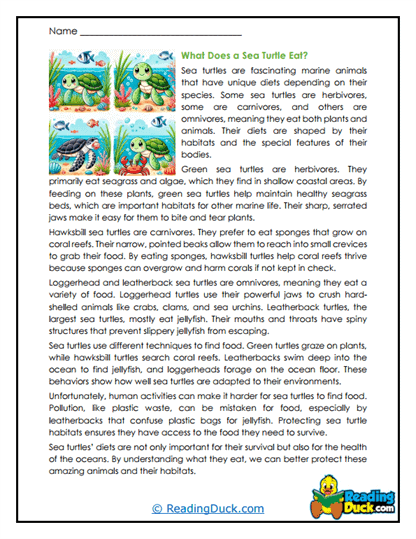
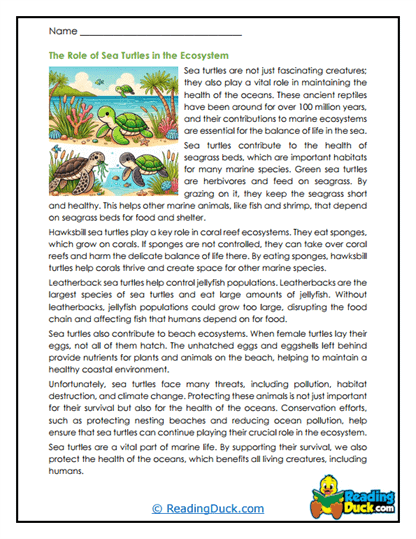
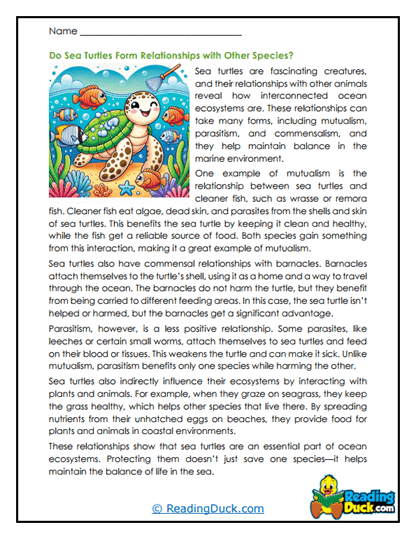
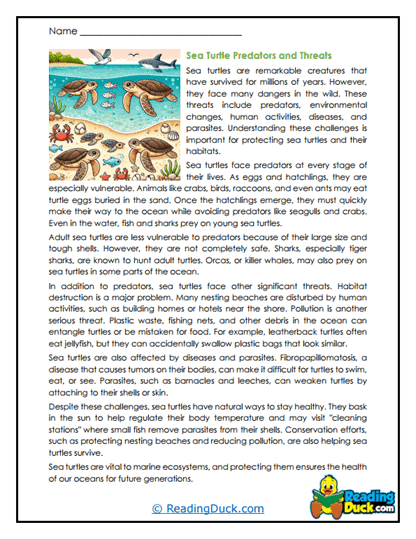
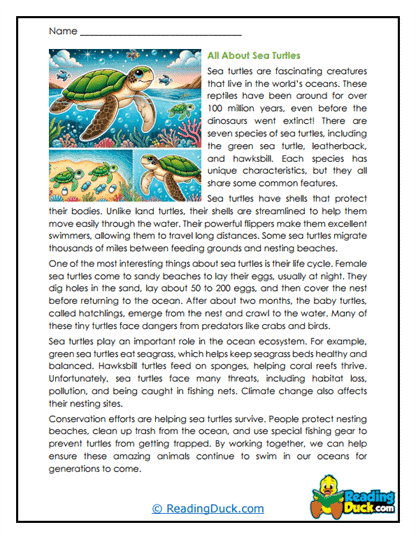
Imagine swimming alongside a creature that's been cruising Earth's oceans since dinosaurs ruled the land. That's the sea turtle-an ancient reptile in a wetsuit, gliding through blue waters with effortless grace. With their strong shells, sleek flippers, and wise expressions, sea turtles are the original ocean travelers. They're living proof that slow and steady really does win the evolutionary race.
Learning about sea turtles means diving into one of nature's most incredible survival stories. From hatchlings battling the odds on sandy beaches to adults migrating thousands of miles, their lives are full of epic journeys. They help coral reefs thrive, seagrass grow, and entire marine ecosystems stay balanced. Plus, they make for the coolest science subjects-half biology, half legend.
Our Sea Turtle Worksheets make marine science come alive with stories of migration, communication, and conservation. Students don't just read about turtles-they become ocean explorers, decoding signals, tracing life cycles, and connecting ecology to real-world impact. Every passage turns reading into an underwater adventure. Warning: side effects may include sudden urges to recycle and protect beaches.
Meet the Worksheets
Ocean Traveler
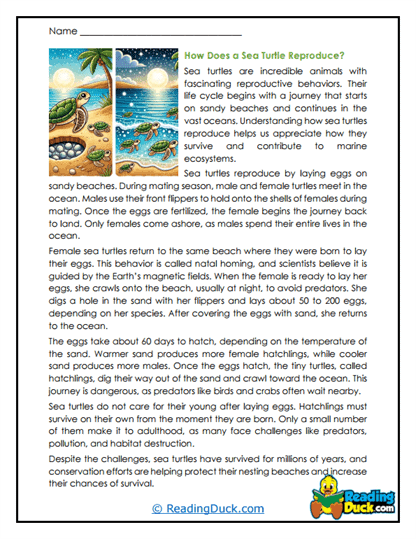
Students meet the sea turtle, a 100-million-year-old ocean wanderer with a life cycle fit for a documentary. They'll learn about shells, flippers, and the connection between humans and marine ecosystems. The passage builds strong vocabulary and cause-and-effect reasoning. Fun fact: sea turtles can migrate across entire oceans and still return to the exact beach where they were born!
Shell Beauty
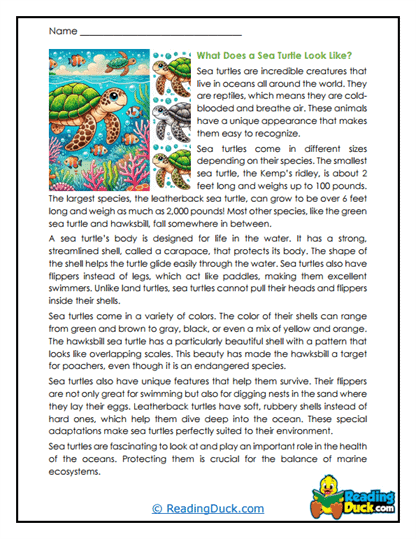
This worksheet dives into the turtle's shimmering armor-its colorful shell and streamlined body built for swimming. Students explore species differences and how structure supports survival. It enhances visualization and descriptive comprehension in nonfiction reading. Bonus: leatherback sea turtles can grow longer than a dining table and weigh as much as a small car!
Ocean Homes
Learners explore the tropical world of coral reefs, seagrass meadows, and open oceans where turtles thrive. The passage links habitats to life cycles and threats like pollution and coastal loss. Students strengthen vocabulary about migration and conservation. Surprise twist: sea turtles sometimes nap under coral ledges-like cozy underwater hammocks!
Ocean Diet
This worksheet reveals the diverse dining habits of ocean herbivores, carnivores, and omnivores-all rolled into one family. Students learn how sea turtles keep coral reefs clean and seagrass healthy. It promotes categorization and cause-and-effect reasoning. Fun extra: green sea turtles actually turn green inside from eating so many plants!
Gentle Swimmers
Students observe the daily life of a sea turtle-sunbathing, swimming, and taking long naps in the reef. The passage highlights solitary habits, migrations, and nesting behavior. It strengthens understanding of time order and behavior sequences. Unexpectedly, turtles can "sleep" underwater for up to seven hours without coming up for air!
Sandy Journey
This one takes students on the most dramatic beach crawl in the animal kingdom-the nesting and hatching of sea turtles. They'll trace each perilous step from sandy egg to ocean sprint. The passage boosts comprehension of life cycles and sequencing. Heart-stirring detail: baby turtles always head toward the brightest horizon-usually the moonlit ocean.
Life Voyage
Students follow a turtle's incredible life story, from tiny hatchling to ocean nomad. They'll track stages, migrations, and milestones that define this species' resilience. It's perfect for practicing sequence words and understanding biological growth. Cool fact: some sea turtles circle the entire Pacific before reaching adulthood-a marathon that would exhaust a map!
Silent Signals
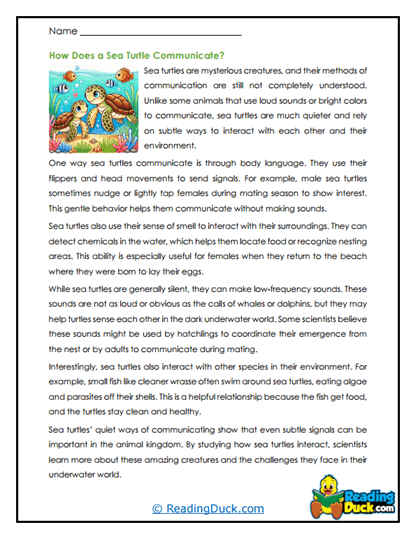
This worksheet explores how sea turtles "talk" through movements, vibrations, and low-frequency sounds. Students connect nonverbal cues to communication and survival. It strengthens inferential comprehension and sensory analysis. Bonus tidbit: male turtles hum underwater during courtship-proving romance exists even below sea level.
Ocean Threats
Here, students face the hard truth about pollution, poaching, and climate change. The passage links human impact to turtle population decline while spotlighting conservation efforts. It builds problem-solution comprehension and empathy. Sobering fact: more than half of sea turtles have eaten plastic, mistaking it for their favorite food-jellyfish.
Ocean Guardian
This worksheet crowns the sea turtle as a true ecosystem hero. Students learn how these reptiles sustain coral reefs, recycle nutrients, and protect biodiversity. It's an inspiring look at balance and interdependence in the ocean world. Bright note: a single sea turtle can help shape the health of an entire coastline-talk about leadership!
Graceful Glider
Readers discover the secret to a turtle's elegant motion-flippers for flight and balance in the sea. The passage contrasts their smooth swimming with their clumsy land crawls. Students practice connecting form to function in biology. Little-known truth: sea turtles can travel thousands of miles using the Earth's magnetic field as their compass!
Ocean Partners
This one introduces turtle teamwork-cleaner fish, hitchhiking barnacles, and parasitic tagalongs. Students classify mutualism, commensalism, and parasitism through ocean examples. It's a fun mix of science and storytelling. Amusing fact: some barnacles spend their entire lives on one turtle's shell-now that's long-term commitment.
All About the Sea Turtle
Where It Lives
Sea turtles live in warm tropical and subtropical waters all around the world. From coral reefs to sandy beaches, they're always near sunshine, surf, and snacks. They migrate thousands of miles between feeding and nesting grounds, guided by magnetic instincts. If the ocean had frequent-flyer miles, sea turtles would be platinum members for life.
What It Eats
These ancient swimmers have surprisingly diverse diets. Green turtles graze on seagrass like ocean cows, hawksbills nibble on sponges, and loggerheads prefer crunchy crabs. By eating selectively, they keep ecosystems balanced and healthy. Their dinner table? The entire ocean buffet-served fresh daily.
How It Acts
Sea turtles are calm, quiet travelers who glide gracefully and rarely stay in one place. They love warmth, sunlight, and silence-true zen masters of the sea. Nesting females return to their birthplace beaches, while males roam freely on lifelong journeys. Watching one swim is like seeing time slow down underwater.
How It Survives
Adaptation is everything for a sea turtle. Its shell shields from predators, while its flippers propel it through waves like underwater wings. They can hold their breath for hours and sense Earth's magnetic field for navigation. Nature made them both tough and tender-gentle souls in armor.
How It Raises Babies
A mother turtle's parenting moment is brief but heroic. She hauls her heavy body ashore, digs a nest, and buries her eggs before returning to the waves. Hatchlings must then face predators, waves, and gravity on their dash to the ocean. It's the most dramatic first five minutes of any animal's life-tiny turtles, massive courage.
Is It in Danger?
Sadly, every sea turtle species faces threats from humans, pollution, and climate change. Plastic waste, light pollution, and warming sands all disrupt their fragile cycle. But global conservation efforts are helping their comeback through protected beaches and cleaner oceans. Each rescued hatchling is a ripple of hope for our blue planet's future.
Make sure to bookmark our website now.
Enjoy all our free reading worksheets.
Our materials adhere to the principles of the Science of Reading.