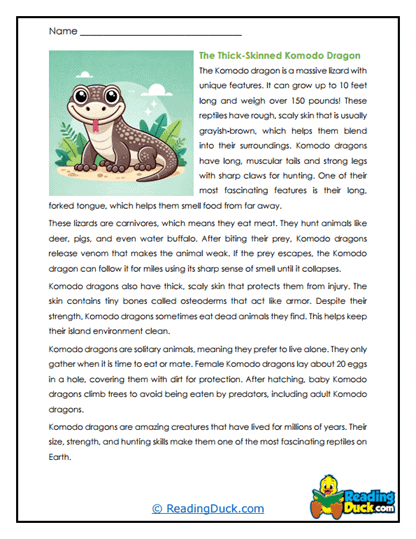
The Komodo dragon isn't your average lizard-it's a prehistoric powerhouse straight out of a fantasy novel. With dagger-like teeth, venomous saliva, and a tongue that flicks like radar, this reptile looks like it was designed by nature's special effects department. Found only on a few Indonesian islands, these ancient giants can reach up to ten feet long and weigh as much as a person. They stalk, swim, sunbathe, and snack with a slow swagger that says, "I was here before the dinosaurs left." If lizards had royalty, the Komodo dragon would sit on the throne.
Studying the Komodo dragon is like getting a front-row seat to evolution in action. These massive reptiles have survived for millions of years by mastering adaptation-from their venom-laced bites to their desert-worthy endurance. They're apex predators, ecosystem engineers, and reminders that nature's most fearsome creatures often have the most fascinating biology. Learning about them helps students understand food webs, island ecology, and how resilience shapes survival. Basically, they're living science lessons with scales.
That's why these worksheets are more than reading exercises-they're adventure guides through one of nature's most awe-inspiring species. Each one turns scientific facts into story-driven reading practice packed with vocabulary growth, comprehension, and curiosity. Students don't just learn about Komodo dragons-they investigate how they think, hunt, and thrive. Every page is a mini expedition into the wild, where words and wildlife meet.
Meet the Worksheets
Sun-Bathing Hunters
This worksheet explores the daily life of Komodo dragons as diurnal predators who start their days soaking up sunshine. Students learn how these reptiles patrol territory, dig burrows, and balance activity with rest. The text teaches behavioral adaptation and cause-and-effect relationships through vivid, scientific description. Fun fact: Komodo dragons regulate their body temperature by sunbathing-basically nature's original solar panels.
Silent Signals
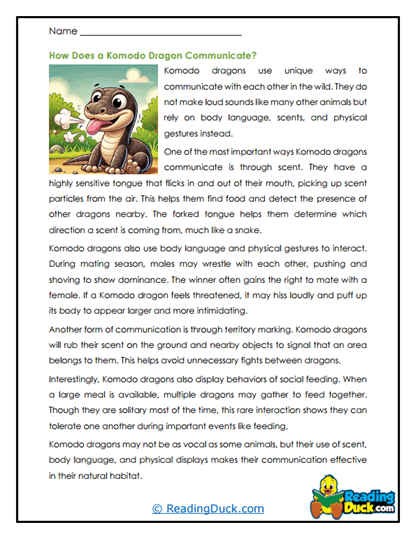
Students uncover how Komodo dragons "speak" without sound, using body language, scent, and flickering tongues. The passage highlights dominance displays, territory marking, and sensory adaptations that replace vocal communication. It builds understanding of nonverbal interaction and strengthens vocabulary about animal behavior. A Komodo dragon's tongue can "taste" the air up to two miles away-talk about long-distance communication!
Fierce Feeders
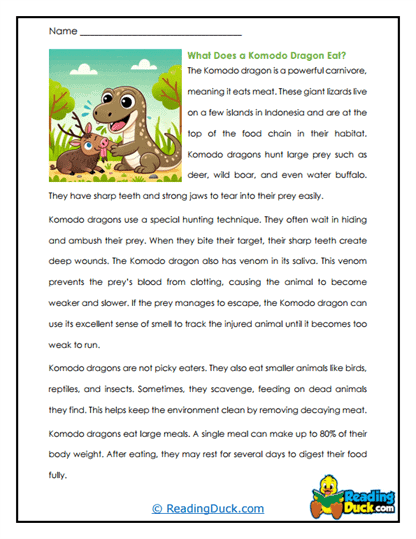
This reading dives into the Komodo dragon's gruesome but fascinating feeding habits. Students learn how they hunt with stealth, venom, and patience, sometimes waiting days for prey to weaken. The passage builds comprehension through logical sequencing and expands ecological vocabulary. Komodo dragons can eat up to 80% of their body weight in a single meal-no doggy bags required.
Ecosystem Enforcers
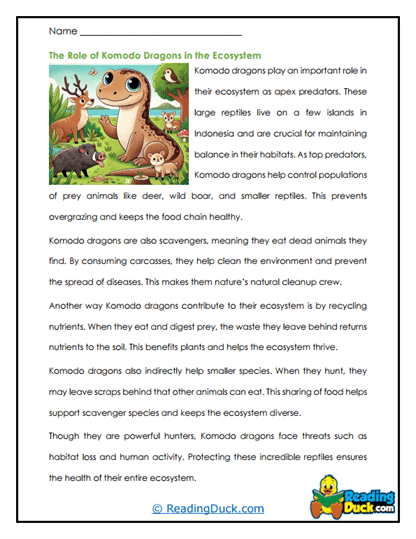
Here, students explore how Komodo dragons act as apex predators keeping their island ecosystems balanced. They discover how these lizards control prey populations, recycle nutrients, and even improve soil health. The worksheet promotes systems thinking and ecological awareness. When a Komodo dragon finishes lunch, it's basically conducting an environmental clean-up operation.
Island Dwellers
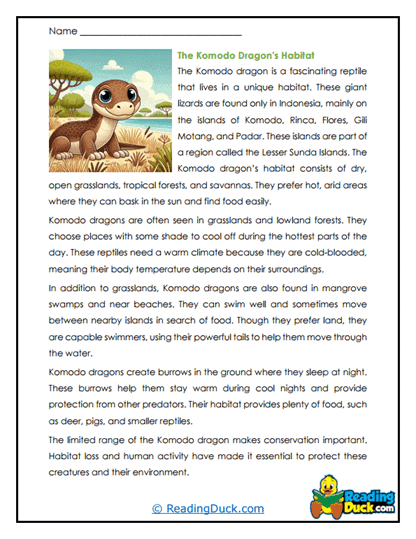
Readers travel to the Indonesian islands of Komodo, Rinca, Flores, and Gili Motang-home to the world's last dragons. The passage explains how habitat, climate, and temperature shape their behavior and survival. Students build geography and adaptation skills while practicing scientific comprehension. Despite their ferocity, Komodo dragons prefer peace and sunshine to conflict and chaos.
Dragon Growth
Students follow the Komodo dragon from fragile egg to fearsome adult. The passage explains how hatchlings survive by climbing trees and eating insects until they grow strong enough to descend. Readers develop sequencing and biological understanding through engaging life cycle detail. Imagine hatching smaller than a candy bar and growing into a creature that can take down a buffalo.
Legendary Lizard
This worksheet introduces the Komodo dragon's evolutionary fame as the world's largest lizard. Students learn about its size, scales, and adaptations that have barely changed over millions of years. The passage promotes scientific literacy through classification and comparison. The Komodo dragon's ancestors once roamed alongside megafauna-real-life dragons in a land before time.
Swift Stalkers
Readers discover how Komodo dragons use strength, stealth, and surprising speed to hunt. Students connect anatomy to motion and explore predation techniques in both land and water. The passage encourages visualization and inference about survival strategy. Komodo dragons may look lumbering, but they can sprint faster than a jogging human-so don't challenge one to a race.
Scaly Symbiosis
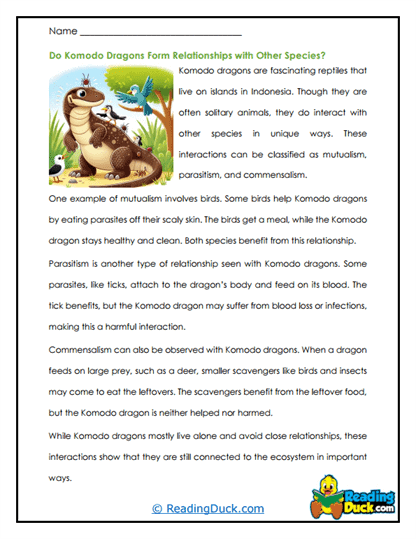
This reading explores the Komodo dragon's relationships with other species, from helpful birds to harmful parasites. Students learn scientific terms like "mutualism" and "commensalism" through vivid ecological examples. It builds comprehension and critical thinking about biodiversity. Even these solitary hunters need teamwork sometimes-especially when it comes to pest control.
Reptile Reproduction
Students learn how Komodo dragons court, mate, and raise the next generation of island rulers. The passage covers mating rituals, egg incubation, and hatchling survival, emphasizing sequence and life science vocabulary. It models expository structure and clear explanation. Female Komodos can even reproduce without males through parthenogenesis-because who needs a partner when you're a dragon?
Armored Hunters
This worksheet highlights the Komodo dragon's anatomy-muscles, scales, teeth, and that secret weapon: venom. Students learn how its bony skin plates called osteoderms act like medieval armor and how its senses make it a perfect predator. The text enhances understanding of adaptation and physiology. Basically, if knights wore scales, they'd still lose to a Komodo dragon.
Survival Struggles
Readers confront the threats these ancient reptiles face-from habitat loss to human interference and disease. The passage blends conservation science with empathy and environmental reasoning. Students practice identifying main ideas and analyzing problem-solution structures. Protecting Komodo dragons today ensures that one of Earth's last living dinosaurs doesn't vanish tomorrow.
All About the Komodo Dragon
Where It Lives
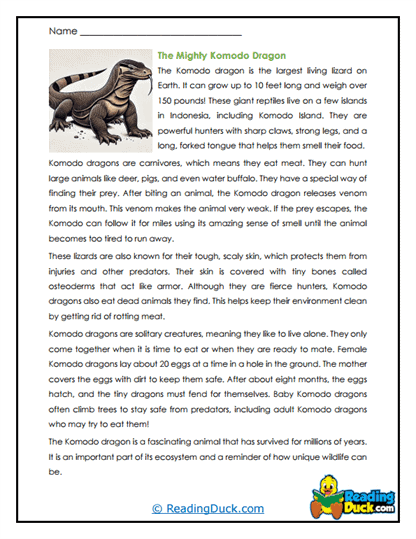
Komodo dragons rule a handful of Indonesian islands, including Komodo, Rinca, Flores, and Gili Motang. They thrive in dry forests, savannas, and scrublands, often near coastlines where they can bask and hunt. Their burrows provide shade and safety from both heat and predators. These isolated islands create the perfect natural laboratory for evolution. It's as if nature decided to save a few dragons and hide them in paradise.
What It Eats
Komodo dragons are carnivores with appetites as big as their reputations. They hunt deer, pigs, birds, and even water buffalo, using venomous bites that weaken prey over time. When hunting isn't an option, they scavenge, playing a vital role in cleaning their ecosystem. Their forked tongues detect chemical scents in the air, turning every breeze into a buffet signal. To a Komodo dragon, mealtime is whenever something stops moving.
How It Acts
Despite their fearsome image, Komodo dragons spend much of their time basking, patrolling, or resting in the shade. They're solitary, preferring personal space except during feeding or mating season. Males wrestle for dominance, while females guard nests fiercely. Each movement-slow, deliberate, and calculated-reflects their mastery of patience. In the reptile world, stealth is strength.
How It Survives
Komodo dragons are marvels of adaptation, combining brute force with biological ingenuity. Their thick scales protect against injury, while venom glands and serrated teeth make hunting efficient. They can swim between islands, climb trees as juveniles, and detect prey from miles away. Their cold-blooded metabolism lets them survive with minimal food for weeks. Evolution didn't just make them tough-it made them terrifyingly efficient.
How It Raises Babies
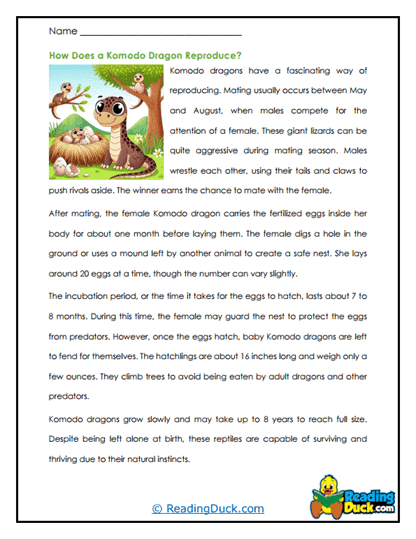
Female Komodo dragons lay around 20 eggs in burrows or abandoned nests, guarding them with vigilant care. After hatching, the tiny dragons scramble up trees to escape hungry adults-including their own kind. For years, they live a secret treetop life, feeding on insects until large enough to descend. This survival strategy keeps the population thriving despite a harsh environment. Mother dragons may not be cuddly, but they're masters of defense.
Is It in Danger?
Sadly, yes. With fewer than 4,000 left in the wild, Komodo dragons are listed as endangered due to habitat loss, natural disasters, and human activity. Deforestation and climate change threaten their island homes, while poaching disrupts ecosystems. Conservationists are working through protected areas and breeding programs to preserve their lineage. Protecting the Komodo dragon means saving a living relic of Earth's evolutionary story. If dragons disappear, a chapter of nature's greatest tale goes with them.
Make sure to bookmark our website now.
Enjoy all our free reading worksheets.
Our materials adhere to the principles of the Science of Reading.