If superheroes wore fur and had thumbs, they'd be raccoons. These masked bandits are the ultimate night explorers-sneaking, splashing, and snacking their way through forests, cities, and even your backyard trash cans. With their ringed tails and curious paws, raccoons turn every shadowy adventure into a scavenger hunt for the ages. You'll never look at a pair of glowing eyes in the dark the same way again.
Learning about raccoons is like unlocking a secret level of nature's game. They're problem-solvers, swimmers, climbers, and snack aficionados all rolled into one mischievous package. From their genius-level foraging tricks to their ecological superpowers, these mammals show what it means to adapt and thrive anywhere. Studying them helps us understand how wildlife can live alongside humans-sometimes a little too closely!
Our Raccoon Worksheets turn this wild curiosity into a learning adventure. Each one helps students explore raccoon science through stories, habitats, and clever challenges. Whether they're tracing life cycles or decoding raccoon "language," kids become part detective, part biologist. It's hands-on reading fun that might just have them peeking out the window for a midnight raccoon sighting!
Meet the Worksheets
Clever Mask
This worksheet introduces the raccoon's signature look-black mask, ringed tail, and a brain full of tricks. Students learn how its senses and smarts help it thrive from forests to cities. They'll explore diet, problem-solving, and the raccoon's place in the wild world. Fun fact: a raccoon can remember solutions to puzzles for up to three years-longer than most humans remember their passwords!
Masked Marvel
Students dive into a descriptive study of raccoon features, from its dexterous paws to its glossy fur and sharp instincts. They'll explore how raccoons use touch, sound, and smell to conquer the night. It's a master class in observation, with sensory-rich language that brings science to life. Bonus: raccoon paws are so sensitive they can identify objects underwater-even with their eyes closed!
Wild Homes
This worksheet explores raccoon habitats, from forest dens to cozy urban hideouts. Students connect how shelter choices link to survival in changing environments. They'll analyze how adaptability helps raccoons live just about anywhere-including your attic. Little secret: a raccoon will move into an empty owl nest faster than you can say "Who?"
Hungry Explorer
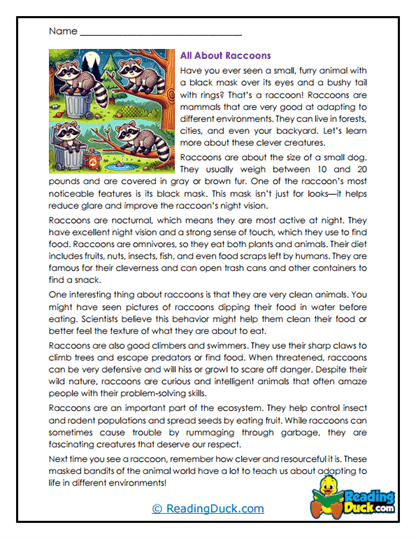
Students discover what's on a raccoon's all-you-can-eat buffet, from berries to bugs to abandoned pizza crusts. The lesson connects omnivore diets with environmental balance and survival. Learners compare natural and city diets through vivid verbs and adjectives. And yes-it's true: raccoons have been known to "wash" their food just because it feels right!
Night Life
This one takes students into the mysterious moonlit world of raccoon routines. They'll follow mothers teaching kits and uncover behaviors that show intelligence and care. It's a perfect example of how animals adapt their daily lives to survive. By the end, students might wish their bedtime was as adventurous as a raccoon's.
Family Bonds
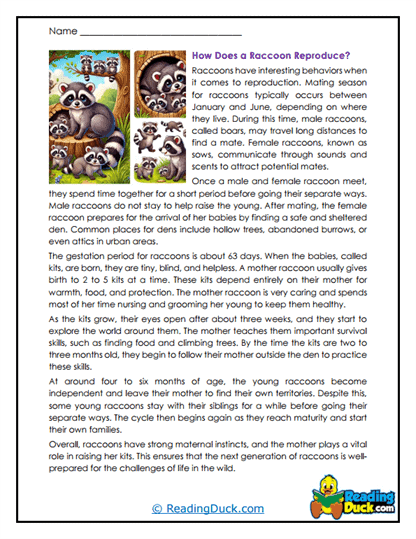
In this worksheet, readers track raccoon parenting from birth to independence. They'll learn how kits grow and how mothers teach survival through patience and play. The text emphasizes nurturing instincts and environmental connection. Fun twist: mother raccoons hum softly to their babies-yes, actual lullabies!
Life Stages
Students journey through the raccoon's life cycle step by step, from wobbly newborns to cunning adults. Each stage highlights new skills and survival lessons. The clear sequence boosts comprehension of growth and adaptation. Unexpected fact: young raccoons are ready to climb trees before they're even fully weaned!
Talking Tails
Communication comes alive here through growls, chirps, and even tail wags. Students interpret meaning from sound and motion like little wildlife detectives. The passage builds inferential skills as they connect emotion to behavior. Surprise: raccoons can make over 50 distinct vocal sounds-basically a furry choir!
Forest Allies
This worksheet shows raccoons as ecosystem MVPs, cleaning up leftovers and spreading seeds. Students learn how scavengers keep the environment healthy and balanced. They practice summarizing and connecting species relationships. Bonus tidbit: raccoons unknowingly plant new forests every time they, ahem, "go."
Ecosystem Helper
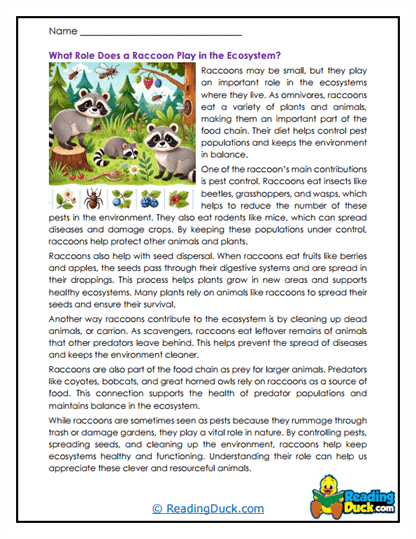
Learners explore raccoons' full ecological résumé-seed spreader, pest controller, and midnight recycler. The text connects their actions to ecosystem cause and effect. Academic vocabulary gets a workout as students define omnivore, scavenger, and ecosystem. Did you know a raccoon's messy dinner habits can help grow new plants? Nature's chaos = forest renewal!
Agile Explorer
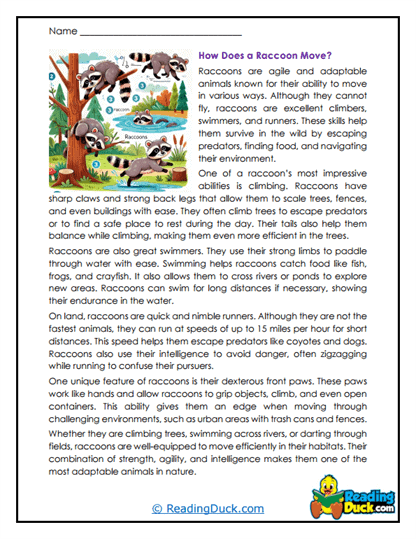
Students examine raccoon athleticism in climbing, swimming, and balancing acts. They'll decode how anatomy supports movement and survival. The reading boosts vocabulary and observation through action-packed verbs. And the cherry on top: raccoons can rotate their back feet 180 degrees-batman-level agility!
Shared Survival
This worksheet introduces interspecies teamwork (and trouble) with mutualism, commensalism, and parasitism. Students classify examples and explore how raccoons coexist with humans. It's an ecological puzzle that makes science feel like storytelling. Plot twist: raccoons sometimes help birds find dinner-accidentally becoming nature's buffet waiters.
All About the Raccoon
Where It Lives
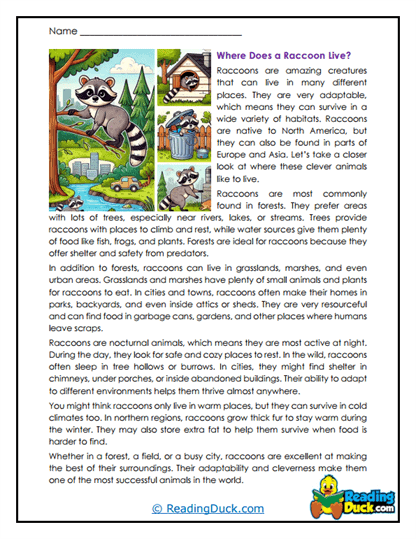
Raccoons are world travelers of the wild, thriving across North America and beyond. They wander forests, marshes, mountains, and alleys with equal enthusiasm. Wherever there's food, shelter, and the occasional trash can, raccoons set up shop. They prefer hollow trees and burrows, but urban raccoons consider chimneys and attics just "premium penthouses."
What It Eats
If raccoons had a motto, it would be "Will eat anything twice." These omnivores feast on fruits, insects, frogs, eggs, and human leftovers with gourmet flair. Their clever paws can pry open jars or shell crustaceans-call it "fine dining, raccoon-style." In short, they're nature's ultimate opportunistic foodies.
How It Acts
Mostly nocturnal, raccoons rule the night like masked adventurers on secret missions. They climb trees, splash in streams, and rummage for snacks with detective-level focus. Curious and cautious, they often study objects like scientists before deciding to eat them. Each raccoon is a blend of explorer, problem-solver, and stand-up comedian in fur.
How It Survives
Adaptability is their superpower. A raccoon's dexterous paws and quick brain let it conquer nearly any habitat. It swims, climbs, and even unscrews lids to survive-nothing is truly raccoon-proof. Their survival strategy? Outsmart everyone, including the humans trying to keep them out of the garbage.
How It Raises Babies
Mother raccoons deserve an award for patience. They raise two to five kits at a time, teaching them everything from climbing to scavenging etiquette. The babies stay close until late summer, learning survival through imitation. Imagine a kindergarten where everyone's homework is "Find your own dinner tonight!"
Is It in Danger?
Luckily, raccoons aren't endangered-but they face risks from habitat loss, cars, and diseases. Their adaptability keeps populations strong, even in bustling cities. Conservationists focus on coexistence, teaching humans how to share space responsibly. After all, a raccoon in your neighborhood isn't a pest-it's just your furry, night-shift neighbor.
Make sure to bookmark our website now.
Enjoy all our free reading worksheets.
Our materials adhere to the principles of the Science of Reading.