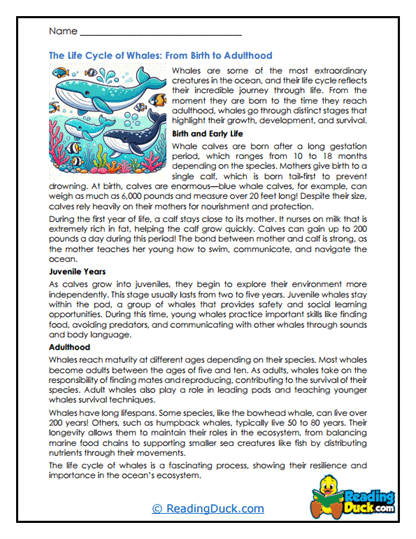
Whales are the ocean's gentle giants-massive, mysterious, and magnificent. These mammals breathe air, sing songs, and migrate thousands of miles beneath shimmering waves. From the thunderous splash of a blue whale to the playful leap of an orca, whales have ruled the seas for millions of years with grace and power. They're living legends, carrying the stories of Earth's deep blue heart in every wave.
Learning about whales feels like reading the ocean's secret diary. They shape ecosystems, regulate the climate, and inspire science with every flick of their flukes. Each whale species-from the plankton-slurping baleen to the squid-hunting sperm whale-reveals something new about adaptation, intelligence, and teamwork in nature. And when humans listen carefully, whale conservation becomes not just science-but a song of hope.
Our Whale Worksheets invite students to dive into the wonders of marine life while sharpening reading and reasoning skills. Through stories of communication, family life, migration, and movement, learners explore how these ancient mammals keep the oceans alive. Each passage is like a submarine window-clear, fascinating, and impossible to look away from.
Meet the Worksheets
Ocean Giants
Students meet Earth's largest mammals-from the tiny dwarf sperm whale to the colossal blue whale. The passage explains breathing, feeding, and the difference between baleen and toothed whales. It also shows how human actions threaten these gentle creatures. Fun fact: a blue whale's tongue alone can weigh as much as an elephant-now that's heavy conversation!
Whale Traits
This worksheet dives into the whale's incredible anatomy, from flippers to blowholes. Students explore how streamlined bodies and specialized skin make whales expert swimmers. It supports descriptive reading and scientific vocabulary building. Bonus: orcas, though called "killer whales," are actually the largest members of the dolphin family-talk about an identity mix-up!
Whale Habitats
Students explore the world's watery neighborhoods, from polar ice to tropical lagoons. The passage links habitat to behavior and threats like climate change and pollution. It builds geography skills and environmental understanding. Cool tidbit: some whales migrate more than 10,000 miles a year-making them the ultimate ocean commuters!
Whale Diets
This reading breaks down whale menus into two styles-baleen filter-feeders and toothed hunters. Students connect diet to habitat and learn how whales keep marine ecosystems balanced. It enhances classification and cause-effect comprehension. Fun fact: baleen whales take "big bites" by gulping entire schools of krill-whale-size buffets, anyone?
Whale Behavior
Students learn how whales communicate, rest, and socialize through playful leaps and haunting songs. The text builds understanding of behavioral sequencing and action verbs. It encourages empathy by showing that whales form close-knit pods like families. Bonus: humpback whales compose songs so complex they can last for hours-and change every season.
Whale Families
This passage traces the family life of whales-from mating songs to mother-calf bonds. Students explore life-cycle vocabulary and learn how whales nurture their young. It reinforces process reading and sequencing. Sweet fact: whale mothers feed their calves milk so rich in fat it's practically milkshake consistency!
Whale Growth
Students follow a whale's journey from newborn calf to full-grown adult. The passage teaches life cycles, stages, and survival adaptations. It strengthens chronological and critical reading comprehension. Fascinating note: a baby blue whale can gain up to 200 pounds per day-fast food, ocean style.
Whale Communication
This worksheet explores the language of the sea-clicks, songs, and body gestures that echo for miles. Students practice inference and analysis as they decode whale "conversations." The text connects science with sound and emotion. Fun extra: some whale songs can travel across entire ocean basins-it's the world's largest group chat.
Survival Challenges
Students examine how whales face both natural predators and human-made dangers. The passage connects issues like pollution, noise, and habitat loss to global conservation. It builds problem-solution comprehension and cause-effect reasoning. Hopeful note: after decades of protection, humpback whale populations are finally rebounding-proof that humans can make waves for good.
Ocean Role
This worksheet transforms whales into ocean engineers. Students learn how whale waste and movement cycle nutrients and support climate health. It builds systems thinking and vocabulary like "food chain" and "nutrient cycling." Fun science fact: every whale dive helps fertilize microscopic plankton-tiny plants that give us the oxygen we breathe!
Swimming Secrets
Students discover how whales glide through the sea with elegance and force. The passage connects flukes, fins, and streamlined shapes to movement and survival. It enhances comprehension of structure and function in biology. Amazing fact: whales move their tails up and down-not side to side-just one way they stand apart from fish.
Ocean Partners
This worksheet explores teamwork and hitchhikers in the sea, from barnacles and birds to parasites and fish. Students classify relationships as mutualism, commensalism, or parasitism. It sharpens analytical reading and ecological vocabulary. Wild twist: barnacles ride whales for years-earning free travel and meals without paying rent.
All About the Whale
Where It Lives
Whales roam every ocean on Earth, from icy poles to tropical lagoons. Some prefer shallow coastal waters, while others dive miles deep into the unknown. Migration paths stretch across hemispheres in tune with the seasons. The ocean is their playground, their pantry, and their planet.
What It Eats
Whales' diets depend on their design-baleen whales sip soup, and toothed whales hunt steak. Filter-feeders scoop up krill, plankton, and tiny fish by the ton, while hunters like orcas coordinate group attacks. Every meal keeps the ocean food chain in balance. In the sea, even dinner is an act of ecological teamwork.
How It Acts
Whales are social, intelligent, and endlessly curious. They breach, sing, spyhop, and sometimes even play games with dolphins. Communication keeps pods united and navigation precise. It's like the ocean's version of a neighborhood barbecue-only everyone's 40 tons heavier.
How It Survives
Adaptation is a whale's greatest power. Blubber insulates against cold, lungs handle long dives, and sonar-like echolocation maps the darkness. Whales thrive because their bodies are perfectly engineered for motion and mystery. Each heartbeat beneath the waves is proof that evolution knows elegance.
How It Raises Babies
Whale mothers are patient teachers of the deep. They nurse, protect, and sing to their calves as they grow and learn the ways of migration. Each calf learns through play, imitation, and maternal care. It's a love story written in saltwater and song.
Is It in Danger?
Sadly, yes-many whale species still face threats from pollution, noise, and changing oceans. Yet conservation and cleaner seas are helping their numbers rise. Protecting whales means protecting entire ecosystems. When a whale thrives, the ocean breathes easier.
Make sure to bookmark our website now.
Enjoy all our free reading worksheets.
Our materials adhere to the principles of the Science of Reading.