If curiosity had fur, stripes, and a love of digging, it would be a meerkat. These little desert dwellers are nature's tiny lookouts - half stand-up comedian, half survival expert. With their bright eyes, twitchy noses, and habit of popping up like furry periscopes, meerkats make "cute and cautious" look like a lifestyle. They live in the dry stretches of southern Africa, where teamwork is as essential as sunscreen.
Learning about meerkats is like opening a window into the world's most cooperative community. They share food, raise each other's babies, and post lookouts while the rest dig for dinner. Studying their habits teaches students about ecosystems, communication, and how nature's underdogs thrive together. Plus, any animal that can sunbathe and outsmart a snake deserves its own worksheet series.
Our Meerkat Worksheets turn all that desert drama into learning fun. Each activity mixes real science with storytelling, vocabulary with adventure, and curiosity with a dash of laughter. Whether your students are reading, sequencing, or exploring life cycles, they'll discover that meerkats are more than adorable - they're natural-born teachers with tails. Let's dig in!
Meet the Worksheets
Curious Companions
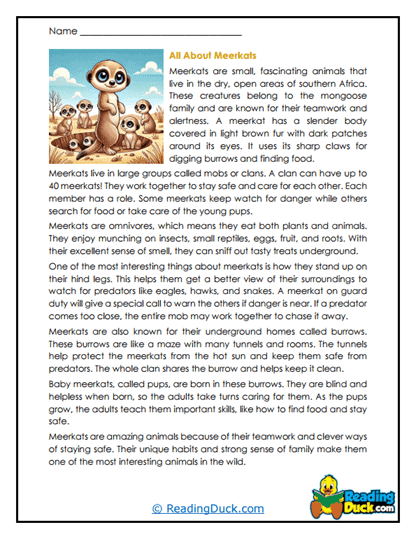
This worksheet introduces students to the meerkat mob - a bustling desert family where everyone pitches in. It strengthens reading comprehension by exploring teamwork, alertness, and survival in the wild. Students learn vocabulary about ecosystems while practicing how to identify main ideas in nonfiction. Fun fact: meerkats take turns being the lookout, like tiny furry lifeguards with attitude.
Daily Diggers
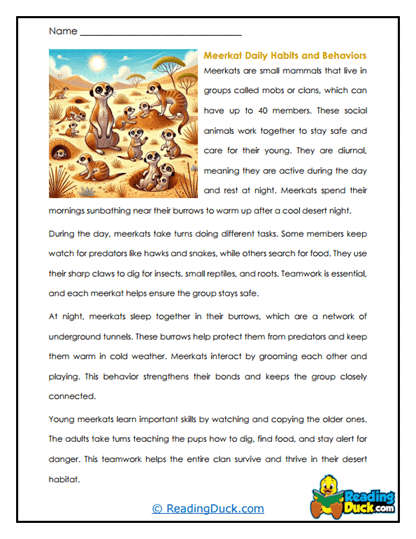
Here, learners follow a day in the life of a meerkat, complete with digging, foraging, and sunbathing schedules. The worksheet sharpens sequencing and cause-and-effect reasoning as students connect behaviors to survival. It highlights cooperation and daily routines through lively descriptions and critical-thinking prompts. Did you know meerkats can move over 200 pounds of sand in a single day? That's a lot of dirt for a 2-pound mammal.
Talkative Tails
Students explore meerkat "language," from chirps and growls to nose-boops and scent messages. The activity boosts inference skills and understanding of animal communication through detailed examples. Learners practice context clues and analyze nonverbal meaning, bridging science with reading skills. Apparently, meerkats have different alarm calls for birds, snakes, and other threats - talk about customized ringtones.
Mighty Menu
This worksheet turns lunchtime into a science lesson, revealing what meerkats eat and how they find it. Students identify details about omnivorous diets while improving categorization and text analysis. The exercise connects biology terms with real-world desert survival. Bonus bite: meerkats are immune to certain scorpion stings - proof that desert dining requires guts (literally).
Ecosystem Engineers
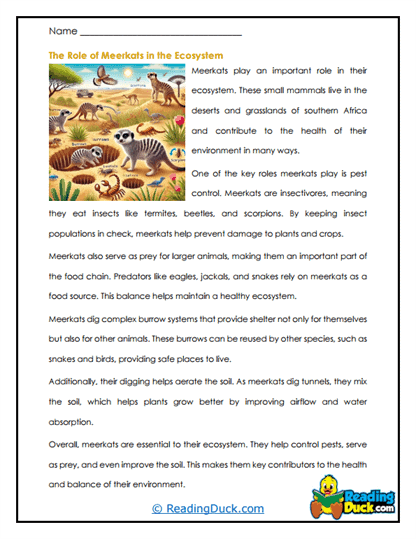
Learners discover how meerkats shape their environment through burrowing and pest control. The worksheet builds ecological literacy and helps students grasp interdependence in nature. Cause-and-effect exercises encourage them to see how small creatures make big impacts. It's like a desert renovation show - only the contractors wear fur and never charge for labor.
Marvelous Mob
This activity dives into meerkat family life, teamwork, and cooperative care of pups. Students analyze informational structure while learning how animals rely on group intelligence. The passage strengthens summarization and vocabulary through rich description. Think of it as the desert's most wholesome reality show - "Keeping Up with the Meerkats."
Habitat Helpers
Here, students learn where meerkats live and how they thrive in tough desert ecosystems. They identify main ideas and evidence while studying adaptation and environmental fit. The worksheet introduces scientific adjectives and strengthens reading fluency through vivid imagery. Fun twist: meerkats use their dark eye patches as built-in sunglasses - desert chic at its finest.
Life Learners
This worksheet follows meerkats from birth to adulthood, showing each stage of growth and learning. Students practice sequencing and chronological comprehension while exploring life cycles. The text connects biology with narrative thinking, reinforcing scientific vocabulary. Who knew that meerkat pups go to "school" by shadowing adults - it's mentorship, meerkat-style.
Speedy Scouts
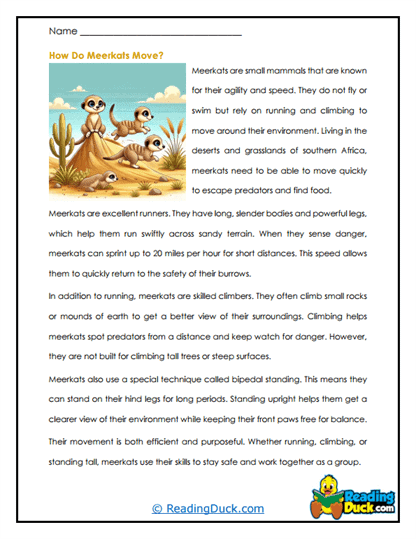
Students examine how meerkats move - sprinting, climbing, and standing tall like sentinels. The worksheet enhances descriptive reading and visualization through vivid motion verbs. Learners expand vocabulary about anatomy and movement while picturing each scene. Surprise stat: these tiny mammals can hit 20 miles per hour - that's faster than a golf cart full of tourists.
Caring Clans
This activity focuses on meerkat reproduction and communal child-rearing. Students build comprehension by tracking family structures and survival strategies. The worksheet supports analysis of hierarchies and cooperation in nonfiction texts. The group babysitting system is so effective, even human parents might get jealous.
Species Partners
Here, students explore the relationships meerkats form with other species - both friendly and not-so-friendly. The worksheet strengthens understanding of symbiosis and ecological roles. Critical-thinking prompts help learners identify mutualism, commensalism, and parasitism. Bonus fact: meerkats sometimes "team up" with drongos, birds that share alarm duties - it's the original desert buddy comedy.
Desert Defenders
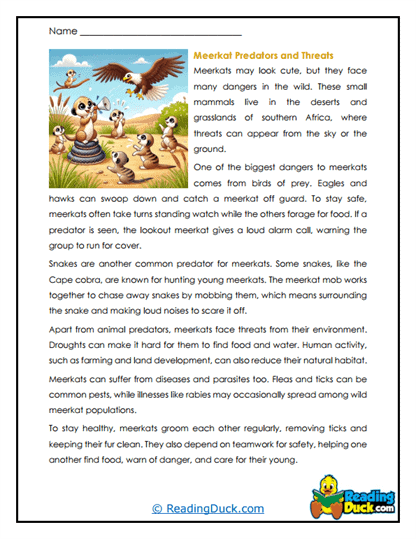
This worksheet teaches students about predators, threats, and the clever survival tactics meerkats use. It improves cause-and-effect comprehension and vocabulary around adaptation and defense. Learners analyze how cooperation helps overcome natural dangers. True story: meerkats even clean each other to stay disease-free - self-care, mob-edition.
All About the Meerkat
Where They Live
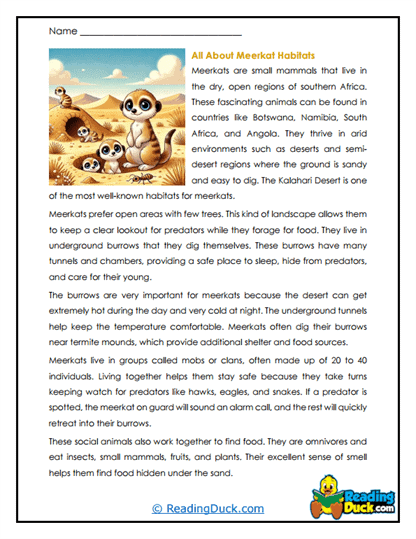
Meerkats make their homes in the dry savannas and scrublands of southern Africa, especially the Kalahari Desert. They build intricate burrow systems that act like underground mansions - cool in the day, cozy at night. These burrows can stretch for yards and include multiple entrances, tunnels, and sleeping chambers. Life in the desert may be harsh, but for meerkats, it's prime real estate with a view of endless sand and sky.
What They Eat
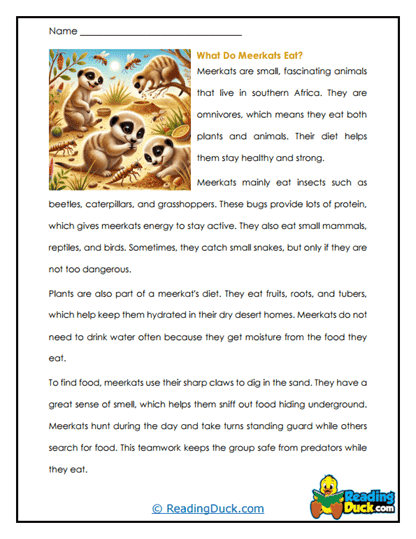
If it crawls, scuttles, or grows underground, a meerkat might eat it. Their diet includes beetles, caterpillars, lizards, and plant roots, providing both nutrients and hydration. With sharp claws and a sharp nose, they dig up food faster than you can say "sandwich." They're also known for eating scorpions - and yes, they're immune to the venom. That's desert dining with a sting of excitement.
How They Act
Meerkats are social butterflies... or maybe social groundhogs. They live in mobs of up to 40 members, each with specific roles - hunters, babysitters, and lookouts. Communication is constant, from chirps to tail flicks, and teamwork is everything. Watching a meerkat group is like seeing a tiny orchestra where everyone plays the same tune - with sand on their paws and smiles on their faces.
How They Survive
Desert life is tough, but meerkats have mastered it. They rotate guard duty to spot predators, rely on cooperation for safety, and use their burrows as escape routes. Their slender bodies and dark eyes help with heat management and glare reduction. Basically, they're walking examples of desert engineering - half genius, half sunbather.
How They Raise Babies
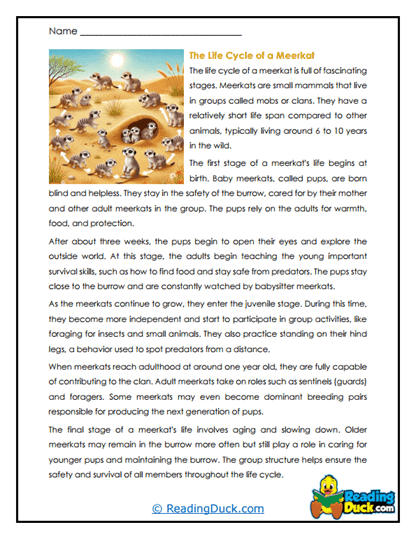
When meerkat pups are born, the entire mob pitches in to help raise them. Babysitters watch the burrow while others fetch food and teach survival skills. The pups learn by copying adults, practicing digging and foraging in adorable slow motion. Family values run deep in meerkat society - it truly takes a mob to raise a meerkat.
Are They In Danger?
Thankfully, meerkats aren't currently endangered, but they still face challenges. Habitat loss, drought, and predators all pose threats, and human expansion doesn't make desert life easier. Conservation efforts focus on protecting their ecosystems and educating people about their importance in pest control. In short, the best way to help meerkats is to keep their desert wild, their burrows safe, and their teamwork strong.
Make sure to bookmark our website now.
Enjoy all our free reading worksheets.
Our materials adhere to the principles of the Science of Reading.