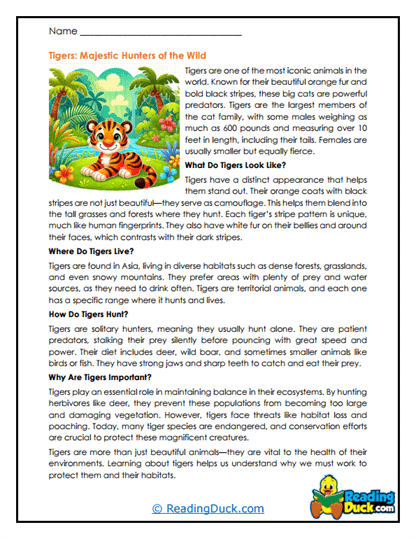
If the rainforest had royalty, the tiger would be king-majestic, mysterious, and impossible to ignore. With fur the color of sunrise and stripes like barcodes of bravery, tigers move through jungles and grasslands with quiet confidence. They're the largest cats on Earth, but they'd rather stalk than strut, blending into shadows before pouncing with perfect precision. Every tiger stripe tells a story-of stealth, strength, and survival.
Studying tigers is like reading a living adventure novel full of science and suspense. These big cats shape entire ecosystems just by being themselves, keeping prey in check and forests in balance. But their survival story is also a global one-humans, habitats, and hope all intertwined. Understanding tigers teaches us not only about nature's power but also about our responsibility to protect it.
Our Tiger Worksheets bring this fierce beauty into the classroom, combining ecological insight with gripping nonfiction reading. Students won't just learn about tigers-they'll track their roars, habits, cubs, and challenges through rich, descriptive texts. Every worksheet feels like a mini safari in literacy, science, and conservation rolled into one wild ride.
Meet the Worksheets
Striped Hunter
Students meet the tiger, nature's stealthy superstar, and learn how its stripes double as camouflage. The passage explores habitats, diets, and the tiger's crucial ecological role. Learners connect cause and effect between behavior and environment while expanding vocabulary. Fun fact: no two tigers share the same stripe pattern-each one has its own natural barcode!
Royal Stripes
This worksheet celebrates the tiger's royal design-muscles, claws, and colors fit for a jungle monarch. Students discover how strength and individuality help tigers survive. The text strengthens descriptive comprehension and visualization. Bonus: a tiger's stripes extend all the way to its skin-making it stripy even if shaved (not recommended).
Jungle Kingdom
Readers journey across Asia's diverse tiger habitats-from tropical forests to snowy peaks. The passage links geography to conservation and introduces problem-solution structures. It develops environmental literacy and spatial reasoning. Fun tidbit: tigers actually like swimming, and some even patrol mangrove swamps!
Fierce Feast
Students follow the tiger's menu, from deer and boar to the occasional buffalo. The passage explains stealth hunting and the balance of predator-prey relationships. It builds comprehension of food webs and ecological cause-effect. Surprising fact: one tiger meal can last a week-leftovers fit for a carnivore king.
Silent Stalker
This worksheet peers into the secret life of tigers-mostly nocturnal, solitary, and endlessly observant. Students explore how tigers communicate through roars, scratches, and scent marking. The text reinforces behavioral vocabulary and sequencing. Quiet truth: a tiger's roar can be heard nearly two miles away, and it's not for the faint of heart.
Gentle Giants
Students meet tiger mothers-the fierce protectors who raise cubs with patience and play. The passage traces life from birth to independence while highlighting maternal care. It builds process comprehension and empathy through biological detail. Heart-melting note: tiger cubs start practicing pouncing on each other before they can even hunt.
Growing Power
Readers follow a tiger's journey from helpless cub to confident hunter. The passage emphasizes growth stages and life challenges. It supports time-order comprehension and science vocabulary. Cool bonus: tiger cubs don't open their eyes for a week-but they start roaring within a month!
Roaring Talk
Students tune into the tiger's language of growls, chuffs, and body movements. They interpret nonverbal communication to understand territory and emotion. The worksheet builds inferential reading and linguistic curiosity. Fun roar fact: friendly tigers greet each other with a soft "chuff"-basically a tiger version of "hey, buddy!"
Striped Survivor
This passage takes on real-world threats-poaching, shrinking habitats, and human conflict. Students learn how resilience and conservation efforts give tigers a fighting chance. It develops evaluative thinking and environmental awareness. Hopeful twist: tiger populations are finally increasing in some regions-proof that protection works!
Ecosystem King
Students see tigers as ecological architects maintaining nature's balance. The text explores their role as apex predators and biodiversity guardians. It strengthens cause-and-effect comprehension and systems thinking. Bonus fact: saving tigers automatically protects over 50,000 other species that share their habitat-royal ripple effect!
Swift Predator
This worksheet reveals the tiger's motion magic-sprinting, swimming, and stalking in silence. Students connect body structure to movement and survival. It sharpens descriptive comprehension and scientific vocabulary. Mind-blowing stat: tigers can leap more than 30 feet in a single bound-Olympic gold, jungle edition.
Wild Connections
Students learn that even solitary tigers have important relationships in nature. The passage explains mutualism, parasitism, and scavenger interactions. It encourages classification and analytical reading. Fascinating truth: vultures, foxes, and insects all depend on tiger leftovers-because every meal echoes through the ecosystem.
All About the Tiger
Where It Lives
Tigers roam across Asia's forests, grasslands, and wetlands-from India's jungles to Siberia's snowy wilderness. They love thick cover and easy access to water for cooling off or swimming. Each tiger rules a huge territory, marking it with scent and scratches. Whether prowling in monsoon rain or winter snow, tigers reign wherever wild still thrives.
What It Eats
As apex carnivores, tigers dine on deer, buffalo, wild pigs, and the occasional unlucky fish. Their stealth, patience, and explosive strength make them near-perfect hunters. By keeping prey populations balanced, they maintain ecosystem health. When a tiger eats, the entire forest breathes easier.
How It Acts
Tigers are mostly solitary, mysterious wanderers who prefer moonlit patrols to daylight drama. They use scent, sound, and even body posture to communicate boundaries. Calm and calculated, they waste no energy unless it's time to hunt-or play with cubs. Every move is deliberate, every stare a lesson in quiet power.
How It Survives
A tiger's survival toolkit includes camouflage stripes, padded paws for silent steps, and muscles that move like coiled springs. They can swim rivers, climb trees, and take down prey twice their size. Their adaptability makes them resilient, even in shrinking habitats. Beneath that roar is pure strategy in motion.
How It Raises Babies
Mother tigers are devoted, fierce, and endlessly patient. They raise cubs alone, teaching them to stalk, hide, and hunt with precision. Cubs stay with mom for two years before claiming their own territories. It's the ultimate combination of family bonding and survival school.
Is It in Danger?
Yes-but not without hope. Fewer than 5,000 tigers remain in the wild, threatened by poaching and deforestation. Conservationists worldwide are working to expand protected habitats and end illegal trade. Every tiger saved is a victory for nature's balance and beauty.
Make sure to bookmark our website now.
Enjoy all our free reading worksheets.
Our materials adhere to the principles of the Science of Reading.