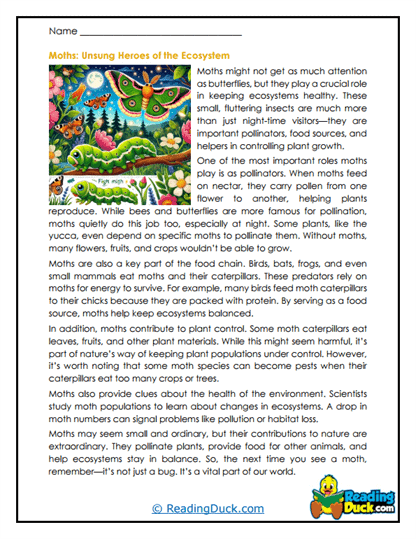
Moths are amazing nighttime insects that many children see fluttering around porch lights and gardens after dark. These gentle insects are closely related to butterflies, but they have their own special features that help them survive in the nighttime world. Students will learn how moths grow, move, communicate, and help ecosystems through engaging nonfiction reading passages. Exploring the world of moths also helps children understand pollination, life cycles, habitats, and animal adaptations in nature.
Our moth worksheets help students strengthen reading comprehension and science skills while learning interesting facts about insects. Children practice identifying main ideas, understanding sequences, and learning new vocabulary connected to ecosystems, metamorphosis, habitats, and survival. These informational passages also encourage critical thinking as students discover how moths protect themselves, find food, and interact with other living things. As students read and discuss what they learn, they improve fluency, organization, and confidence with nonfiction texts.
Learning about moths encourages children to become curious observers of the natural world, especially the creatures that are active at night. Students discover that moths are important pollinators and food sources that help ecosystems stay balanced and healthy. Reading science-based nonfiction also helps children build stronger observation, problem-solving, and communication skills. With thoughtful and engaging passages, these worksheets inspire students to explore science with confidence and excitement.
Meet the Worksheets
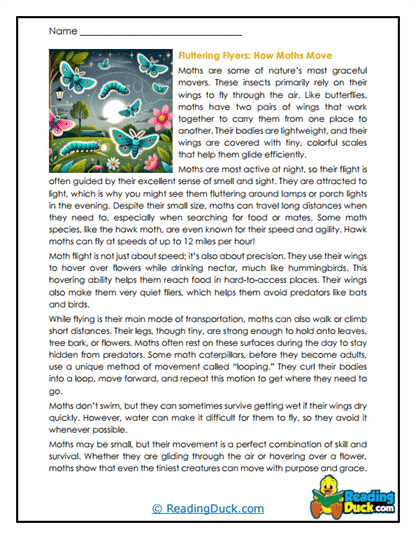
Fluttering Flight
Students learn about the graceful ways moths move through the air and across different surfaces. The passage explains how lightweight bodies and scaled wings help moths glide quietly while searching for food and shelter. Readers strengthen comprehension by connecting movement with survival and adaptation. Children often enjoy discovering that some moth species can travel long distances during migration.
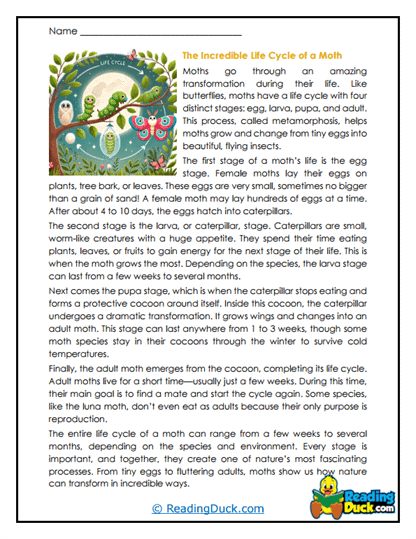
Midnight Metamorphosis
This worksheet explores the complete life cycle of a moth from egg to adult. Students follow each stage of development while learning how caterpillars transform inside protective cocoons. The passage strengthens sequencing and science vocabulary skills through clear explanations of metamorphosis. Readers are often fascinated by how some moths remain inside cocoons during the winter before emerging later.
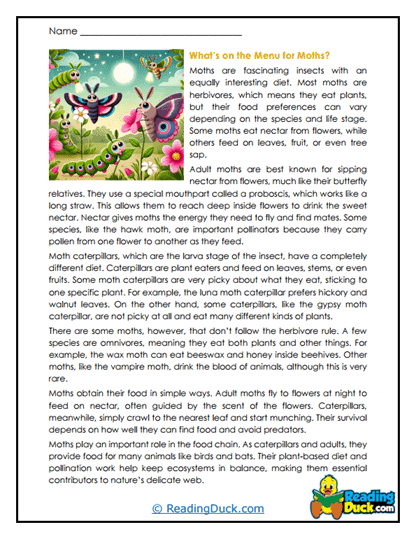
Moonlight Meals
Students discover what moths eat during different stages of their lives. The worksheet explains how caterpillars feed on plants while adult moths often drink nectar using a proboscis. Readers strengthen cause-and-effect thinking while learning how feeding behaviors support survival. Children also learn that moths help pollinate flowers while searching for food at night.
Moonlight Messages
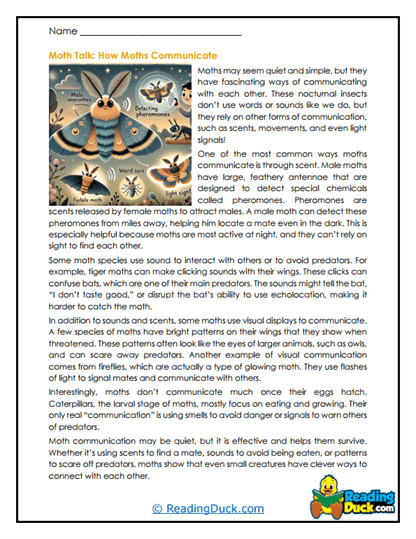
This passage teaches students about the clever ways moths communicate with one another. Readers explore how moths use pheromones, body movements, sounds, and wing patterns to survive and attract mates. The worksheet supports close reading and analytical thinking through examples of animal behavior and defense. Students are often surprised to learn that some moths create clicking sounds to confuse bats.
Nature's Web
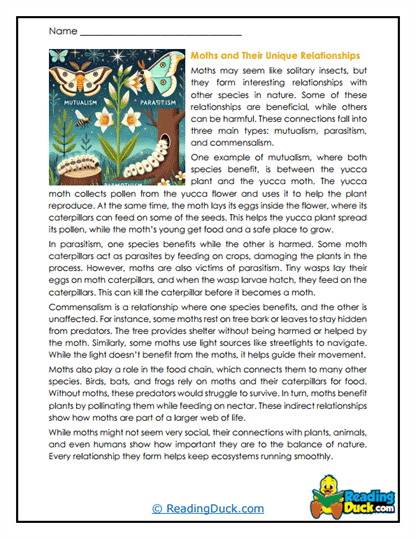
Students explore the many relationships moths have with plants, predators, and other insects in ecosystems. The passage introduces interactions such as mutualism, parasitism, and commensalism through real-life examples. Readers practice comparing different relationships while building higher-level nonfiction comprehension skills. Children gain a deeper appreciation for how connected living things are in nature.
Night Dangers
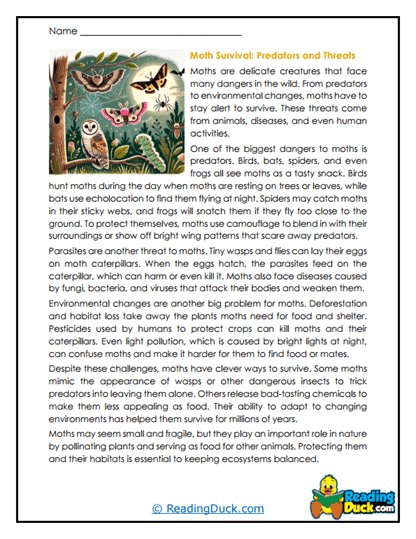
This worksheet explains the many dangers moths face from predators and environmental changes. Students learn how camouflage, warning colors, and chemical defenses help moths survive in the wild. The passage strengthens critical thinking by encouraging readers to identify challenges and survival strategies. Readers also discover how habitat loss and pollution can affect moth populations.
Night Flyers
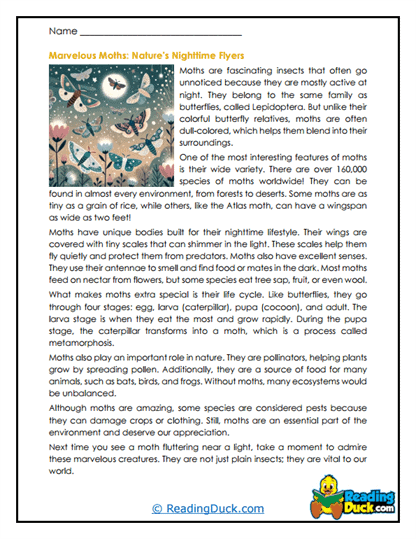
Students are introduced to the fascinating world of moths and their important role in nature. The passage explains moth life cycles, nighttime behaviors, and how moths help ecosystems as pollinators and food sources. Readers build nonfiction comprehension and vocabulary skills while exploring scientific concepts. Children begin to see moths as valuable and interesting insects instead of ordinary nighttime bugs.
Night Pollinators
This passage explores the important role moths play in pollinating flowers and supporting ecosystems. Students learn how moths help plants reproduce while feeding on nectar during nighttime hours. The worksheet strengthens comprehension by helping readers identify cause-and-effect relationships in nature. Children also discover that moths provide food for many animals, including bats and birds.
Nighttime Adventures
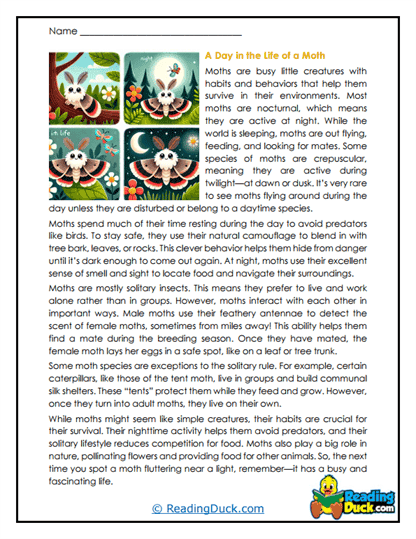
Students take a closer look at the daily habits and routines of moths. The worksheet explains how moths rest during the day and become active at night to avoid predators and search for food. Readers strengthen sequencing and comprehension skills while following nighttime behaviors in order. Students often enjoy learning how moths use camouflage to hide during daylight hours.
Nocturnal Neighbors
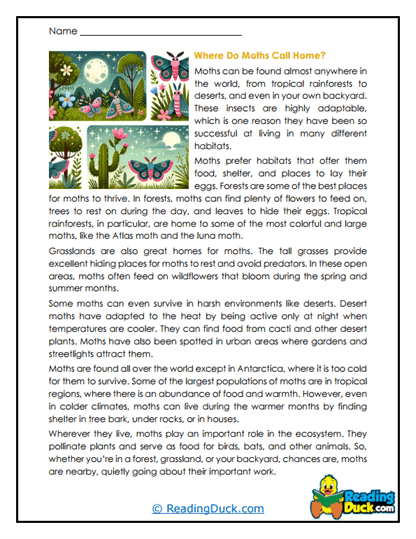
This passage explores the habitats where moths live and survive around the world. Students investigate forests, deserts, rainforests, gardens, and other environments that provide shelter and food for moths. The worksheet helps readers connect animals with their habitats and survival needs. Children also discover how moths adapt to cooler nighttime temperatures in different climates.
Silken Beginnings
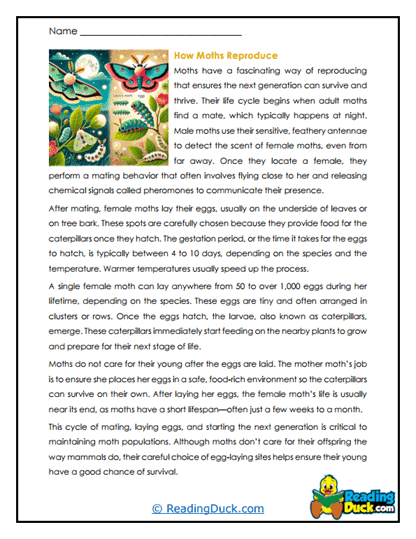
Students learn how moths reproduce and develop through complete metamorphosis. The passage explains how moths use pheromones to locate mates and carefully lay eggs on plants for future caterpillars. Readers strengthen sequencing and vocabulary skills while following the stages of development step by step. Children are often amazed by how quickly caterpillars grow before forming cocoons.
Winged Wonders
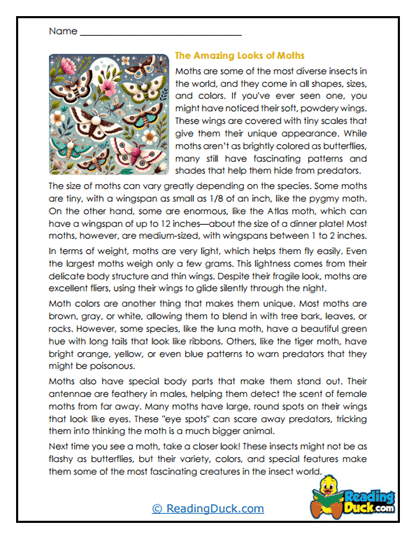
This worksheet gives students a detailed look at the body structure and appearance of moths. Readers learn about scaly wings, feathery antennae, camouflage colors, and eye-like wing patterns used for defense. The passage strengthens observation and close-reading skills by connecting body parts with their functions. Students are often fascinated by giant moth species like the atlas moth.
A Better Look At Moths
Moths are important insects that quietly help ecosystems remain healthy and balanced around the world. These nighttime pollinators help flowers reproduce while also serving as food for birds, bats, frogs, spiders, and many other animals. Moths and caterpillars also help scientists study environmental health because their populations can show changes in habitats and climates. By learning about moths, students gain a deeper understanding of ecosystems, life cycles, adaptation, and the important jobs insects perform in nature.
Reading about moths helps children become stronger nonfiction readers while building curiosity about science and the natural world. Students practice learning new vocabulary, understanding scientific explanations, and explaining ideas clearly using details from the text. Exploring topics like metamorphosis, habitats, communication, and survival also strengthens sequencing, comprehension, and analytical thinking skills. These engaging passages encourage students to ask thoughtful questions, observe nature more carefully, and grow into confident lifelong learners.
Make sure to bookmark our website now.
Enjoy all our free reading worksheets.
Our materials adhere to the principles of the Science of Reading.