Unexpected Connections Multiple Choices
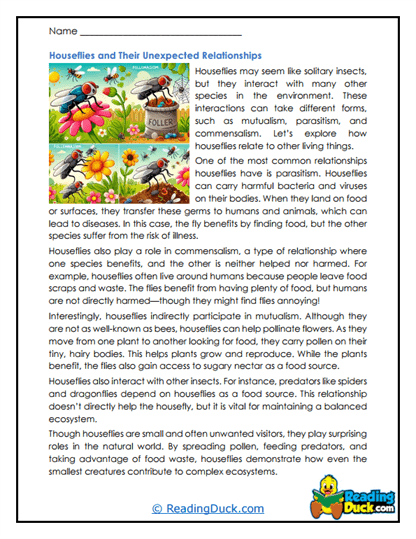
This passage explores the many relationships houseflies have with other living things in their environment. Students learn about interactions such as parasitism, commensalism, pollination, and predator-prey relationships. The text explains how houseflies can spread germs that affect humans and animals, but also how they help by pollinating flowers and serving as food for predators like birds and dragonflies. Readers discover that houseflies often benefit from living near humans because food waste provides them with easy meals. The passage shows students that even small insects can have complex and important connections within ecosystems.
Reading passages about relationships in nature helps students strengthen higher-level thinking and comprehension skills. Students practice comparing different interactions and understanding how organisms depend on one another for survival. Exposure to academic vocabulary such as parasitism, commensalism, and pollination supports stronger language development and scientific understanding. Informational reading also teaches students how to explain ideas clearly, recognize examples, and summarize complex information. These experiences help students grow into thoughtful readers who can analyze nonfiction texts with greater confidence and understanding.