About Our Praying Mantis Reading Comprehension Worksheets
Praying mantises are some of the most fascinating insects in nature. Their folded front legs, sharp eyesight, and amazing hunting skills make them stand out from many other insects. Students are often surprised to learn that a mantis can turn its head and blend almost perfectly into its surroundings. Learning about these unique creatures helps children connect science concepts to the natural world around them.
Our Praying Mantis Reading Comprehension Worksheets help students build strong reading skills while exploring interesting facts about insect life. As they read, children practice finding main ideas, identifying supporting details, and learning new science vocabulary. The passages encourage critical thinking by showing how physical features, behaviors, and habitats help animals survive. These skills support success in both reading and science classrooms.
Studying praying mantises can spark curiosity and inspire young learners to ask questions about the world around them. Students develop observation skills as they discover how these insects hunt, grow, communicate, and interact with other living things. Along the way, they gain confidence reading nonfiction texts and analyzing information. We hope these worksheets encourage a lifelong love of learning and discovery.
Meet the Worksheets
Agile Acrobat
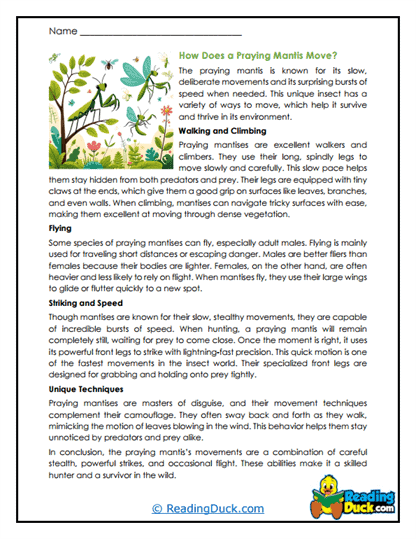
Students learn how praying mantises walk, climb, fly, and move with remarkable speed. The worksheet explores the body parts that make these movements possible and explains how they support hunting and survival. Readers strengthen their understanding of cause-and-effect relationships between structure and function. It is a great reminder that even small insects can be incredible athletes.
Curious Colors
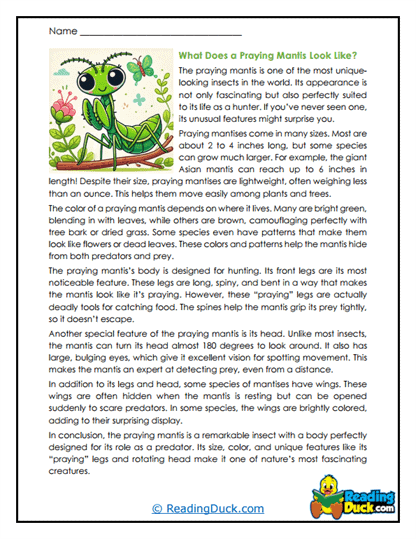
This worksheet introduces the many colors, shapes, and physical features of the praying mantis. Students examine how its body is designed to help it hunt, hide, and survive in different environments. The passage builds descriptive vocabulary and observation skills through detailed explanations. Readers discover that a mantis's appearance is one of its greatest tools.
Egg Secrets
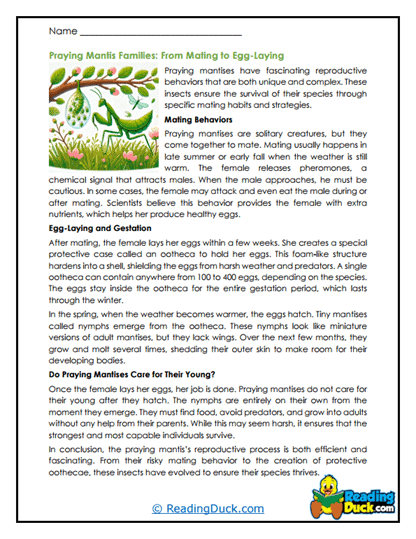
Students explore how praying mantises reproduce and protect their young. The passage follows the process from mating to egg-laying and explains the purpose of the protective ootheca. Readers practice following events in sequence while learning scientific vocabulary. It highlights the clever ways insects help future generations survive.
Growth Journey
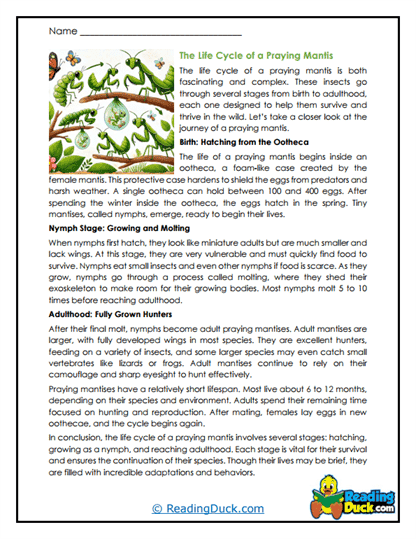
This worksheet takes students through the life cycle of a praying mantis from egg to adult. Readers learn about hatching, molting, growth, and the changes that occur at each stage. The passage strengthens sequencing and chronological thinking skills. Students gain a deeper appreciation for the challenges of growing in the insect world.
Habitat Hideouts
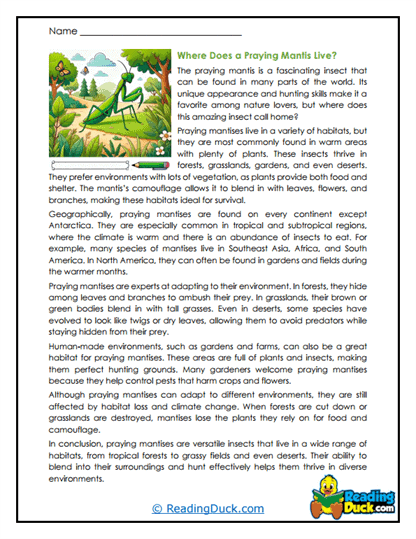
Students discover where praying mantises live and why certain habitats suit them so well. The worksheet explores forests, grasslands, gardens, deserts, and other environments around the world. Readers build geography and science vocabulary while learning how habitats affect survival. It shows that even human-made spaces can become important homes for wildlife.
Mantis Marvel
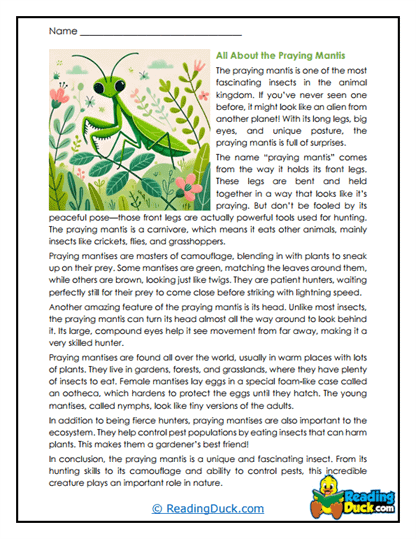
This passage introduces students to the praying mantis and its most remarkable characteristics. Readers learn about its appearance, hunting habits, and role in maintaining healthy ecosystems. The text strengthens nonfiction reading skills by combining facts with clear explanations. Students quickly see why this insect has fascinated people for centuries.
Nature Guardian
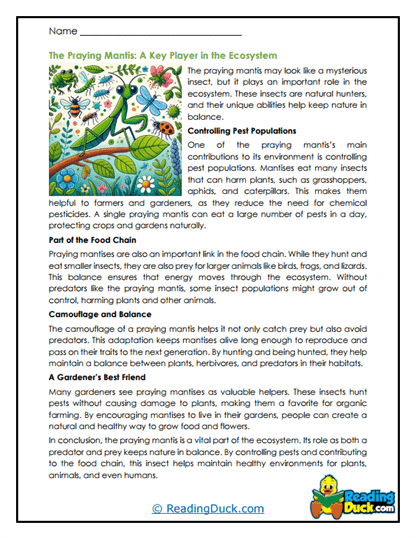
Students learn how praying mantises contribute to balanced ecosystems. The worksheet explains their role as predators, prey, and natural helpers that control insect populations. Readers practice identifying important relationships within food chains and habitats. It highlights how even a single species can make a big difference in nature.
Nature Neighbors
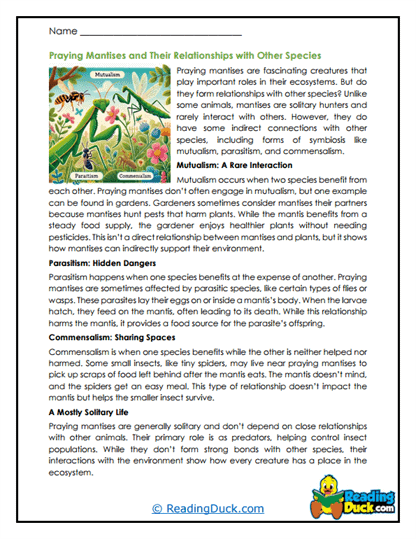
This worksheet explores the different relationships praying mantises have with other living things. Students learn about mutualism, parasitism, commensalism, and predator-prey interactions. The passage develops comparison skills while introducing important ecology concepts. Readers discover that every species is connected to many others in surprising ways.
Predator Plate
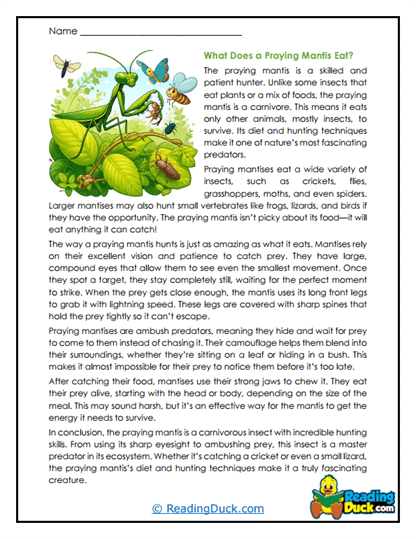
Students investigate what praying mantises eat and how they catch their meals. The worksheet explains ambush hunting, camouflage, and the use of powerful front legs to capture prey. Readers practice understanding sequences and identifying key details in informational text. It reveals how patience can be one of nature's most effective hunting strategies.
Silent Signals
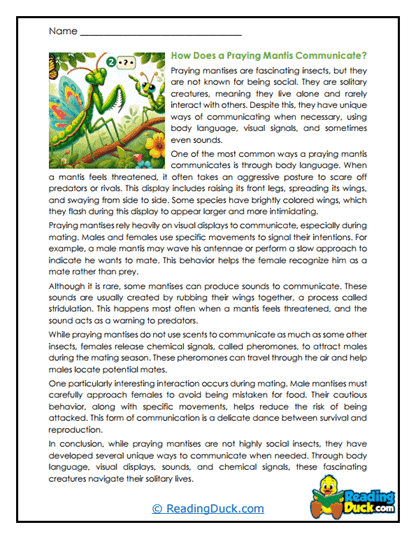
This passage examines how praying mantises communicate despite spending much of their time alone. Students learn about visual displays, body language, wing movements, and chemical signals. The worksheet strengthens comprehension by helping readers connect behaviors to specific purposes. It shows that communication can happen without a single sound.
Stealthy Schedule
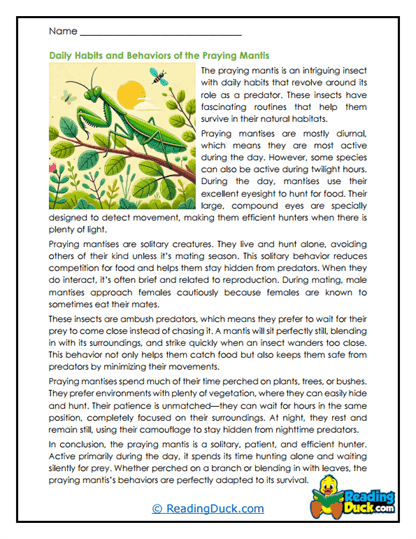
Students learn about the daily routines and behaviors of praying mantises. The worksheet explains how they hunt, rest, hide, and interact with their surroundings throughout the day. Readers build understanding of behavioral patterns and survival strategies. It offers a fascinating glimpse into the life of a skilled insect hunter.
Wild Challenges
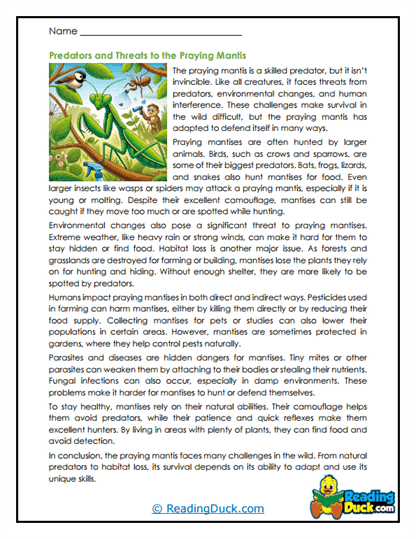
This worksheet focuses on the many dangers praying mantises face in the wild. Students explore threats from predators, weather, habitat loss, parasites, and human activities. The passage develops problem-and-solution thinking as readers examine how mantises respond to challenges. It demonstrates the resilience needed to survive in nature.
A Better Look At the Praying Mantis
Praying mantises play an important role in ecosystems around the world. As predators, they help keep insect populations under control, while also serving as food for larger animals. Their camouflage, hunting techniques, and unique life cycle make them excellent subjects for science learning. Exploring these insects helps students understand how living things adapt to their environments and interact within food webs.
Reading about praying mantises also helps children become stronger readers and more thoughtful observers. Informational texts encourage students to ask questions, analyze details, and connect facts across different topics. As they build vocabulary and comprehension skills, they gain confidence in reading nonfiction independently. With curiosity and careful observation, every student can become a young scientist ready to explore the wonders of nature.
Make sure to bookmark our website now.
Enjoy all our free reading worksheets.
Our materials adhere to the principles of the Science of Reading.