
Winged Wonders
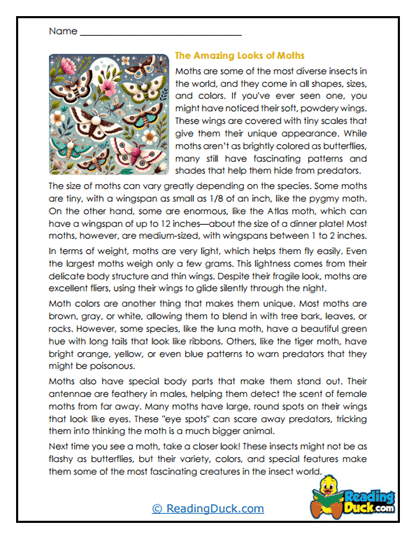
This passage gives students a closer look at the appearance and physical features that make moths unique. Readers learn about moths’ soft, scaly wings, feathery antennae, and camouflage colors that help protect them from predators. The text explains how moths come in many different sizes and patterns, from tiny species to giant atlas moths with enormous wingspans. Students also discover how some moths use eye-like patterns on their wings to scare away predators. The passage highlights how every part of a moth’s body helps it survive and thrive in its environment.
Reading passages about animal anatomy and adaptations helps students improve close-reading and observation skills. Students practice connecting body structures with their functions, which strengthens comprehension and analytical thinking. Rich descriptive language builds vocabulary while improving fluency and sentence understanding. Informational reading also teaches students how to explain ideas clearly using details from the text. These experiences help students become more thoughtful readers while encouraging them to explore and appreciate the natural world.
Questions:
Answer Keys: