Connected Colonies Open Response
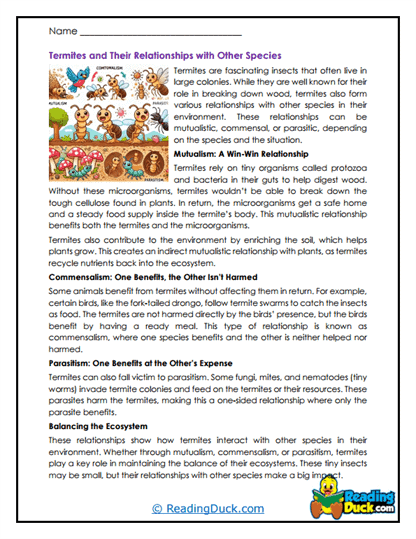
This passage introduces students to the many relationships termites have with other living things in their environment. Readers learn about mutualistic relationships, such as the partnership termites share with the microorganisms in their digestive systems that help them break down cellulose. The text also explores examples of commensalism and parasitism, showing how some organisms benefit from termites while others may harm them. Students discover that termites influence plants, animals, soil organisms, and entire ecosystems through these interactions. The passage emphasizes that termites are not isolated creatures but important participants in a larger web of life.
Reading passages about ecological relationships encourages students to think critically about how living things depend on one another. Children practice comparing different types of interactions and identifying examples within informational text. Academic vocabulary such as mutualism, commensalism, parasitism, and microorganisms helps build both scientific understanding and reading confidence. These texts also strengthen comprehension by requiring students to analyze information, draw conclusions, and explain complex ideas clearly. By exploring the connections between organisms, students gain a deeper appreciation for the balance and interdependence found in nature.