
From Egg to Worker Open Response
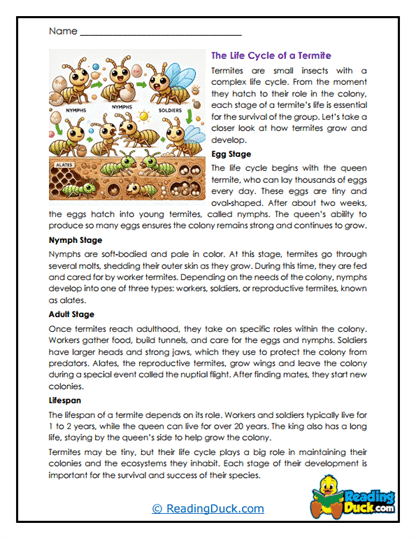
This passage helps students understand the fascinating life cycle of a termite and how every stage plays an important role in the success of the colony. Readers learn that termite life begins as an egg laid by the queen and progresses through the nymph stage before developing into an adult. The text explains how young termites molt several times as they grow and eventually take on specialized roles such as worker, soldier, or reproductive termite. Students also discover that queens can live for decades and produce thousands of eggs, making them one of the most important members of the colony. By the end of the passage, children gain a deeper appreciation for the complex social structure that allows termite colonies to thrive.
Passages about life cycles are especially valuable because they help students practice sequencing events and understanding processes. Children learn to follow stages in order while building scientific vocabulary such as nymph, molting, reproductive, and colony. These texts also strengthen comprehension skills by requiring students to identify key details and explain how one stage leads to the next. As students discuss and summarize what they learn, they develop stronger communication skills and a better understanding of biological concepts.