
Silent Messages Short Answer
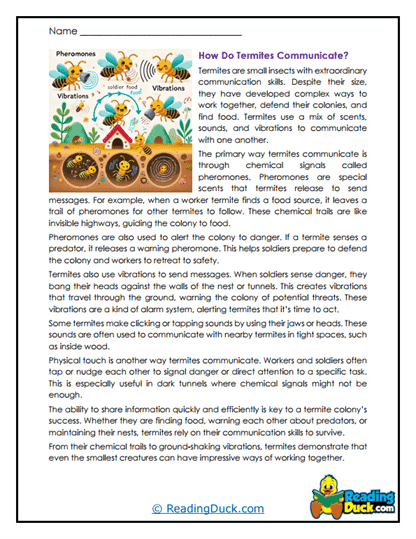
One of the most surprising things parents discover is that termites are constantly communicating with one another. This passage explores the different ways termites share information and coordinate life within the colony. Students learn that termites use chemical signals called pheromones to create trails, locate food, and warn others about danger. The text also explains how termites communicate through vibrations and physical contact, especially in the dark tunnels where sight is limited. Readers discover that these communication methods help thousands of termites work together efficiently without confusion.
Reading passages about communication and behavior helps students develop strong analytical thinking skills. Children learn to connect actions with outcomes and understand how cooperation contributes to survival. The passage also introduces sophisticated science vocabulary such as pheromones, vibrations, and signals in an age-appropriate way. Informational texts like this encourage students to identify cause-and-effect relationships, summarize complex ideas, and explain how organisms interact with one another. These skills support success across science, reading, and writing.