The Walking Leaf Multiple Choices
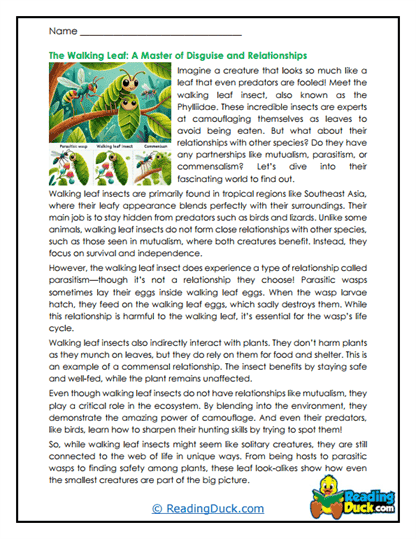
This passage explores the relationships walking leaves have with other organisms in their ecosystem. Readers learn that although walking leaves are largely solitary insects, they still interact with plants, predators, parasites, and other species in important ways. The text discusses examples of parasitism, such as tiny wasps that use walking leaf eggs as hosts, and explains how walking leaves depend on plants for food and shelter. Students also discover that predators benefit from finding and eating these insects, making walking leaves part of a larger ecological network. The passage emphasizes that every species, no matter how hidden or quiet, plays a role in maintaining balance within nature.
Reading passages about ecological relationships helps students strengthen higher-order thinking skills. Children learn to compare different types of interactions and understand how organisms depend on one another. Academic vocabulary such as parasitism, predator, host, and ecosystem supports scientific understanding and reading growth. Informational texts also encourage students to analyze information, identify examples, and explain complex concepts in their own words. These skills help students become stronger readers while developing a deeper appreciation for the interconnectedness of life on Earth.