Nature’s Web
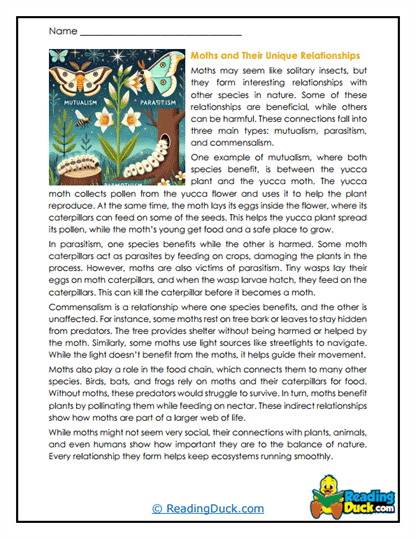
This passage explores the many relationships moths have with plants, animals, and other insects in nature. Students learn about interactions such as mutualism, parasitism, and commensalism through examples involving moths and their ecosystems. The text explains how moths help pollinate flowers while also providing food for predators like birds, bats, and spiders. Readers discover that some wasps lay eggs inside caterpillars, creating parasitic relationships that affect moth survival. The passage emphasizes that moths are deeply connected to the natural world and help ecosystems remain balanced and healthy.
Reading passages about relationships in nature helps students strengthen higher-level thinking and comprehension skills. Students practice comparing different interactions and understanding how organisms depend on one another for survival. Academic vocabulary such as mutualism, parasitism, and commensalism supports stronger scientific understanding and reading development. Informational texts also help students explain ideas clearly, recognize examples, and summarize complex concepts. These reading experiences encourage curiosity, thoughtful discussion, and greater confidence when reading challenging nonfiction passages.
Questions:
Answer Keys: