About Our Angelfish Reading Comprehension Worksheets
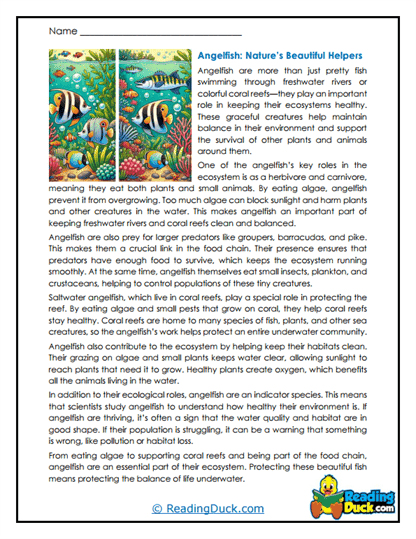
Angelfish are some of the most eye-catching fish in the underwater world. Their colorful patterns, unusual body shapes, and graceful movements make them fascinating animals to study, but there is much more to them than their appearance. These worksheets introduce students to freshwater and saltwater angelfish while exploring their habitats, diets, behaviors, life cycles, adaptations, and relationships with other organisms. Along the way, children discover how angelfish survive and contribute to the aquatic ecosystems they call home.
Our Angelfish Reading Comprehension Worksheets help students strengthen nonfiction reading skills while learning engaging life science concepts. As they read, students practice identifying main ideas, finding supporting details, comparing information, following sequences, and recognizing cause-and-effect relationships. The passages also encourage students to make connections between an angelfish's physical features, behaviors, and environment. These skills support stronger reading comprehension while building useful science vocabulary and background knowledge.
Learning about angelfish gives children an opportunity to explore the remarkable variety of life found beneath the water's surface. Students discover how these fish communicate, reproduce, avoid predators, find food, and interact with other living things. They also learn why healthy rivers, reefs, and other aquatic habitats are so important for survival. We hope these worksheets encourage careful observation, scientific curiosity, and a greater appreciation for life underwater.
Meet the Worksheets
Color Signals
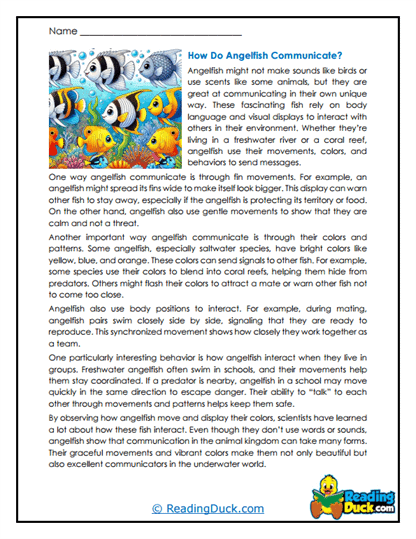
Students discover how angelfish communicate without words or loud sounds. They learn how colors, body movements, swimming patterns, and positioning can send warnings, defend territory, or play a role in mating. This worksheet strengthens inference skills by encouraging readers to connect behaviors with their possible meanings. Students see how even subtle signals can provide important information underwater.
Colorful Features
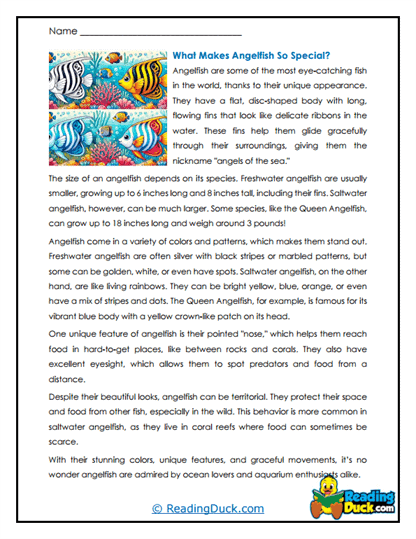
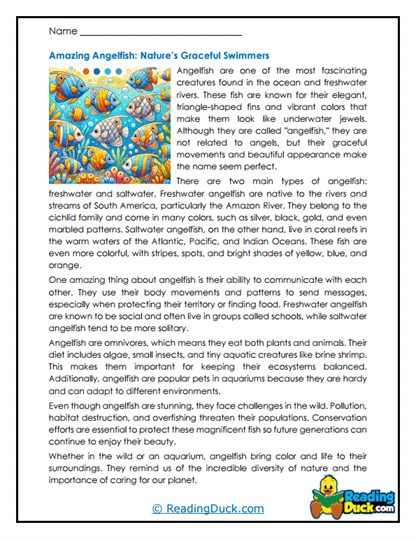
Students take a closer look at the physical traits that make angelfish so distinctive. They explore how flat bodies, flowing fins, pointed noses, stripes, and colors can help these fish swim, find food, and respond to danger. This worksheet strengthens comprehension by connecting body structures with their functions. Readers also compare features of freshwater and saltwater angelfish.
Daily Rhythms
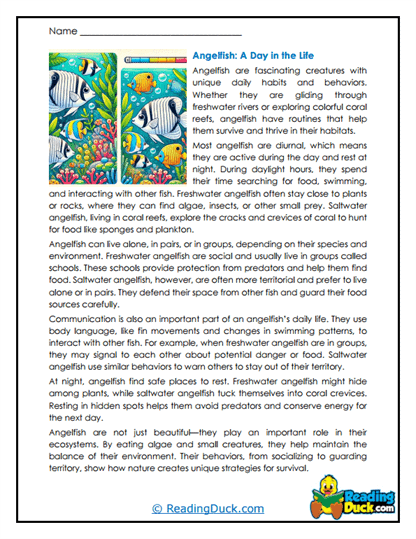
Students explore what angelfish do during a typical day. They learn how these fish search for food, communicate, guard their space, and eventually settle into sheltered areas to rest. This worksheet provides useful practice with sequencing and recognizing patterns in animal behavior. Readers also discover how daily routines can differ depending on habitat and species.
Egg Guardians
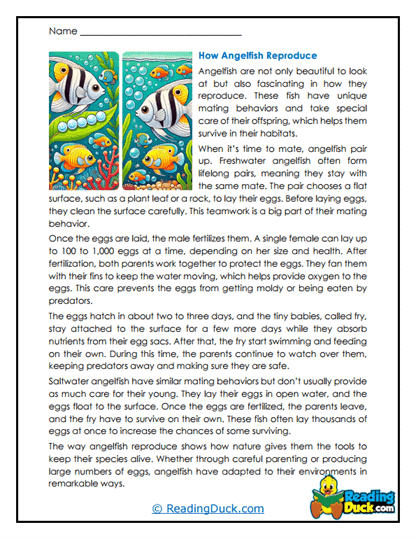
Students learn how angelfish reproduce and the different strategies species use to protect their offspring. They follow the process of pairing, laying eggs, fertilization, and early development while comparing freshwater and saltwater species. This worksheet strengthens sequence and process-based comprehension skills. Readers discover how different reproductive behaviors can help the next generation survive.
Fin Control
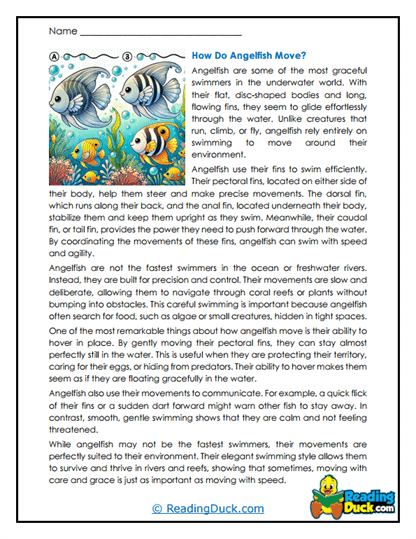
Students investigate how an angelfish's fins and body shape create its smooth, controlled movements. They learn how different fins provide steering, balance, and forward motion while helping the fish hover and maneuver through tight spaces. This worksheet strengthens comprehension by connecting individual body parts with specific functions. Readers discover how graceful movement supports feeding, communication, and survival.
Graceful Swimmers
Students are introduced to the fascinating world of angelfish. They learn about freshwater and saltwater species while exploring their habitats, diets, behaviors, and survival challenges. This worksheet provides a strong foundation for the more focused topics throughout the collection. Readers practice identifying important details while discovering the remarkable diversity of angelfish.
Growing Fry
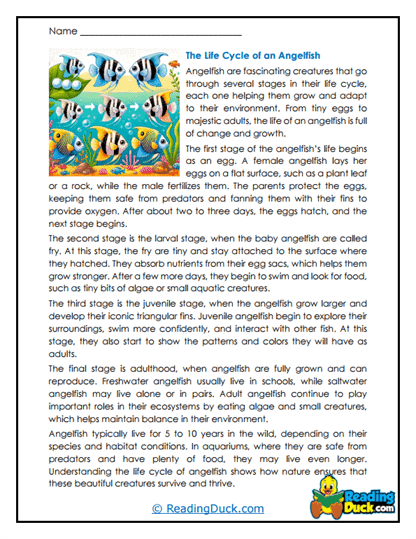
Students follow the angelfish life cycle from a tiny egg to a fully grown adult. They learn how larvae depend on their yolk sacs before beginning to swim and feed independently, and how juveniles gradually develop their adult features. This worksheet strengthens sequencing and summarizing skills. Readers gain a clear understanding of how angelfish change throughout their lives.
Hidden Dangers
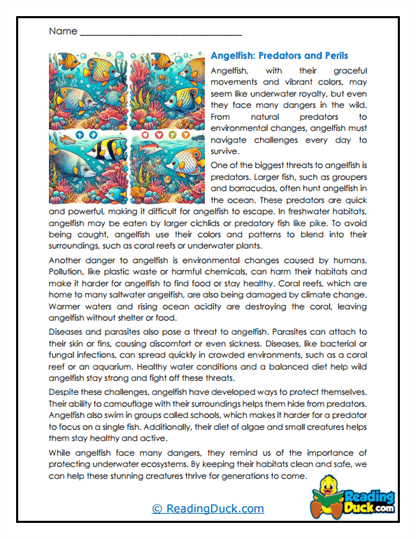
Students examine the challenges angelfish face in their natural habitats. They learn about predators, pollution, disease, parasites, habitat damage, and changing water conditions while exploring the adaptations angelfish use for protection. This worksheet develops problem-and-solution thinking. Readers discover how survival depends on both an animal's abilities and the health of its environment.
Reef Helpers
Students discover how angelfish contribute to the ecosystems where they live. They learn how feeding on algae, sponges, and small organisms can influence habitat health while also exploring the angelfish's place within aquatic food chains. This worksheet strengthens cause-and-effect thinking and systems-based comprehension. Readers see how one species can contribute to the balance of an entire ecosystem.
Reef Menu
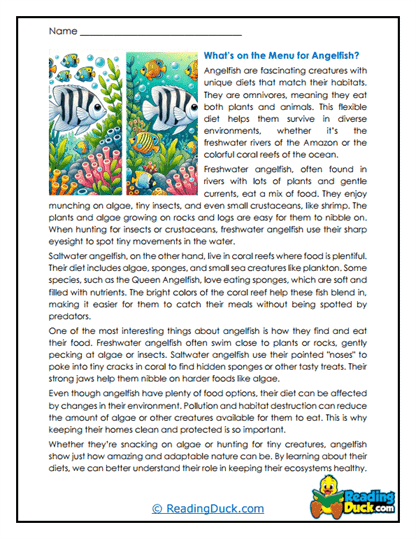
Students explore the varied foods eaten by freshwater and saltwater angelfish. They learn how plants, algae, insects, crustaceans, sponges, and other organisms can become part of an angelfish's diet. This worksheet helps readers connect feeding habits with habitat and survival. Students also strengthen comprehension by gathering related details from different parts of the passage.
River or Reef
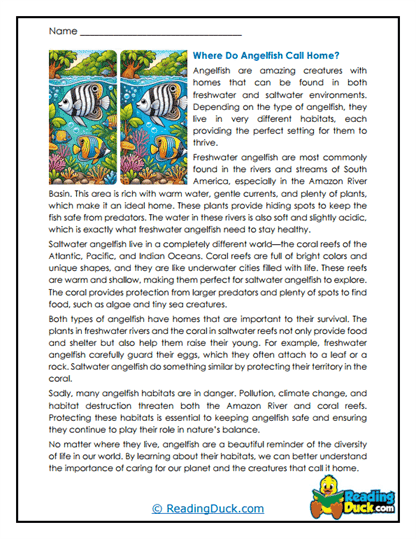
Students travel from the warm rivers of South America to colorful coral reefs while comparing angelfish habitats. They learn how different environments provide food, shelter, protection, and places to reproduce. This worksheet strengthens comparison skills and helps readers connect animals with their environmental needs. Students also discover why protecting habitats is essential for healthy angelfish populations.
Underwater Connections
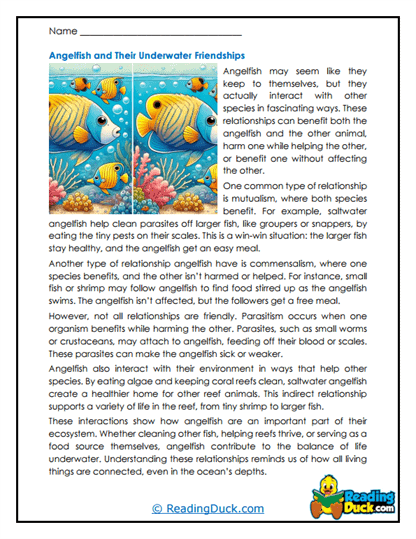
Students explore the different relationships angelfish have with other organisms. They learn about mutualism, commensalism, and parasitism through examples involving fish, parasites, reefs, and other marine life. This worksheet develops higher-level comparison and classification skills. Readers gain a broader understanding of how living things are connected within aquatic ecosystems.
A Better Look At Angelfish
Angelfish are much more than colorful additions to rivers and coral reefs. Their specialized bodies, feeding habits, communication methods, reproductive strategies, and relationships with other organisms all help them survive in complex aquatic environments. Freshwater and saltwater species may live very different lives, but both depend on healthy habitats that provide the resources and protection they need. Studying angelfish helps students understand how an animal's traits and behaviors connect with the larger ecosystem around it.
Reading about angelfish also helps students become stronger readers and scientific thinkers. They practice comparing information, following life cycles and processes, recognizing relationships, building science vocabulary, and supporting ideas with details from informational texts. These skills can strengthen learning across reading and life science while encouraging students to ask more questions about the natural world. With every passage, children gain confidence while discovering the remarkable life hidden beneath the water's surface.
Make sure to bookmark our website now.
Enjoy all our free reading worksheets.
Our materials adhere to the principles of the Science of Reading.