About Our Catfish Reading Comprehension Worksheets
Catfish are unusual and highly adaptable fish known for their whisker-like barbels and bottom-dwelling lifestyles. They can be found in rivers, lakes, ponds, reservoirs, and even some brackish or salty waters, with different species displaying an impressive variety of sizes and survival strategies. These worksheets introduce students to catfish habitats, diets, physical features, behaviors, reproduction, life cycles, and ecological relationships. Along the way, children discover how these remarkable fish use specialized senses and adaptations to thrive in aquatic environments around the world.
Our Catfish Reading Comprehension Worksheets help students strengthen nonfiction reading skills while exploring engaging life science concepts. As they read, students practice identifying main ideas, finding supporting details, following sequences, comparing information, and recognizing cause-and-effect relationships. The passages also encourage readers to connect physical structures and behaviors with the challenges of living in dark or muddy water. These skills build reading confidence while expanding science vocabulary and knowledge about freshwater ecosystems.
Learning about catfish gives children an opportunity to explore animals that may live very differently from the fish they usually imagine. Students discover how catfish locate food, communicate, reproduce, protect their young, avoid threats, and interact with other organisms. They also learn why healthy rivers, lakes, ponds, and wetlands are important for supporting aquatic life. We hope these worksheets encourage scientific curiosity and help students appreciate the many connections hidden beneath the water's surface.
Meet the Worksheets
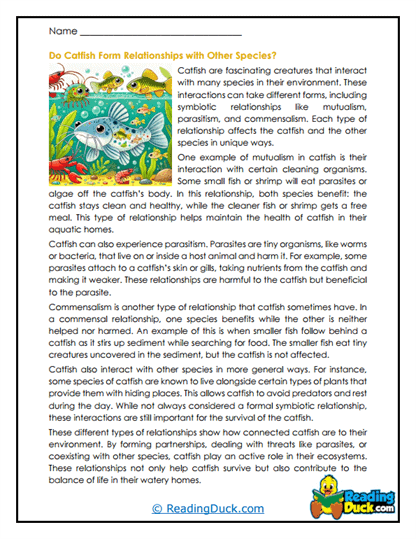
Aquatic Connections
Students explore the relationships catfish have with other organisms in aquatic environments. They learn about mutualism, parasitism, and commensalism through examples involving parasites, cleaner organisms, smaller fish, and aquatic plants. This worksheet strengthens comparison and classification skills by asking readers to determine how each organism is affected. Students discover that even seemingly solitary fish remain connected to a much larger web of life.
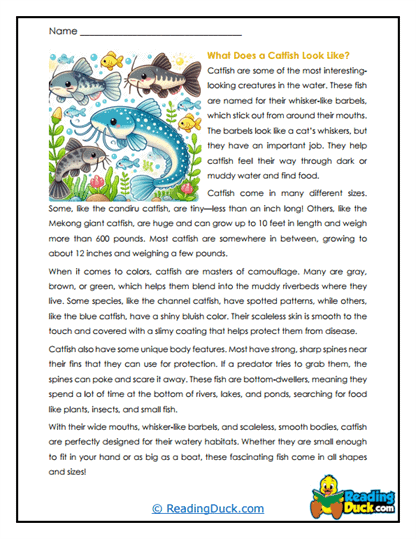
Bottom Features
Students take a closer look at the distinctive physical characteristics of catfish. They learn about barbels, wide mouths, smooth skin, protective slime coatings, sharp spines, and camouflage while exploring how these features support survival. This worksheet strengthens descriptive comprehension by connecting body structures with their functions. Readers discover why the catfish's unusual appearance is so well suited to its environment.
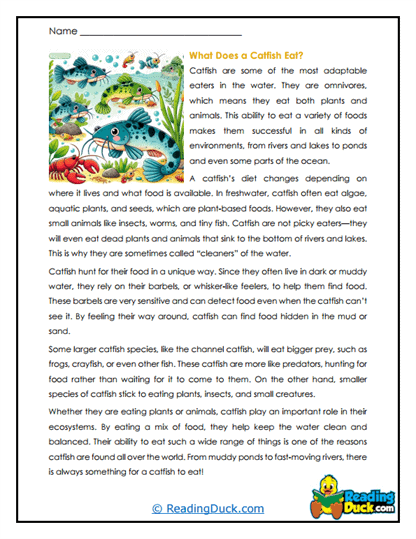
Bottom Feeders
Students investigate the varied diet of catfish and how these fish locate food. They learn how catfish eat plants, insects, worms, crustaceans, small fish, and other available foods while using sensitive barbels to search in dark or muddy water. This worksheet strengthens cause-and-effect thinking by connecting feeding adaptations with survival. Readers also discover how body size and habitat can influence what a catfish eats.
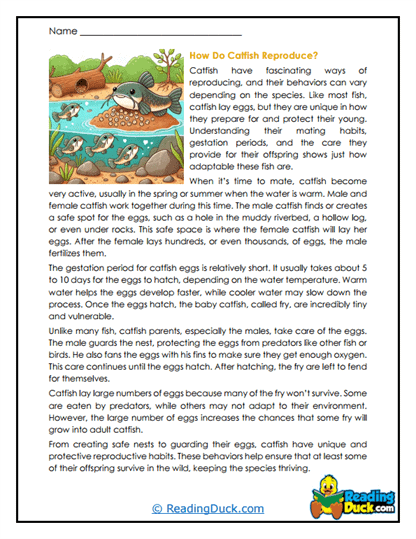
Egg Guardians
Students explore the reproductive process of catfish and the parental behaviors found in some species. They follow nest building, egg laying, guarding, hatching, and early development while learning why protecting eggs can improve survival. This worksheet provides strong practice with sequencing and process-based comprehension. Readers also build useful science vocabulary related to reproduction and animal development.
Growing Catfish
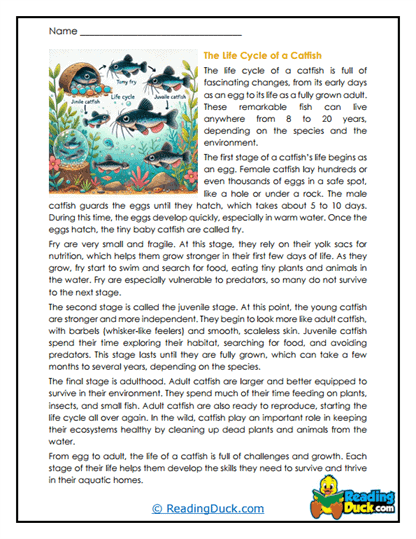
Students follow the catfish life cycle from tiny eggs to fully grown adults. They learn how fry initially depend on their yolk sacs before becoming stronger swimmers and more independent feeders. This worksheet strengthens chronological thinking by helping readers identify the important changes that occur during each life stage. Students gain a clearer understanding of how an animal's needs and abilities change as it matures.
Muddy Homes
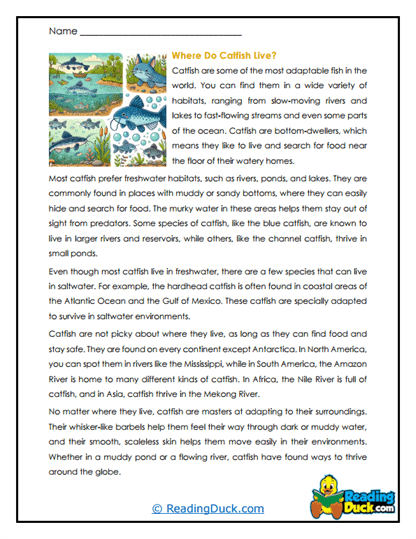
Students explore the wide variety of aquatic habitats where catfish can survive. They learn about rivers, ponds, lakes, reservoirs, muddy bottoms, and even some brackish and saltwater environments while examining examples from major river systems around the world. This worksheet strengthens comparison skills by connecting habitat conditions with animal adaptations. Readers see why specialized senses and bottom-dwelling behaviors are so useful in murky water.
Night Routines
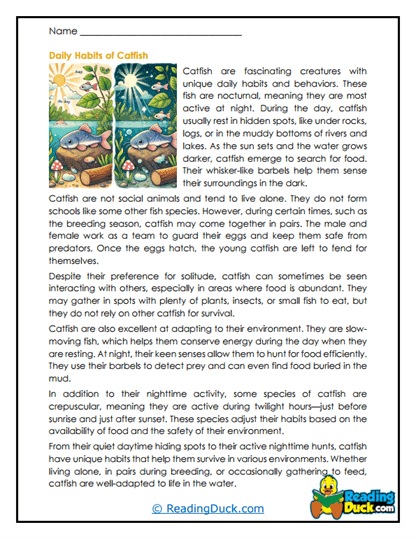
Students investigate the daily habits of catfish and why many species are especially active after dark. They learn how catfish rest during the day, search for food at night, and use their specialized senses when visibility is poor. This worksheet strengthens sequencing and pattern-recognition skills while connecting behavior with environmental conditions. Readers also discover how routines can vary between different catfish species.
River Threats
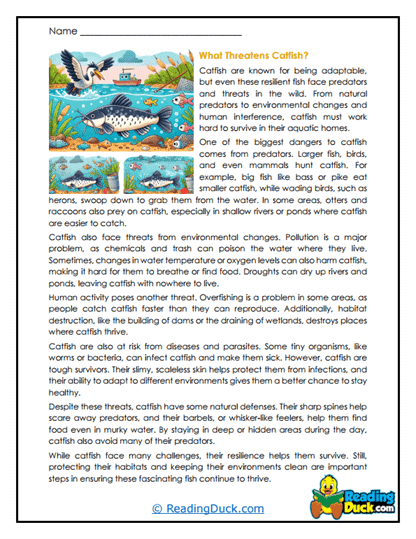
Students examine the natural and human-related challenges catfish face in the wild. They learn about predators, parasites, disease, pollution, habitat destruction, drought, changing water conditions, and overfishing. This worksheet develops problem-and-solution comprehension while introducing important conservation concepts. Readers discover why even adaptable animals depend on clean water and healthy habitats.
Smooth Swimmers
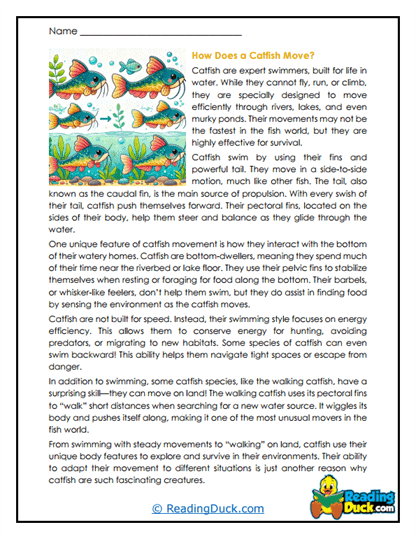
Students learn how catfish use their tails, fins, and barbels to move and navigate through aquatic environments. They explore how different body parts support propulsion, steering, balance, and movement near the bottom. This worksheet strengthens comprehension by connecting anatomy with function. Readers also discover that some catfish species have unusual ways of moving beyond ordinary swimming.
Underwater Signals
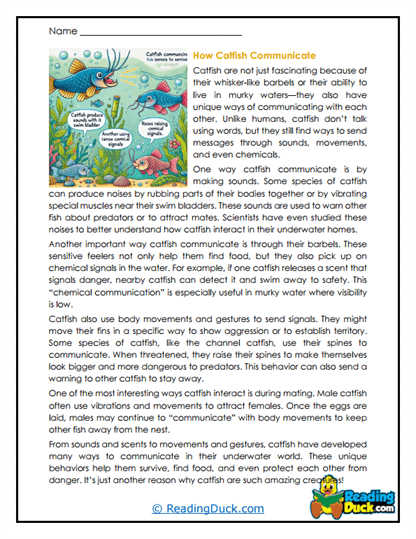
Students discover how catfish communicate in environments where sight may not always be reliable. They learn about sounds, vibrations, body movements, chemical signals, and sensory information used during territorial encounters and mating. This worksheet strengthens inference skills by encouraging readers to connect different signals with their possible meanings. Students see how an animal's environment can shape the way it communicates.
Waterway Cleaners
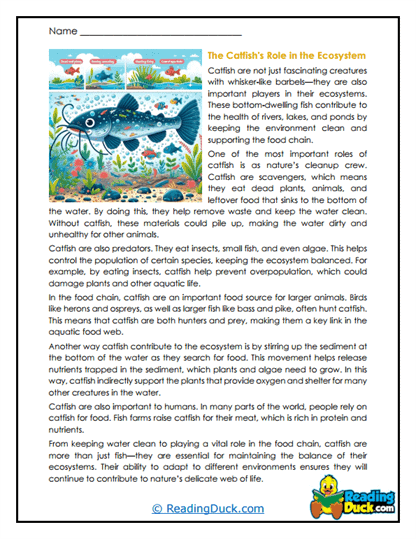
Students investigate the role catfish play in freshwater ecosystems. They learn how feeding on insects, fish, plants, and organic material can help recycle nutrients while connecting catfish to larger aquatic food webs. This worksheet develops systems thinking and cause-and-effect comprehension. Readers discover why bottom-dwelling animals can have an important influence on the ecosystems around them.
Whiskered Wonders
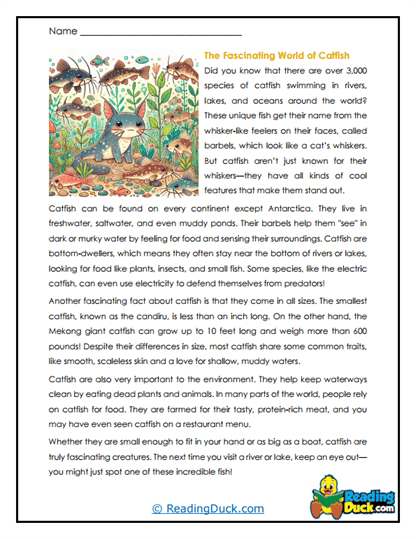
Students are introduced to the diverse world of catfish and the adaptations that make these fish so successful. They explore barbels, bottom-dwelling behaviors, habitats, feeding strategies, defensive features, and the roles catfish play in ecosystems and human communities. This worksheet provides useful background knowledge for the rest of the collection. Readers practice identifying main ideas and organizing supporting details from a broad informational passage.
A Better Look At Catfish
Catfish are much more than bottom-dwelling fish with whisker-like barbels. Their specialized senses, varied diets, protective features, reproductive behaviors, and ability to survive in many aquatic environments make them fascinating examples of animal adaptation. Catfish are also connected to larger food webs as both consumers and prey, helping shape the ecosystems where they live. Studying these fish helps students understand how an animal's body, behavior, habitat, and ecological role work together.
Reading about catfish also helps students become stronger readers and scientific thinkers. They practice following life cycles and processes, comparing habitats and ecological relationships, making inferences about animal communication, and connecting physical structures with their functions. These skills support learning across reading and life science while encouraging children to think more carefully about freshwater environments. With every passage, students gain confidence while discovering the fascinating lives of one of the world's most diverse groups of fish.
Make sure to bookmark our website now.
Enjoy all our free reading worksheets.
Our materials adhere to the principles of the Science of Reading.