Bass are powerful freshwater fish known for their strong bodies, quick movements, and impressive hunting skills. Different species, including largemouth, smallmouth, and striped bass, can be found in a variety of aquatic environments where they search for food, defend territory, and reproduce. These worksheets introduce students to bass habitats, diets, behaviors, life cycles, physical adaptations, and ecological relationships. Along the way, children discover how these familiar fish survive and contribute to the balance of freshwater ecosystems.
Our Bass Reading Comprehension Worksheets help students strengthen nonfiction reading skills while exploring engaging life science concepts. As they read, students practice identifying main ideas, finding supporting details, following sequences, comparing information, and recognizing cause-and-effect relationships. The passages also encourage readers to connect physical traits and behaviors with the needs of an animal living in lakes, rivers, and ponds. These skills build reading confidence while expanding science vocabulary and knowledge about freshwater wildlife.
Learning about bass gives children an opportunity to explore how predators fit into larger aquatic communities. Students discover how these fish hunt, communicate, reproduce, grow, avoid danger, and interact with other organisms. They also learn why clean water and healthy freshwater habitats are important for maintaining stable bass populations. We hope these worksheets encourage scientific curiosity and help students appreciate the complex relationships found beneath the surface of freshwater environments.
Meet the Worksheets
Built for Power
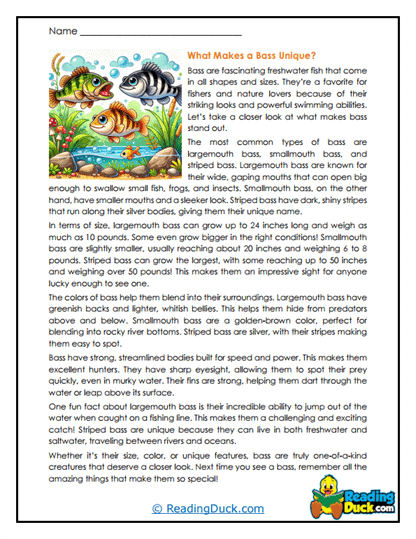
Students take a closer look at the physical traits that make bass effective swimmers and hunters. They compare largemouth, smallmouth, and striped bass while learning how body shape, mouth size, fins, eyesight, and camouflage support survival. This worksheet strengthens descriptive comprehension by connecting physical structures with their functions. Readers discover why each adaptation matters in a bass's daily life.
Daily Routines
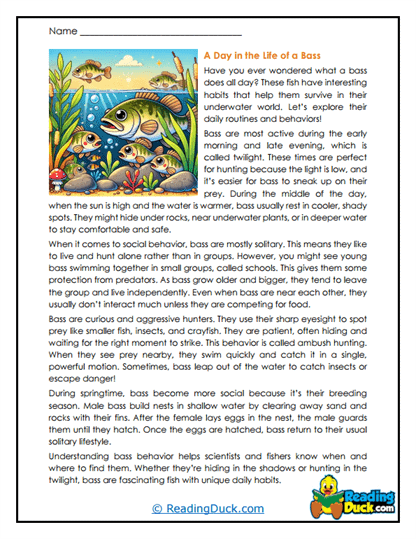
Students explore the everyday habits of bass and how their activity changes throughout the day and across seasons. They learn when bass are most likely to hunt, where they rest, and how behavior can change during the breeding season. This worksheet strengthens sequencing and pattern-recognition skills. Readers also compare the behaviors of younger bass with those of more solitary adults.
Ecosystem Balance
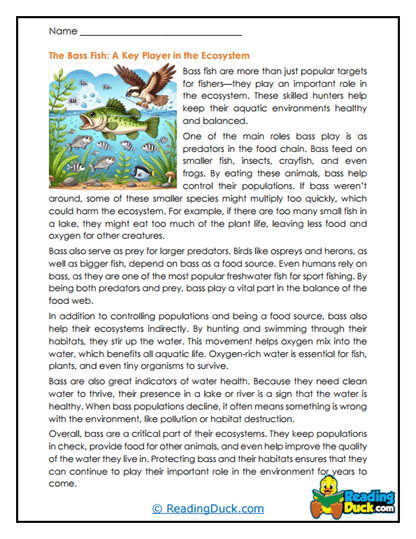
Students discover the important role bass play within freshwater ecosystems. They learn how bass control populations of smaller animals while also serving as prey for larger fish and birds. This worksheet develops cause-and-effect thinking through clear food-chain connections. Readers see how changes in one species can influence many other parts of an ecosystem.
Freshwater Fighters
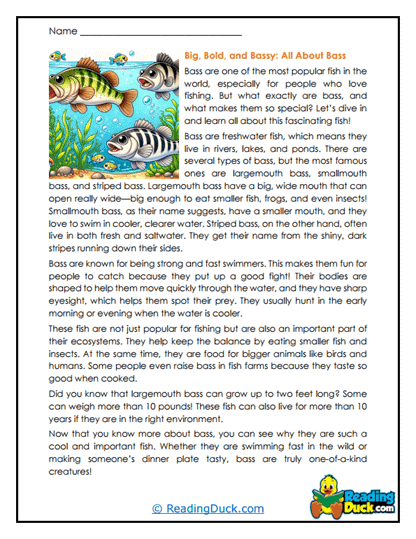
Students are introduced to largemouth, smallmouth, and striped bass while exploring what makes these fish successful predators. They learn about bass habitats, diets, physical adaptations, and their role within freshwater food webs. This worksheet provides a strong foundation for the more focused readings in the collection. Readers practice identifying main ideas and supporting details while building useful science vocabulary.
Growing Fry
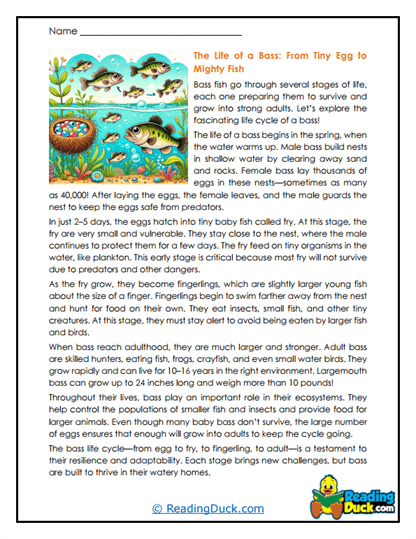
Students follow the bass life cycle from eggs through fry, fingerlings, juveniles, and adulthood. They learn how young bass become more independent as their swimming abilities, diets, and hunting skills develop. This worksheet strengthens sequencing and process-based comprehension. Readers discover how the needs and behaviors of bass change as they grow.
Hungry Hunters
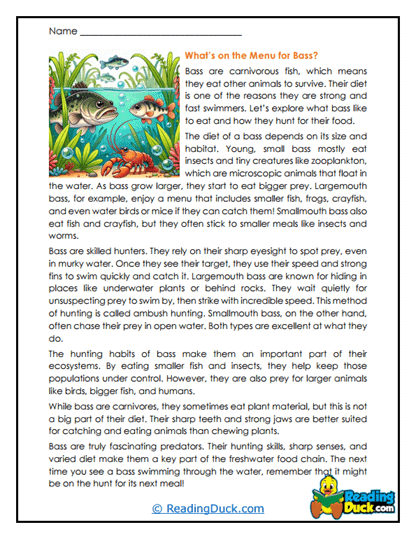
Students investigate what bass eat and how their diets change throughout their lives. They learn how young bass feed on smaller organisms while larger fish hunt prey such as fish, crayfish, and frogs. This worksheet strengthens cause-and-effect thinking by connecting feeding habits with hunting adaptations. Readers also discover how bass help keep prey populations in balance.
Nest Guardians
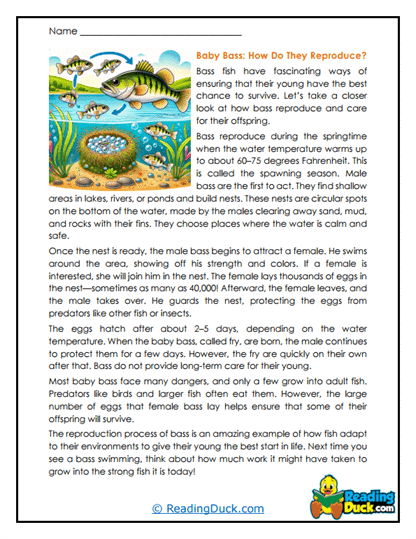
Students explore the reproductive behaviors that help bass produce the next generation. They learn how males build nests, females lay eggs, and males remain behind to protect the eggs and newly hatched fry. This worksheet develops sequencing skills while introducing reproduction vocabulary in context. Readers discover why nest protection can improve the survival chances of young bass.
Powerful Swimmers
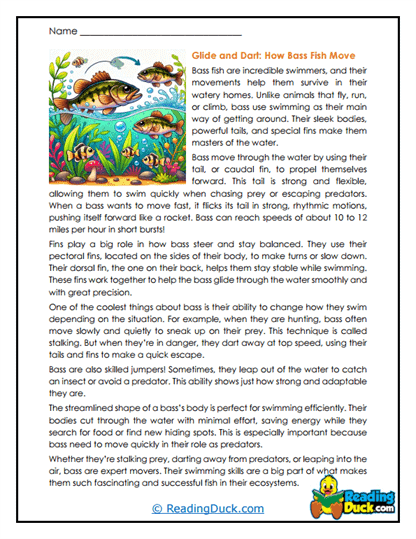
Students investigate how bass use their streamlined bodies, strong muscles, and specialized fins to move through the water. They learn how different fins contribute to forward motion, balance, steering, and sudden bursts of speed. This worksheet strengthens comprehension by connecting anatomy with movement. Readers see how controlled swimming helps bass both hunt and escape danger.
Silent Messages
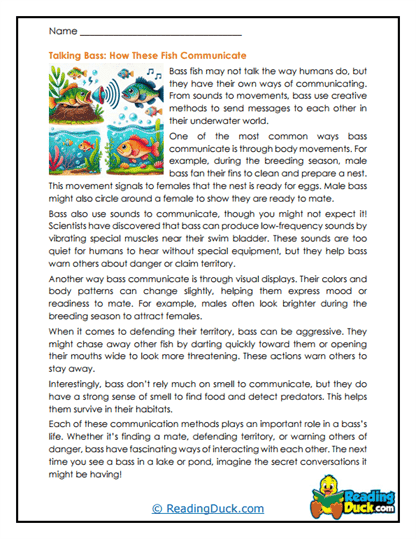
Students discover how bass communicate through movement, body position, color changes, and low-frequency sounds. They learn how these signals can be used during mating, territorial encounters, and interactions with other fish. This worksheet develops inference skills by encouraging readers to connect behaviors with their meanings. Students discover that animal communication can happen in many different ways.
Underwater Connections
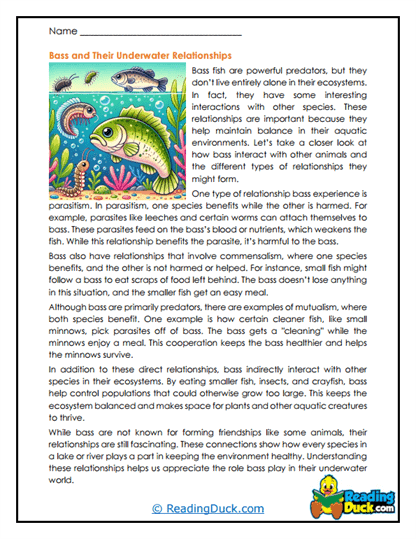
Students explore the ecological relationships bass have with other organisms in freshwater environments. They learn about parasitism, commensalism, and other interactions involving parasites, smaller fish, and cleaner species. This worksheet develops comparison and classification skills through concrete examples. Readers gain a broader understanding of how bass are connected to freshwater food webs.
Watery Homes
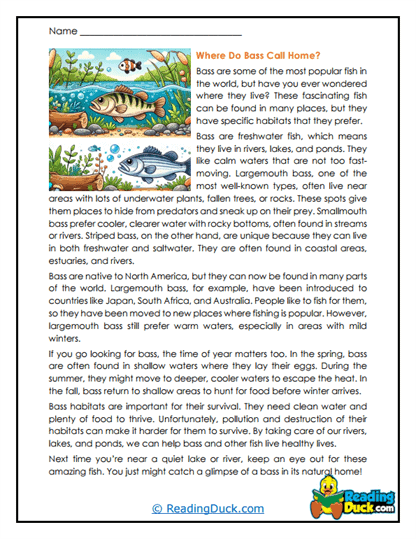
Students compare the different habitats used by largemouth, smallmouth, and striped bass. They learn how temperature, water clarity, vegetation, spawning needs, and seasonal changes can influence where each species lives. This worksheet strengthens comparison and cause-and-effect comprehension. Readers also discover why healthy aquatic habitats are essential for bass populations.
Wild Challenges
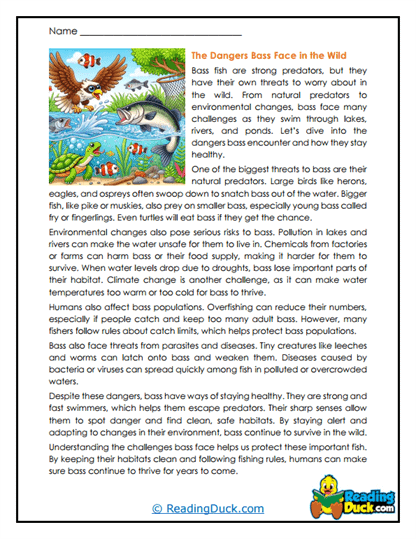
Students examine the natural and human-related threats bass face in the wild. They learn about predators, disease, parasites, pollution, habitat damage, changing water temperatures, and overfishing. This worksheet strengthens problem-and-solution thinking while introducing conservation concepts. Readers discover how clean water, healthy habitats, and responsible management can support bass populations.
A Better Look At Bass
Bass are more than popular freshwater fish and skilled predators. Their strong bodies, changing diets, reproductive behaviors, daily routines, and interactions with other organisms all help them survive in lakes, rivers, ponds, and other aquatic environments. As predators and prey, bass also influence food webs and help shape the balance of the ecosystems around them. Studying these fish gives students a useful example of how an animal's adaptations, behaviors, and habitat are closely connected.
Reading about bass also helps students become stronger readers and scientific thinkers. They practice following life cycles, comparing species, recognizing ecological relationships, building science vocabulary, and connecting physical features with their functions. These skills support learning across reading and life science while encouraging students to think more deeply about freshwater environments. With every passage, children gain confidence while discovering how even a familiar fish can reveal fascinating lessons about life underwater.
Make sure to bookmark our website now.
Enjoy all our free reading worksheets.
Our materials adhere to the principles of the Science of Reading.