About Our Barracuda Reading Comprehension Worksheets
Barracudas are powerful ocean predators known for their long bodies, sharp teeth, and impressive bursts of speed. These fascinating fish live in warm marine environments where their keen eyesight and carefully controlled movements help them locate and capture prey. These worksheets introduce students to barracuda habitats, diets, behaviors, life cycles, adaptations, and relationships with other ocean organisms. Along the way, children discover that barracudas are more than skilled hunters-they are also important members of healthy marine ecosystems.
Our Barracuda Reading Comprehension Worksheets help students strengthen nonfiction reading skills while exploring engaging life science concepts. As they read, students practice identifying main ideas, finding supporting details, following sequences, comparing information, and recognizing cause-and-effect relationships. The passages also encourage students to connect physical adaptations and behaviors with survival in the ocean. These skills build reading confidence while expanding science vocabulary and knowledge about marine life.
Learning about barracudas gives children an opportunity to look more closely at how predators fit into larger ecosystems. Students discover how these fish hunt, reproduce, communicate, avoid danger, and interact with other species. They also learn why healthy coral reefs, mangroves, seagrass beds, and coastal waters are important throughout a barracuda's life. We hope these worksheets encourage scientific curiosity and a greater appreciation for the complex connections found beneath the ocean's surface.
Meet the Worksheets
Built to Hunt
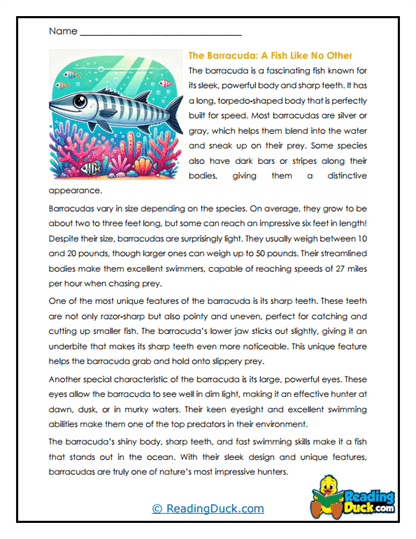
Students take a closer look at the physical features that make barracudas successful predators. They learn how streamlined bodies, powerful jaws, sharp teeth, large eyes, and silvery coloring support hunting and survival. This worksheet strengthens comprehension by connecting body structures with their functions. Readers discover how each adaptation helps a barracuda succeed in its ocean environment.
Daily Patrols
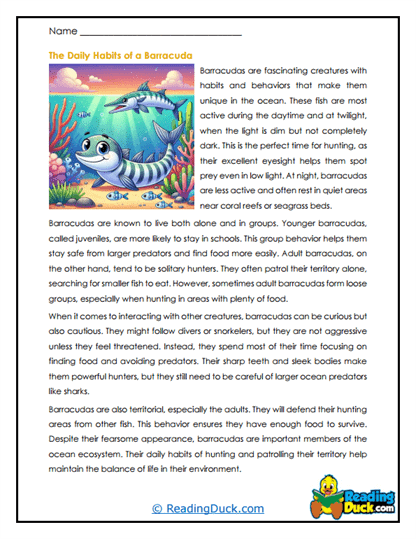
Students explore the daily habits of barracudas and how their behavior changes with age. They learn how these fish hunt, rest, patrol territories, and remain alert to predators and prey. This worksheet strengthens sequencing and comparison skills by examining the routines of younger and adult barracudas. Readers see how behavior can change as an animal grows.
Food Web Balance
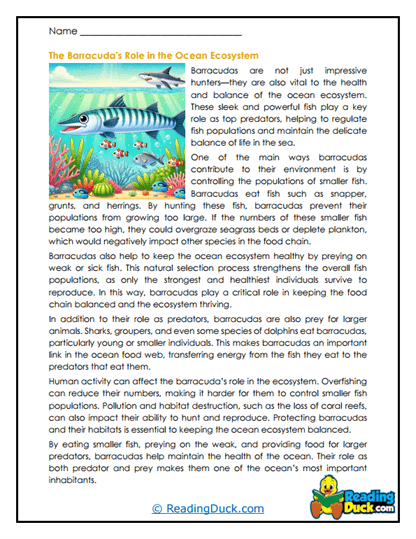
Students discover the important role barracudas play within marine food webs. They learn how these predators help control smaller fish populations while also becoming prey for larger animals. This worksheet develops cause-and-effect thinking by showing how changes in one population can affect an entire ecosystem. Readers gain a clearer understanding of why predators are important for ocean balance.
Growing Hunters
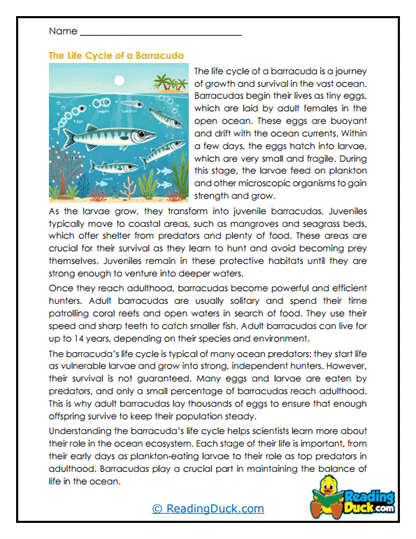
Students follow the barracuda life cycle from tiny eggs to powerful adults. They learn how larvae develop into juveniles, why young fish depend on protected coastal habitats, and how adults eventually move into deeper waters. This worksheet strengthens sequencing and process-based comprehension. Readers discover how a barracuda's needs and abilities change throughout its life.
Ocean Speedsters
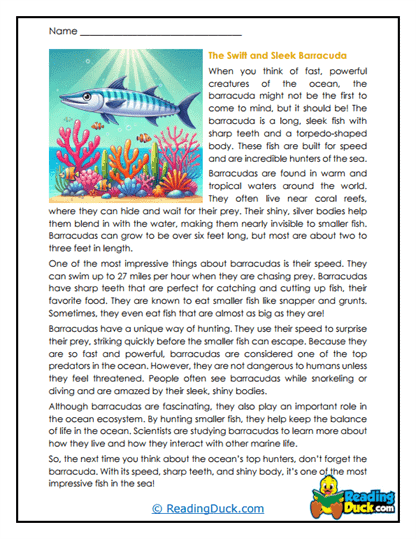
Students are introduced to the fascinating world of barracudas and the adaptations that make them successful hunters. They explore where these fish live, what they eat, how they catch prey, and why they matter within marine food webs. This worksheet builds a strong foundation for the rest of the collection. Readers practice identifying important details while learning how speed, camouflage, and body shape support survival.
Ocean Threats
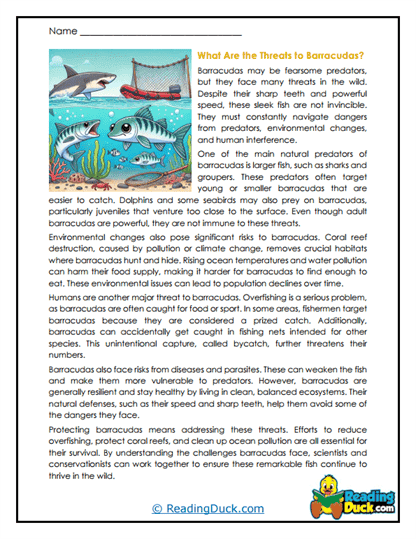
Students examine the natural and human-related challenges barracudas face. They learn about predators, parasites, pollution, overfishing, habitat destruction, and changing ocean conditions. This worksheet develops problem-and-solution reading skills while introducing important conservation concepts. Readers discover that even powerful predators depend on healthy environments for survival.
Precision Swimming
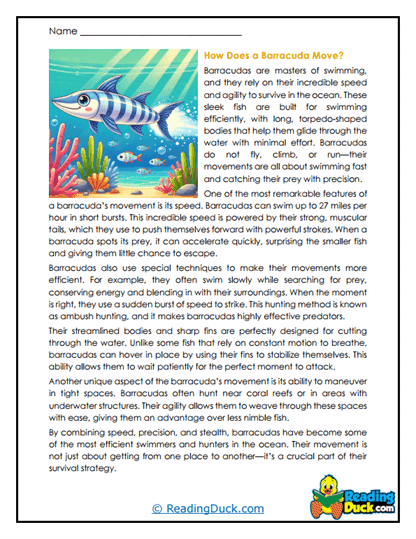
Students investigate how barracudas combine speed with remarkable control in the water. They learn how streamlined bodies, powerful tails, and carefully controlled fins allow these fish to accelerate, hover, and turn sharply. This worksheet strengthens descriptive comprehension by connecting anatomy with movement. Readers see why successful hunting requires more than simply swimming fast.
Predator Menu
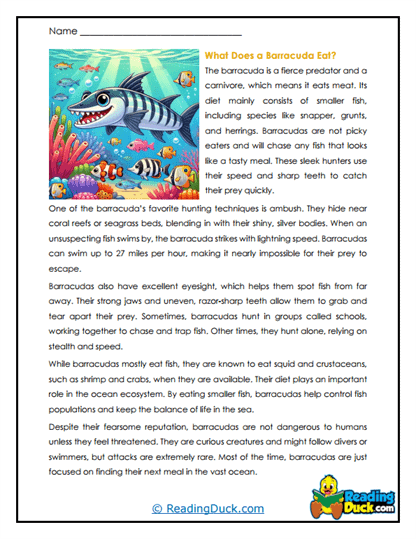
Students explore what barracudas eat and the different strategies they use to capture prey. They learn how sharp eyesight, strong jaws, speed, and ambush tactics help barracudas hunt fish, squid, and crustaceans. This worksheet strengthens cause-and-effect thinking while connecting diet with physical adaptations. Readers also discover that barracudas may hunt alone or sometimes in loose groups.
Silent Signals
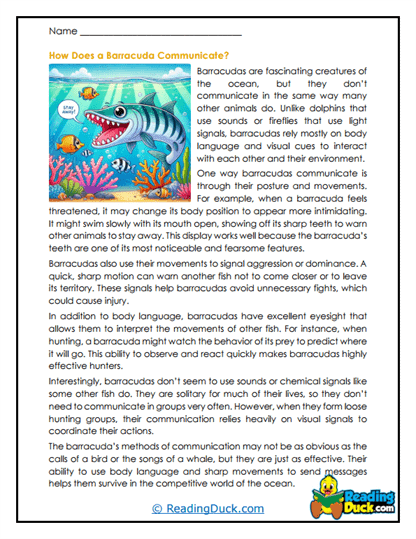
Students discover how barracudas communicate using visual signals and body language. They learn how body position, sudden movements, and other behaviors can help defend territory or send messages to nearby fish. This worksheet strengthens inference skills by asking readers to connect actions with their meanings. Students discover that communication does not always require sound.
Spawning Strategy
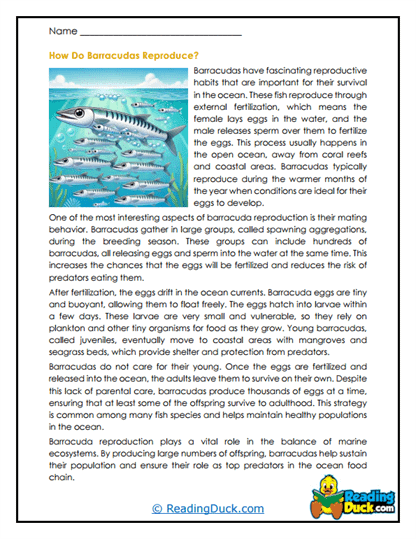
Students learn how barracudas reproduce through spawning and external fertilization. They follow the process from the release of eggs through hatching and the earliest stages of development. This worksheet strengthens sequencing and cause-and-effect skills while introducing reproduction vocabulary. Readers discover why producing large numbers of eggs can improve a species' chances of survival.
Tropical Hideaways
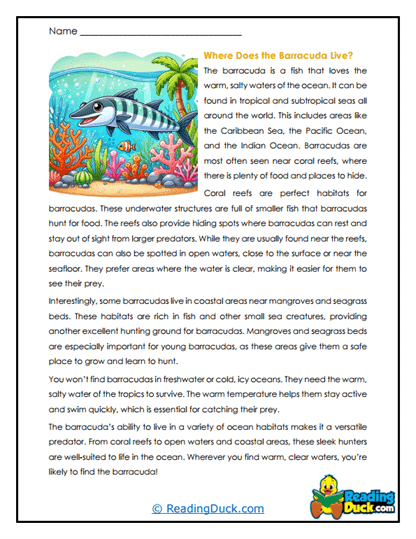
Students explore the warm coastal habitats where barracudas live and grow. They learn how coral reefs, mangroves, seagrass beds, and clear coastal waters provide food, shelter, and places to hunt. This worksheet strengthens comprehension by connecting habitat features with an animal's needs. Readers gain a better understanding of why protecting marine habitats is important for barracuda populations.
Underwater Connections
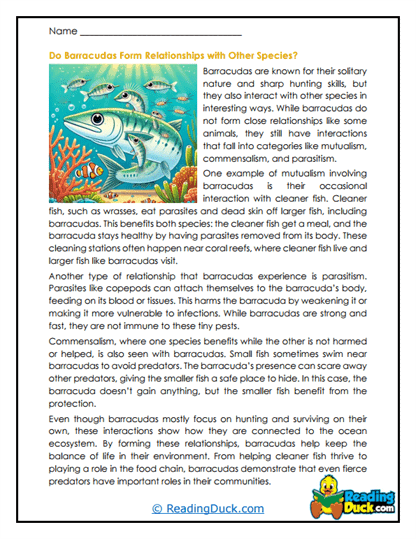
Students investigate the relationships barracudas have with other ocean organisms. They explore mutualism, parasitism, and commensalism through examples involving cleaner fish, parasites, and other marine species. This worksheet develops comparison and classification skills while building ecology vocabulary. Readers discover that even a powerful predator is connected to a much larger community of living things.
A Better Look At Barracudas
Barracudas are much more than fast fish with sharp teeth. Their specialized bodies, precise movements, hunting strategies, life cycles, and interactions with other organisms all help them survive in complex marine environments. They also contribute to healthy food webs by influencing populations of smaller fish while providing food for larger predators. Studying barracudas helps students understand how predators are connected to the overall health and balance of ocean ecosystems.
Reading about barracudas also helps students become stronger readers and scientific thinkers. They practice following life cycles, comparing behaviors, recognizing ecological relationships, building science vocabulary, and connecting physical features with their functions. These skills support learning across reading and life science while encouraging children to think more deeply about how animals survive. With every passage, students gain confidence while discovering the remarkable connections that shape life in the ocean.
Make sure to bookmark our website now.
Enjoy all our free reading worksheets.
Our materials adhere to the principles of the Science of Reading.