About Our Betta Fish Reading Comprehension Worksheets
Betta fish are small freshwater fish known for their brilliant colors, flowing fins, and fascinating behaviors. Native to the warm, shallow waters of Southeast Asia, these fish have special adaptations that help them survive in environments where oxygen levels can sometimes be low. These worksheets introduce students to betta fish habitats, diets, physical features, daily routines, reproduction, life cycles, and relationships with other organisms. Along the way, children discover that there is much more to these popular aquarium fish than their colorful appearance.
Our Betta Fish Reading Comprehension Worksheets help students strengthen nonfiction reading skills while exploring engaging life science concepts. As they read, students practice identifying main ideas, finding supporting details, following sequences, comparing information, and recognizing cause-and-effect relationships. The passages also encourage readers to connect physical adaptations and behaviors with survival needs. These skills build reading confidence while expanding science vocabulary and helping students understand how animals interact with their environments.
Learning about betta fish gives children an opportunity to explore both wild animal behavior and the needs of animals kept in human care. Students discover how bettas hunt, communicate, reproduce, grow, avoid danger, and move through the water. They also learn why healthy habitats and appropriate care are important to an animal's well-being. We hope these worksheets encourage careful observation, scientific curiosity, and a greater appreciation for the remarkable lives of freshwater fish.
Meet the Worksheets
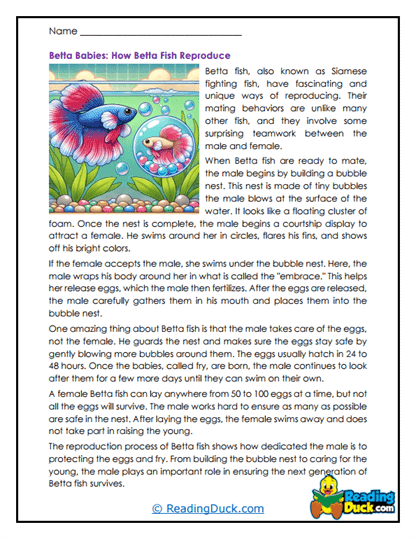
Bubble Babies
Students explore the unusual reproductive process of betta fish, beginning with the male's bubble nest. They follow courtship, fertilization, egg placement, protection, and hatching while learning how the male cares for the developing young. This worksheet provides strong practice with sequencing and process-based comprehension. Readers discover how several behaviors work together to give young bettas a better chance of survival.
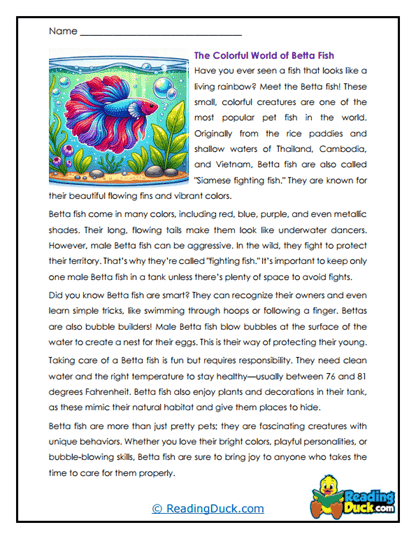
Colorful Fighters
Students are introduced to betta fish and the traits that make them so interesting. They explore the fish's Southeast Asian origins, colorful appearance, territorial behavior, bubble nests, and basic environmental needs. This worksheet provides useful background knowledge for the rest of the collection. Readers practice gathering important details from several different parts of an informational passage.
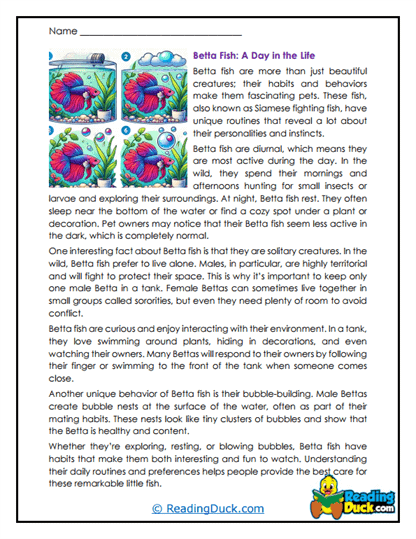
Daily Rhythms
Students investigate the daily routines and behaviors of betta fish. They learn about daytime activity, nighttime rest, territorial instincts, curiosity, solitary living, and bubble-nest building. This worksheet strengthens sequencing and pattern-recognition skills by helping readers organize behaviors according to time and purpose. Students also discover how an animal's environment can influence its routine.
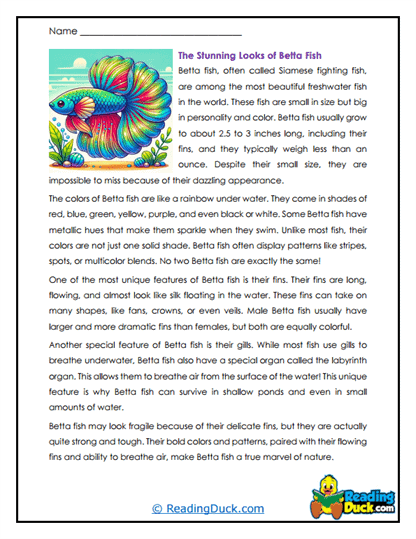
Flowing Colors
Students take a closer look at the spectacular physical characteristics of betta fish. They explore colorful patterns, different fin shapes, differences between males and females, and the special labyrinth organ that allows bettas to breathe air at the surface. This worksheet strengthens comparison skills while connecting physical structures with their functions. Readers discover how an animal can be both beautiful and highly adapted to its habitat.
Graceful Gliders
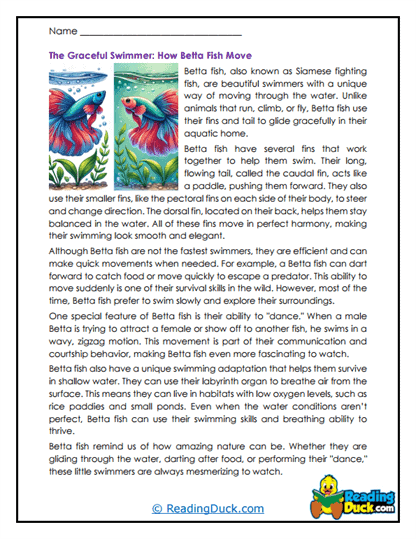
Students discover how different fins work together to help betta fish move with impressive control. They learn how fins provide propulsion, steering, balance, and precise movements used for hunting and courtship. This worksheet develops descriptive comprehension by connecting anatomy with movement. Readers see how the betta's swimming abilities suit its shallow, plant-filled natural habitat.
Growing Fry
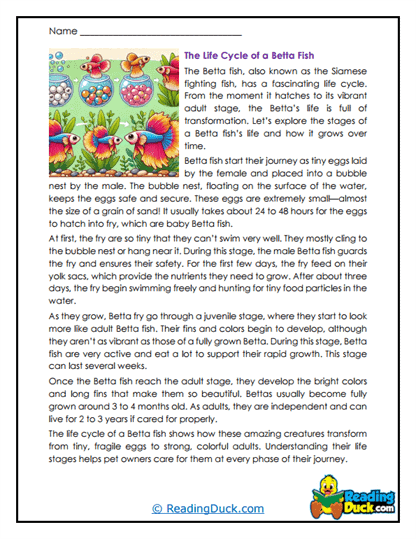
Students follow the betta fish life cycle from eggs to colorful adults. They learn how newly hatched fry depend on their yolk sacs before beginning to swim and feed independently, and how juveniles gradually develop stronger fins and brighter colors. This worksheet strengthens chronological thinking and summarizing skills. Readers gain a clear understanding of the major stages of betta development.
Living Connections
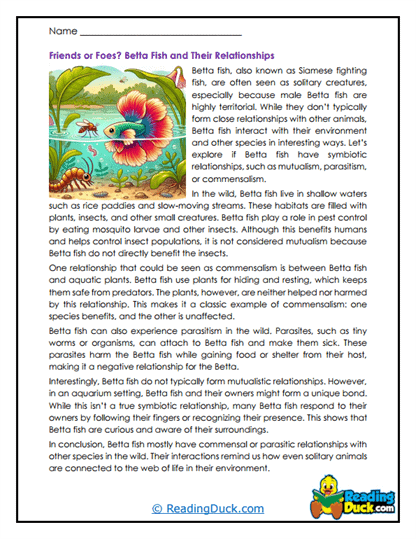
Students explore how betta fish interact with plants, insects, parasites, and people. They learn about ecological relationships such as commensalism and parasitism while considering how different organisms may benefit, be harmed, or remain unaffected. This worksheet develops classification and comparison skills. Readers discover that even solitary animals remain connected to a larger web of life.
Pond Helpers
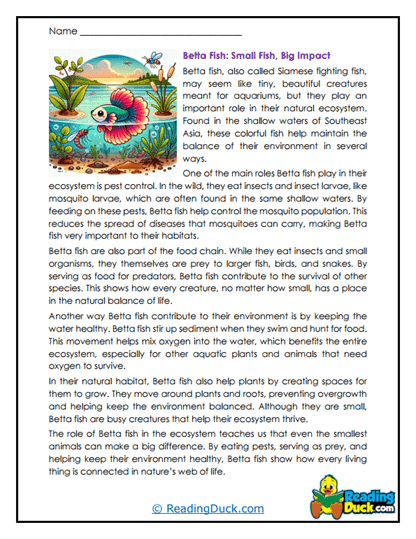
Students investigate the role betta fish play within freshwater ecosystems. They learn how bettas feed on insects and mosquito larvae while also becoming prey for larger animals. This worksheet strengthens systems thinking by connecting one small fish with a larger food web. Readers discover that an animal does not need to be large to influence its ecosystem.
Shallow Waters
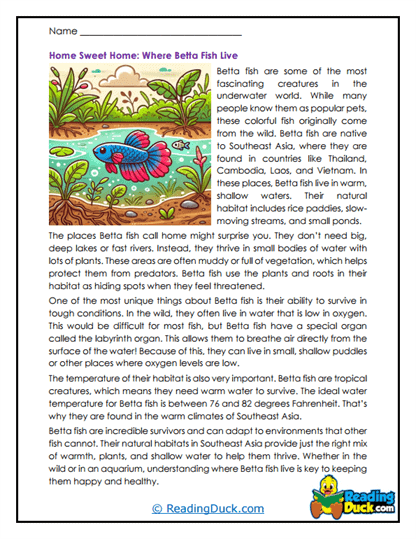
Students travel to the warm, shallow freshwater habitats where wild bettas naturally live. They explore rice paddies, ponds, slow-moving streams, vegetation, and low-oxygen water while learning how the labyrinth organ helps bettas survive. This worksheet strengthens comprehension by connecting habitat conditions with physical adaptations. Readers see why an animal's environment is closely tied to the features it develops.
Silent Signals
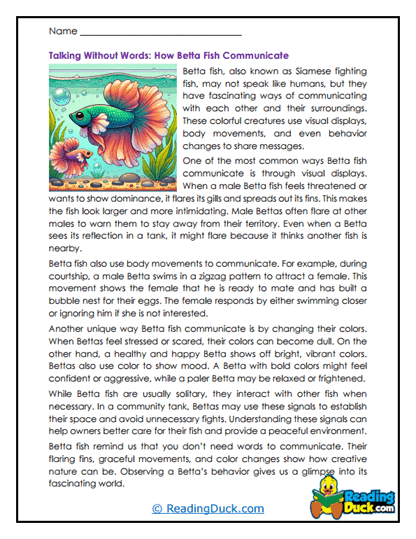
Students discover how betta fish communicate through colors, movements, body positions, and displays. They learn how flaring fins and gills, swimming patterns, and color changes can signal territorial warnings, courtship, stress, or confidence. This worksheet strengthens inference skills by asking readers to connect visible behaviors with possible meanings. Students learn that communication does not always require words or sounds.
Tiny Hunters
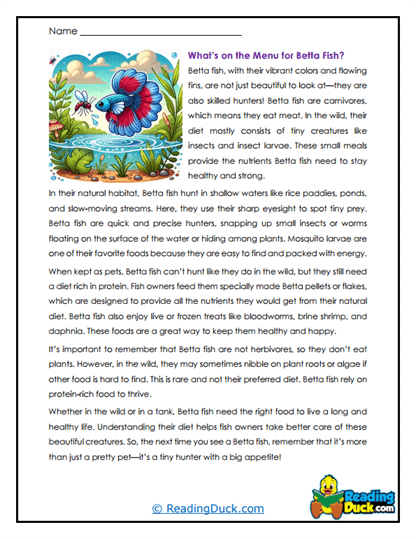
Students explore the carnivorous diet and hunting behavior of betta fish. They learn how wild bettas capture insects, larvae, and other small aquatic animals while comparing natural foods with foods commonly provided in captivity. This worksheet strengthens cause-and-effect thinking by connecting diet with health and survival. Readers also discover how eyesight and quick movements help these small predators catch their meals.
Water Dangers
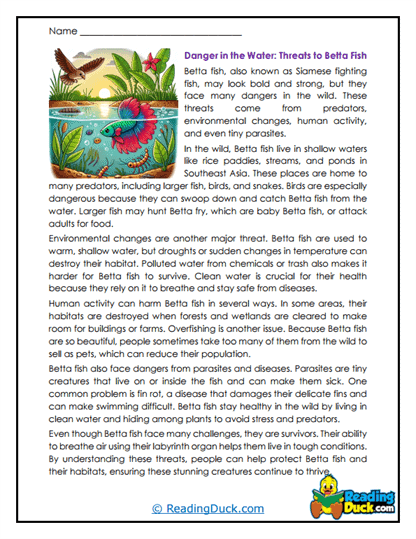
Students examine the natural and environmental challenges betta fish face. They learn about predators, parasites, disease, pollution, drought, habitat destruction, and changing water conditions while exploring ways bettas protect themselves. This worksheet develops problem-and-solution comprehension and environmental awareness. Readers discover why an animal's survival depends on both its adaptations and the health of its habitat.
A Better Look At Betta Fish
Betta fish are much more than colorful aquarium animals. Their labyrinth organs, territorial behaviors, specialized diets, bubble nests, communication signals, and carefully controlled movements all help them survive in challenging freshwater environments. Even though bettas often live solitary lives, they remain connected to plants, insects, predators, parasites, and other parts of their ecosystems. Studying these fish helps students understand how physical adaptations, behaviors, habitats, and ecological relationships work together.
Reading about betta fish also helps students become stronger readers and scientific thinkers. They practice following life cycles and processes, making inferences from animal behavior, comparing information, recognizing ecological relationships, and connecting body structures with their functions. These skills support learning across reading and life science while encouraging children to look more carefully at the animals around them. With every passage, students gain confidence while discovering the fascinating science behind one of the world's most recognizable freshwater fish.
Make sure to bookmark our website now.
Enjoy all our free reading worksheets.
Our materials adhere to the principles of the Science of Reading.