
What’s on the Menu?
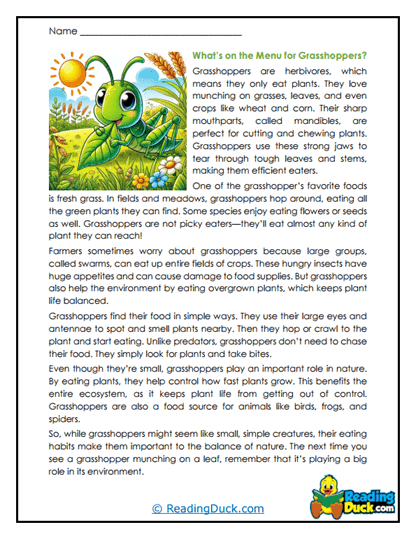
This passage teaches students about the eating habits of grasshoppers and explains why they are called herbivores. Readers learn that grasshoppers mostly eat grasses, leaves, crops, flowers, and seeds. The passage describes how their strong mouthparts help them chew tough plants and explains how their feeding habits can sometimes affect farms and gardens. Students also discover that grasshoppers play an important role in nature by helping control plant growth and by serving as food for many animals. The overall message helps children understand that even small insects have a big impact on the environment around them.
Reading passages like this help students develop strong informational reading skills while expanding their science vocabulary. Students learn to identify important details and understand how facts support a main idea. They also practice making connections between animals, habitats, and food chains. Exposure to academic words such as *herbivores*, *mandibles*, and *ecosystem* strengthens vocabulary and comprehension. These passages also encourage students to think critically about balance in nature while improving fluency and confidence with nonfiction text.
Questions:
Answer Keys: