
Spotted Beauties Open Response
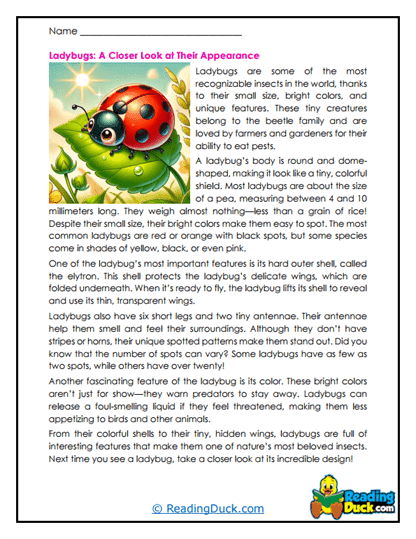
This passage gives students a detailed look at the appearance and body structure of ladybugs. Readers learn about the ladybug’s dome-shaped body, colorful shell, delicate wings, antennae, and tiny legs. The text explains how the hard outer shell protects the insect’s flying wings and how the bright colors help warn predators to stay away. Students also discover that ladybugs come in many colors and spot patterns, making each species unique. The passage highlights how every part of a ladybug’s body helps it survive and thrive in nature.
Reading passages about animal anatomy and adaptations helps students improve close-reading and observation skills. Students practice connecting body parts with their functions, which strengthens comprehension and analytical thinking. Rich descriptive language also builds vocabulary and supports stronger sentence understanding. Informational reading encourages children to explain ideas clearly and use evidence from the text to support their thinking. Over time, these reading experiences help students become more confident with nonfiction texts while encouraging curiosity and deeper learning.