About Our Goldfish Reading Comprehension Worksheets
Goldfish are familiar freshwater fish, but there is much more to them than their bright colors and popularity as pets. First kept in China more than 1,000 years ago, goldfish have developed into many varieties with different colors, body shapes, fins, and other distinctive features. These worksheets introduce students to goldfish habitats, diets, behaviors, reproduction, life cycles, communication, movement, and ecological relationships. Along the way, children discover that goldfish can learn routines, remember information, interact with other fish, and respond to changes in their surroundings.
Our Goldfish Reading Comprehension Worksheets help students strengthen nonfiction reading skills while exploring engaging life science concepts. As they read, students practice identifying main ideas, locating supporting details, following sequences, comparing information, making inferences, and recognizing cause-and-effect relationships. The passages also encourage readers to connect physical features and behaviors with an animal's needs and environment. These skills build reading confidence while expanding science vocabulary and knowledge about freshwater animals.
Learning about goldfish gives children an opportunity to look more closely at an animal they may already recognize. Students discover how goldfish find food, communicate, reproduce, grow, swim, avoid danger, and interact with other living things. They also learn why clean water, enough space, proper nutrition, and responsible care are important for keeping these fish healthy. We hope these worksheets encourage scientific curiosity and help students see that even familiar animals can have fascinating lives worth exploring.
Meet the Worksheets
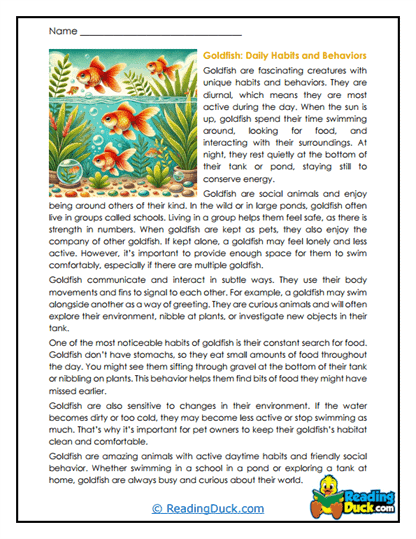
Daily Patterns
Students explore the routines and behaviors that shape a goldfish's day. They learn about swimming, searching for food, resting, interacting with other fish, and responding to changes in water temperature and other conditions. This worksheet strengthens sequencing and pattern-recognition skills by helping readers organize behaviors and notice what can cause them to change. Students also discover how an animal's behavior can provide clues about its health and environment.
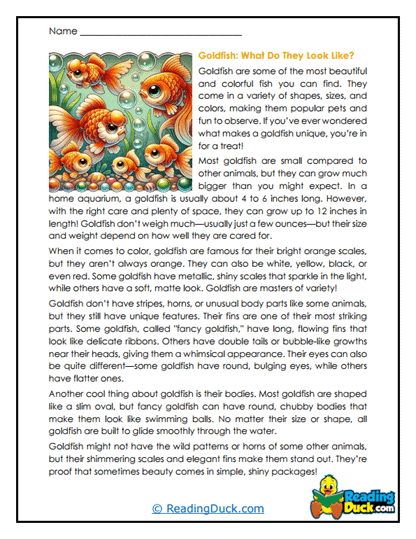
Fancy Features
Students take a closer look at the many colors, shapes, fins, scales, and body types found among goldfish. They compare ordinary goldfish with fancy varieties while discovering just how different members of the same species can appear. This worksheet strengthens descriptive comprehension and comparison skills. Readers practice organizing physical details while building vocabulary related to animal anatomy and variation.
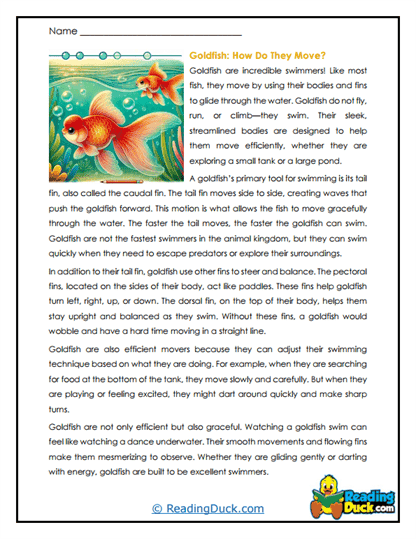
Fin Power
Students investigate how a goldfish's fins work together to create smooth, controlled movement. They learn how the tail provides forward motion while other fins contribute to steering, balance, turning, and control. This worksheet strengthens comprehension by connecting individual body parts with their functions. Readers discover how swimming abilities help goldfish search for food, explore their surroundings, and avoid danger.
Flexible Feeders
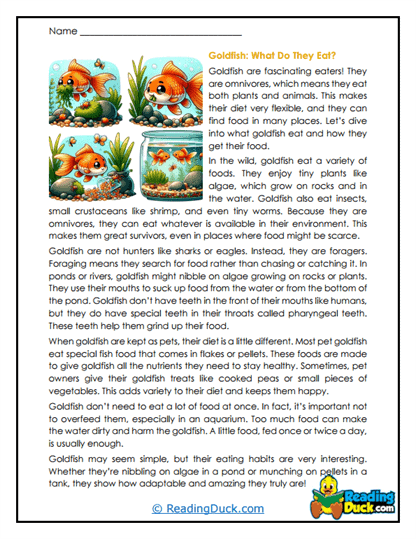
Students explore the varied diet of goldfish and learn why these fish are considered omnivores. They discover how wild goldfish eat algae, plants, insects, worms, crustaceans, and other small organisms while comparing these foods with the flakes and pellets commonly given to pets. This worksheet develops cause-and-effect thinking by connecting diet with health and water quality. Readers also see how an adaptable diet can help an animal survive in different environments.
Golden Companions
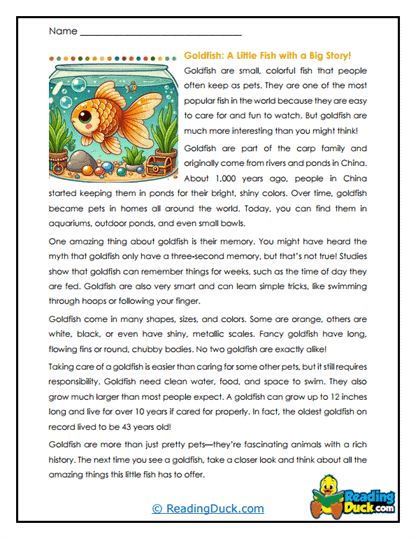
Students are introduced to goldfish through their long history, varied appearance, behaviors, and basic needs. They learn how goldfish became popular around the world while discovering that these fish can remember information, recognize routines, and learn simple behaviors. This worksheet strengthens main-idea and supporting-detail skills by bringing several areas of information together. Readers gain useful background knowledge for the more focused passages throughout the collection.
Growing Goldfish
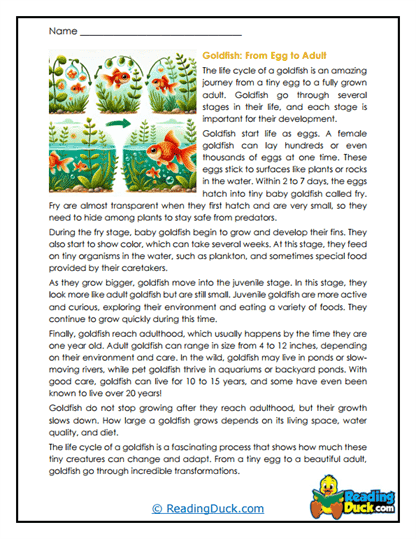
Students follow the goldfish life cycle from tiny eggs to mature adults. They learn how fry initially depend on yolk sacs before swimming and feeding independently and how juveniles gradually develop stronger bodies and more noticeable colors. This worksheet strengthens chronological thinking and summarizing skills. Readers discover how an animal's appearance, behavior, and needs change as it grows.
Hidden Threats
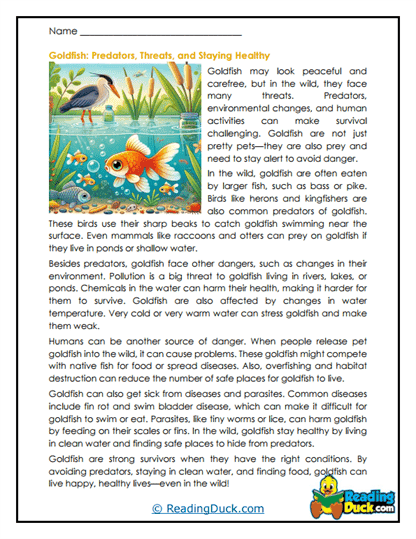
Students examine the dangers goldfish can face in both natural environments and human care. They learn about predators, parasites, disease, pollution, poor water quality, habitat damage, and unhealthy temperature or oxygen levels. This worksheet develops problem-and-solution and cause-and-effect comprehension. Readers discover why suitable habitats and responsible care are important for keeping goldfish healthy.
Pond Helpers
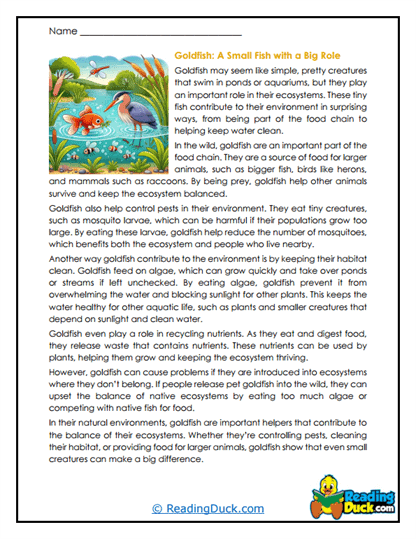
Students investigate the role goldfish can play within freshwater food webs. They learn how goldfish eat insects and other small organisms while also becoming prey for larger fish, birds, and mammals. This worksheet strengthens systems thinking by connecting feeding behaviors with larger environmental effects. Readers discover how even a familiar pond fish can influence other organisms living nearby.
Pond Homes
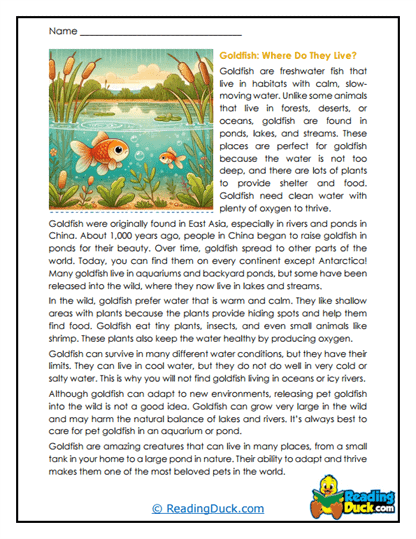
Students explore the freshwater environments where goldfish can live. They learn about ponds, lakes, slow-moving streams, aquatic plants, water quality, temperature, and the importance of having enough space. This worksheet strengthens comprehension by connecting habitat conditions with an animal's needs. Readers also learn why releasing pet goldfish into natural waterways can create problems for local ecosystems.
Silent Signals
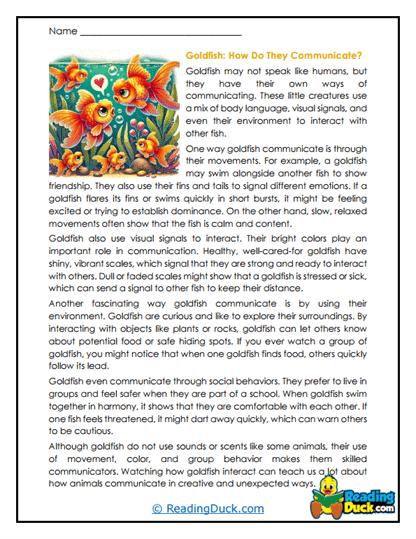
Students discover how goldfish communicate without relying on spoken sounds. They explore body movements, swimming patterns, fin positions, color changes, and group behaviors that may provide information about food, stress, territory, or excitement. This worksheet strengthens inference skills by asking readers to connect actions with possible meanings. Students learn that communication can happen in subtle ways throughout the animal world.
Spawning Season
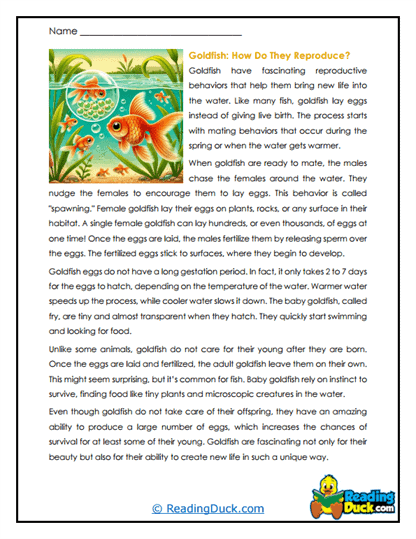
Students follow goldfish reproduction from courtship and spawning through fertilization and hatching. They learn how females can lay large numbers of sticky eggs and how newly hatched fry must quickly begin surviving without parental care. This worksheet provides strong practice with sequencing and process-based comprehension. Readers also discover why producing many eggs can help a species continue even when only some young survive.
Water Connections
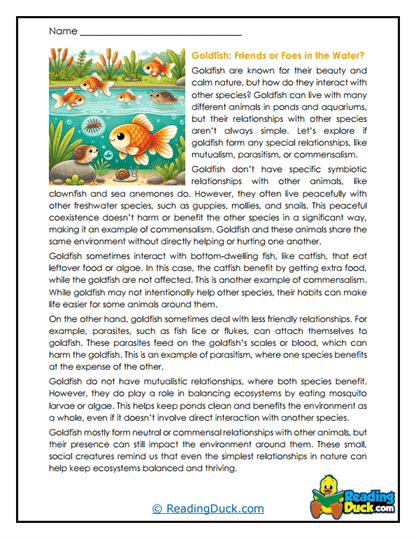
Students explore the different ways goldfish interact with organisms in freshwater environments. They learn about relationships involving parasites, aquatic plants, bottom-dwelling fish, insects, and other animals while examining concepts such as commensalism and parasitism. This worksheet strengthens comparison, classification, and reasoning skills. Readers discover that even peaceful fish are connected to a much larger network of living things.
A Better Look At Goldfish
Goldfish are much more complex than the simple pets they are sometimes thought to be. Their varied diets, social behaviors, swimming abilities, life cycles, physical differences, and responses to environmental conditions make them interesting animals to study. Goldfish are also connected to other organisms through freshwater food webs, and their health depends greatly on the quality of the environment around them. Studying these fish helps students understand how animal behavior, anatomy, habitat, and ecological relationships work together.
Reading about goldfish also helps students become stronger readers and scientific thinkers. They practice following processes, comparing physical traits, making inferences about animal behavior, recognizing ecological connections, and explaining how body structures perform specific jobs. These skills support learning across reading and life science while encouraging children to look more carefully at familiar animals. With every passage, students gain confidence while discovering that there is much more to goldfish than what they might see swimming inside an aquarium.
Make sure to bookmark our website now.
Enjoy all our free reading worksheets.
Our materials adhere to the principles of the Science of Reading.