About Our Clownfish Reading Comprehension Worksheets
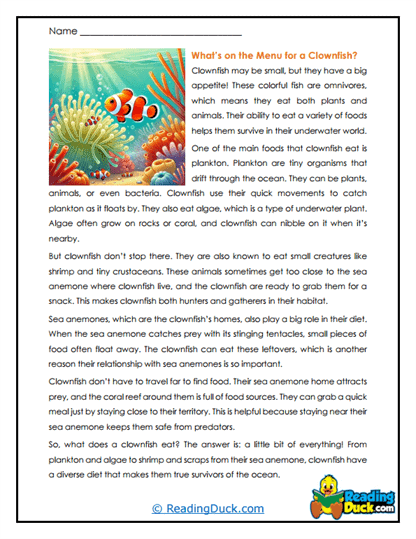
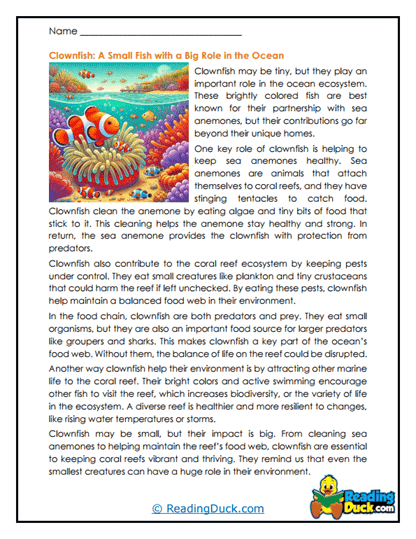
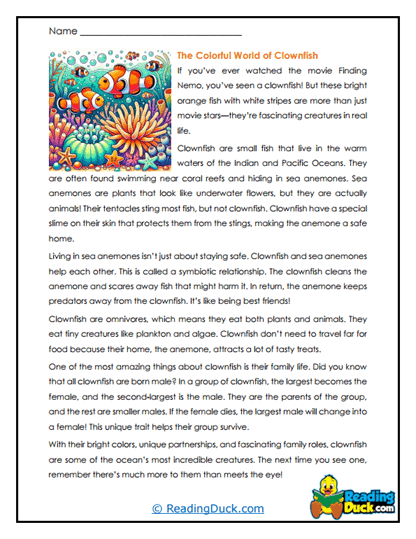
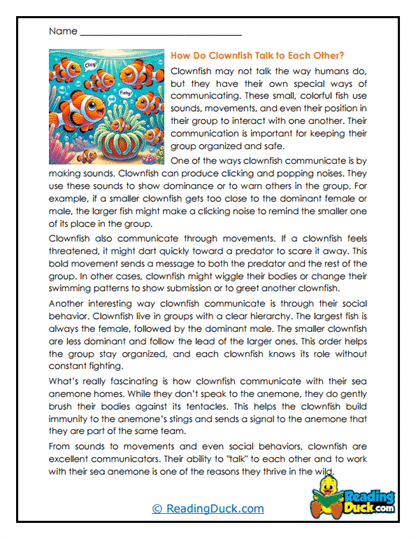
Clownfish are colorful reef fish known for their bright patterns and remarkable partnership with sea anemones. Living among anemone tentacles gives these small fish protection from many predators, while the clownfish provide benefits to their unusual hosts in return. These worksheets introduce students to clownfish habitats, diets, physical features, behaviors, reproduction, life cycles, communication, and ecological relationships. Along the way, children discover how these familiar fish use teamwork and specialized adaptations to survive in busy coral reef environments.
Our Clownfish Reading Comprehension Worksheets help students strengthen nonfiction reading skills while exploring engaging life science concepts. As they read, students practice identifying main ideas, finding supporting details, following sequences, comparing information, making inferences, and recognizing cause-and-effect relationships. The passages also encourage readers to connect an animal's physical features and behaviors with its habitat and survival needs. These skills build reading confidence while expanding science vocabulary and knowledge about ocean ecosystems.
Learning about clownfish gives children an opportunity to explore one of nature's most interesting animal partnerships. Students discover how clownfish find food, communicate, raise young, move through reefs, avoid predators, and live within organized social groups. They also learn how closely the survival of clownfish is connected to healthy sea anemones and coral reef habitats. We hope these worksheets encourage scientific curiosity and help students appreciate the remarkable relationships that connect life beneath the ocean's surface.
Meet the Worksheets
Busy Families
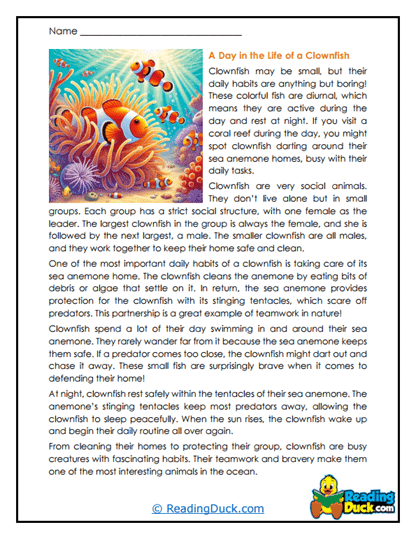
Students explore the organized social lives and daily routines of clownfish. They learn about dominant females and males, searching for food, cleaning the anemone, defending territory, and resting safely among the tentacles at night. This worksheet strengthens sequencing and comparison skills by helping readers recognize patterns in daily behavior. Students discover how social roles and routines help a clownfish group survive.
Careful Swimmers
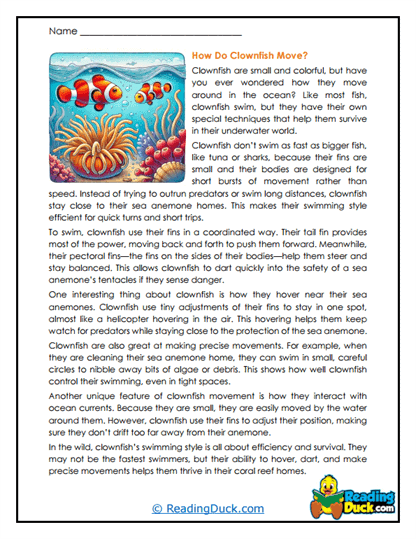
Students investigate how clownfish move through the tight spaces surrounding coral reefs and sea anemones. They learn how different fins help these fish steer, hover, dart, and remain close to the protection of their anemone homes. This worksheet strengthens comprehension by connecting anatomy with movement and survival. Readers discover that successful swimming can depend more on control and precision than tremendous speed.
Egg Guardians
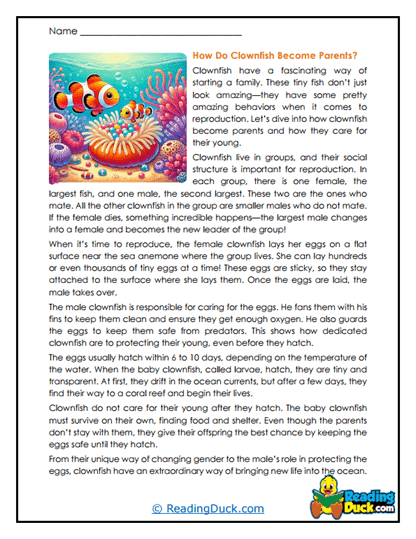
Students explore the fascinating reproductive behaviors of clownfish. They follow egg laying, fertilization, nest protection, and hatching while learning how males fan and care for developing eggs. This worksheet provides strong practice with sequencing and process-based comprehension. Readers also discover the unusual way clownfish can change sex when the dominant female in a group dies.
Growing Clownfish
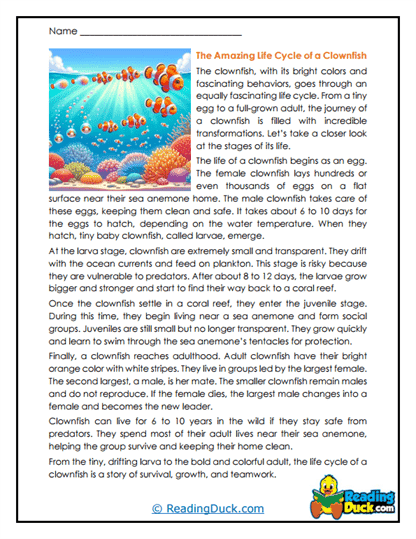
Students follow the clownfish life cycle from eggs to larvae, juveniles, and fully grown adults. They learn how young clownfish begin life drifting in open water before settling near a reef and finding a sea anemone. This worksheet strengthens chronological thinking and summarizing skills. Readers discover how habitat, appearance, behavior, and social roles change as clownfish mature.
Ocean Partnerships
Students take a broader look at the many ecological relationships surrounding clownfish. They explore mutualism with sea anemones, predator-and-prey relationships, food-web connections, and interactions between clownfish and people. This worksheet strengthens comparison and classification skills by helping readers determine how different organisms are affected. Students see how one small fish is connected to a much larger network of ocean life.
Reef Dangers
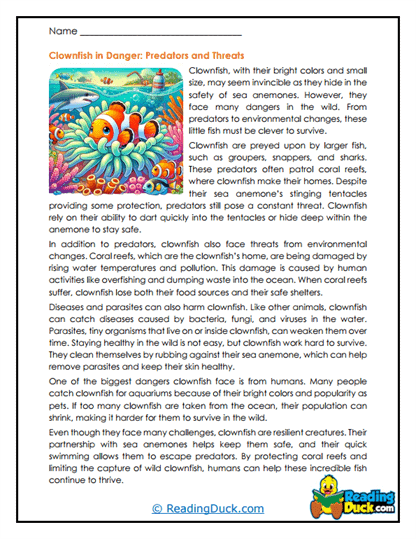
Students examine the natural and environmental threats clownfish face in the wild. They learn about predators, parasites, disease, pollution, warming water, coral reef damage, and collection for the aquarium trade. This worksheet develops problem-and-solution comprehension while introducing conservation concepts. Readers discover why even well-protected animals depend on healthy habitats for long-term survival.
Reef Foragers
Students investigate what clownfish eat and how they find food while remaining close to their protective sea anemones. They learn about plankton, algae, shrimp, tiny crustaceans, and scraps left behind by anemones. This worksheet strengthens cause-and-effect thinking by connecting diet, habitat, and feeding behavior. Readers discover how the clownfish's home influences both what it eats and how it searches for food.
Reef Helpers
Students discover the important role clownfish play within coral reef ecosystems. They learn how clownfish can help sea anemones by removing debris and providing nutrients while also participating in larger food webs. This worksheet strengthens systems thinking by connecting several smaller details to the health of an entire ecosystem. Readers see how even a tiny fish can make an important contribution to its environment.
Reef Partners
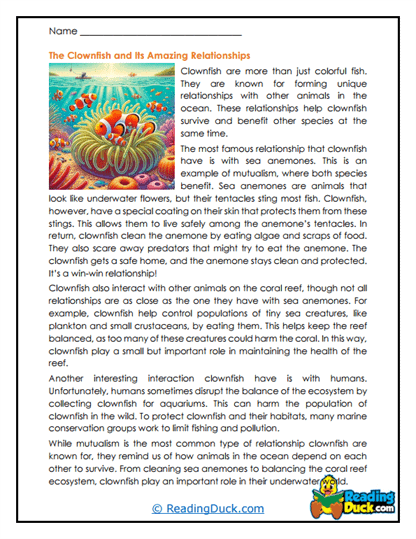
Students are introduced to clownfish through their famous partnership with sea anemones. They learn how protective mucus allows clownfish to live safely among stinging tentacles and how both animals can benefit from living together. This worksheet builds main-idea and supporting-detail skills while introducing symbiosis through an easy-to-understand example. Readers gain useful background knowledge for the more focused passages that follow.
Reef Signals
Students discover how clownfish communicate using clicking and popping sounds, body movements, swimming patterns, and social positioning. They learn how these signals can help establish rank, attract mates, give warnings, and maintain order within a group. This worksheet strengthens inference skills by encouraging readers to connect different signals with their likely meanings. Students discover how communication supports both cooperation and survival.
Striped Swimmers
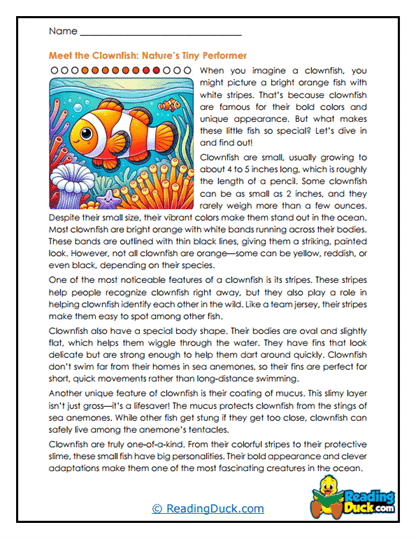
Students take a closer look at the physical characteristics that make clownfish so recognizable. They explore colorful patterns, white stripes, body shape, strong fins, and the protective mucus that allows clownfish to live among sea anemone tentacles. This worksheet develops descriptive comprehension by connecting physical structures with their functions. Readers learn why the clownfish's appearance is closely tied to how it lives and survives.
Anemone Homes
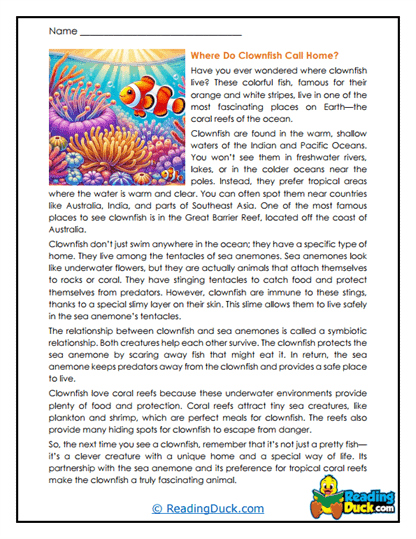
Students travel to the warm tropical waters and coral reefs where clownfish naturally live. They learn about the Indian and Pacific Oceans while exploring how sea anemones provide protection and reefs supply food, shelter, and other resources. This worksheet strengthens comprehension by connecting habitat features with an animal's basic needs. Readers discover why clownfish depend on a very specialized environment.
A Better Look At Clownfish
Clownfish are much more than brightly colored reef fish. Their protective mucus, specialized swimming, unusual family structure, parental behaviors, and close partnership with sea anemones all help them survive in complex coral reef environments. Their lives also provide students with an especially clear example of how different organisms can depend on one another. Studying clownfish helps children understand how adaptations, behaviors, habitats, and ecological relationships work together in nature.
Reading about clownfish also helps students become stronger readers and scientific thinkers. They practice following life cycles and processes, making inferences about animal communication, comparing ecological relationships, and connecting physical features with their functions. These skills support learning across reading and life science while encouraging children to think more deeply about ocean ecosystems. With every passage, students gain confidence while discovering the fascinating connections that make coral reefs such remarkable places to live.
Make sure to bookmark our website now.
Enjoy all our free reading worksheets.
Our materials adhere to the principles of the Science of Reading.