About Our Lionfish Reading Comprehension Worksheets
Lionfish are striking ocean predators known for their bold stripes, flowing fins, and long venomous spines. Native to warm waters of the Pacific and Indian Oceans, these skilled hunters have also spread into places such as the Atlantic Ocean and Caribbean Sea, where they have become a serious invasive species. These worksheets introduce students to lionfish habitats, diets, physical features, behaviors, reproduction, life cycles, communication, movement, and ecological relationships. Along the way, children discover how the same animal can fit naturally into one ecosystem while causing major problems in another.
Our Lionfish Reading Comprehension Worksheets help students strengthen nonfiction reading skills while exploring engaging marine science concepts. As they read, students practice identifying main ideas, finding supporting details, following sequences, comparing information, making inferences, and recognizing cause-and-effect relationships. The passages also encourage readers to connect physical adaptations and behaviors with hunting, protection, reproduction, and survival. These skills build reading confidence while expanding science vocabulary and helping students understand how ocean ecosystems work.
Learning about lionfish gives children an especially interesting way to explore predators and invasive species. Students discover how lionfish hunt, communicate, reproduce, grow, defend themselves, and interact with other reef animals. They also learn why location matters when scientists consider whether a species is helping maintain an ecosystem or disrupting its natural balance. We hope these worksheets encourage scientific curiosity while helping students think more carefully about the connections between animals and their environments.
Meet the Worksheets
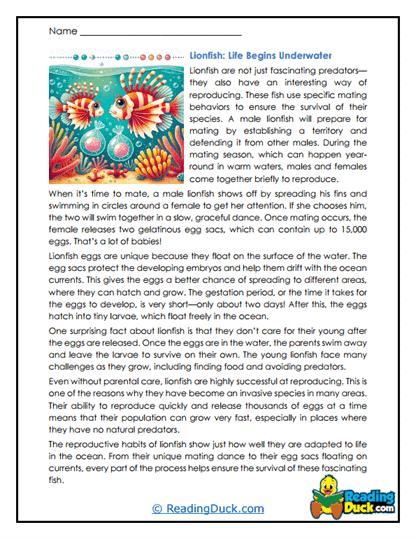
Floating Beginnings
Students explore how lionfish reproduce and begin their lives in the open ocean. They follow courtship, spawning, egg release, hatching, and early development while learning how thousands of eggs can drift with ocean currents. This worksheet strengthens sequencing and process-based comprehension. Readers also discover how producing large numbers of offspring can contribute to the rapid growth and spread of lionfish populations.
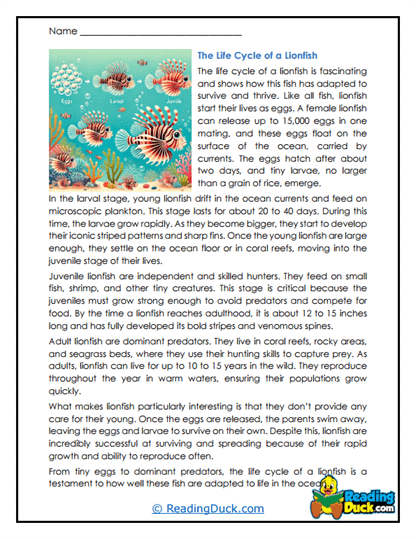
Growing Lionfish
Students follow the lionfish life cycle from drifting eggs and tiny larvae to juveniles and fully grown adults. They learn how young lionfish develop bold stripes, venomous spines, stronger bodies, and increasingly independent hunting behaviors as they mature. This worksheet strengthens chronological thinking and summarizing skills. Readers also discover why rapid growth and early reproduction can help lionfish populations increase quickly.
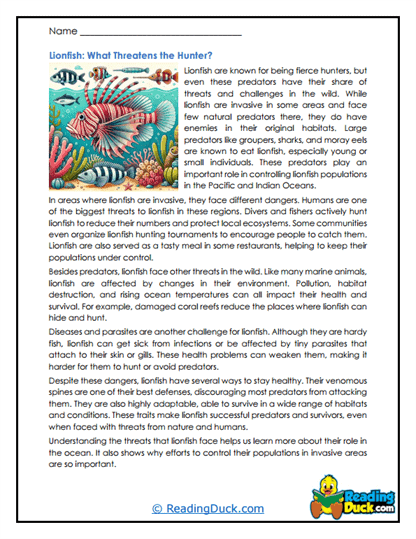
Predator Problems
Students examine the different challenges lionfish face in their native and invasive ranges. They learn about groupers, sharks, moray eels, parasites, pollution, habitat damage, and human efforts to remove invasive lionfish from reefs. This worksheet strengthens comparison and cause-and-effect comprehension by asking readers to distinguish between natural threats and population-control efforts. Students discover why the same species may be treated differently depending on where it lives.
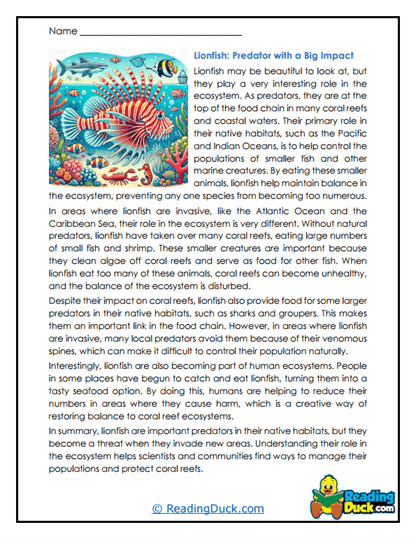
Reef Balance
Students investigate how lionfish can affect the balance of marine ecosystems. They learn how these predators fit naturally into food webs within their native range while potentially reducing native fish populations too quickly in places where they are invasive. This worksheet develops systems thinking by connecting predators, prey, populations, and location. Readers discover why an animal's ecological role can change dramatically when it enters a new environment.
Reef Hideouts
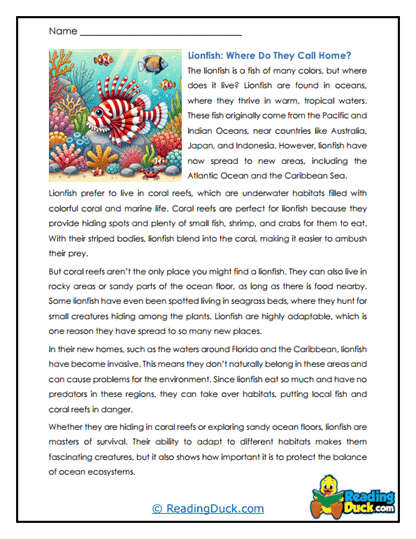
Students explore the warm marine habitats where lionfish live and hunt. They learn about coral reefs, rocky areas, sandy bottoms, seagrass beds, and the differences between the lionfish's native and invasive ranges. This worksheet strengthens comprehension by connecting habitat features with hunting, hiding, and survival. Readers discover why reefs and rocky spaces provide lionfish with excellent places to wait for unsuspecting prey.
Reef Hunters
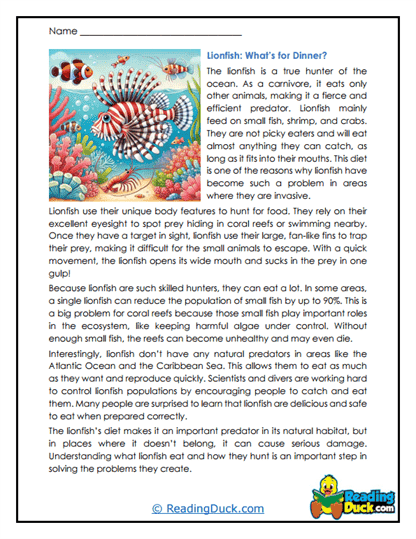
Students take a closer look at the lionfish's impressive hunting abilities. They learn how these carnivores use large fins to guide small fish, shrimp, crabs, and other prey into tight spaces before swallowing them with their wide mouths. This worksheet strengthens supporting-detail and cause-and-effect skills by connecting feeding behavior with larger ecosystem changes. Readers see how the hunting success of one predator can influence many other species.
Reef Relationships
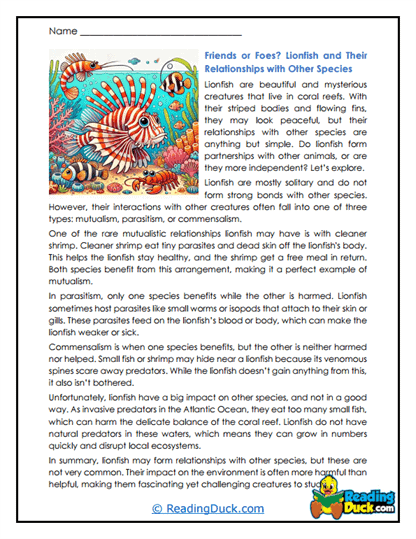
Students explore the different ways lionfish interact with organisms in reef environments. They examine relationships involving cleaner shrimp, parasites, smaller fish, predators, and prey while learning about mutualism, parasitism, and commensalism. This worksheet strengthens comparison, classification, and reasoning skills. Readers discover how lionfish are connected to a much larger network of marine life.
Silent Displays
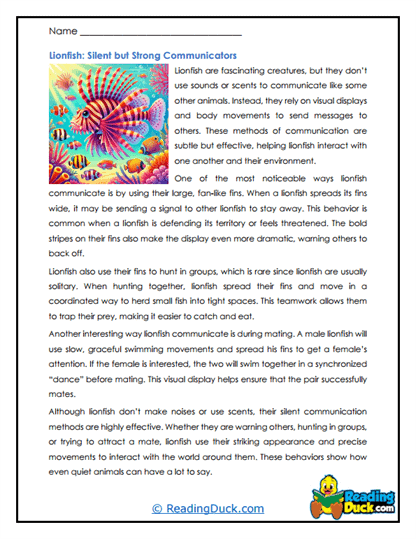
Students discover how lionfish communicate through fin spreading, body position, swimming patterns, and coordinated movements. They learn how these behaviors can signal danger, defend territory, attract mates, or support hunting. This worksheet strengthens inference skills by asking readers to connect visible actions with their likely meanings. Students see how body language can provide an effective form of communication without spoken sounds.
Silent Swimmers
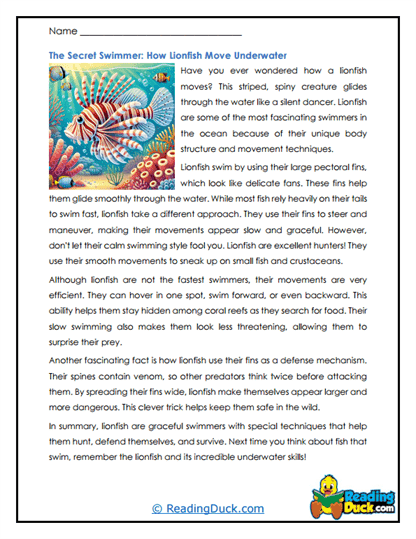
Students investigate the slow, controlled swimming style that helps lionfish move through reef environments. They learn how pectoral and other fins support hovering, steering, balance, and precise movements while hunting. This worksheet strengthens comprehension by connecting anatomy with movement and survival. Readers discover that successful predators do not always depend on speed and may instead rely on patience, control, and precision.
Striped Defenses
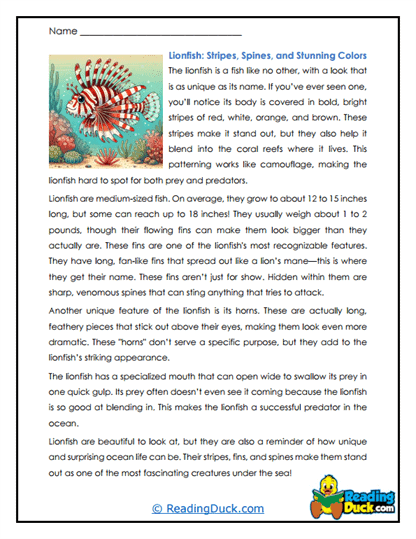
Students take a closer look at the striking physical characteristics that make lionfish so recognizable. They explore colorful stripes, wide fins, venomous spines, large mouths, and camouflage while learning how each feature can support protection or hunting. This worksheet develops descriptive comprehension by connecting body structures with their functions. Readers discover that the lionfish's dramatic appearance is closely connected to how it survives.
Twilight Patrols
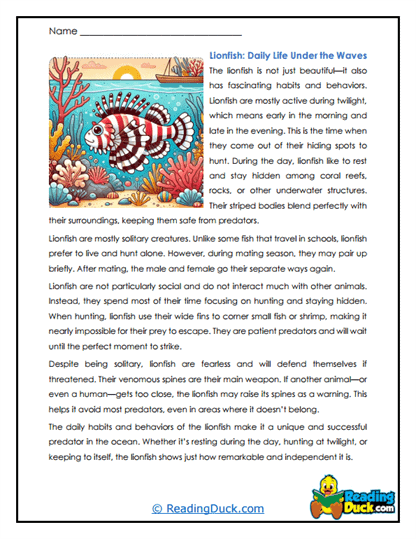
Students explore the daily routines of lionfish and learn why dawn and dusk can be especially useful times for hunting. They discover how lionfish may rest among coral and rocks before becoming more active when lower light levels make prey easier to surprise. This worksheet strengthens sequencing and pattern-recognition skills by connecting activity with time of day. Readers also see how solitary behavior, hiding, and defensive spines fit into the lionfish's survival strategy.
Venomous Invader
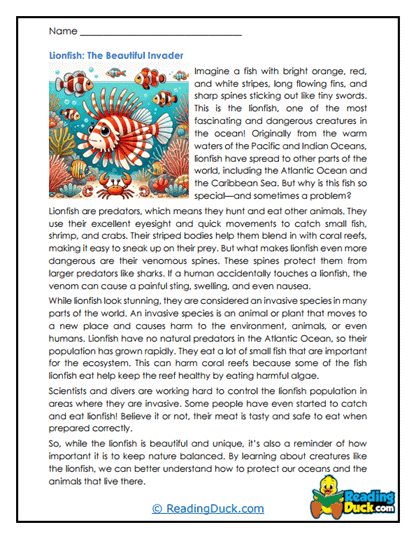
Students are introduced to lionfish through their appearance, native habitat, diet, defenses, and spread into new ocean environments. They learn why venomous spines make lionfish difficult for many predators to attack and why their hunting abilities can become problematic where they are invasive. This worksheet strengthens main-idea and supporting-detail skills while introducing the important concept of invasive species. Readers gain useful background knowledge for the more focused lionfish passages throughout the collection.
A Better Look At Lionfish
Lionfish are a powerful example of how an animal's impact can depend on where it lives. Their venomous spines, camouflage, patient hunting style, rapid reproduction, and ability to eat many kinds of prey make them successful predators. In their native waters, lionfish are part of established marine food webs, but in areas where they have become invasive, those same abilities can put added pressure on native reef animals. Studying lionfish helps students understand how adaptations, food webs, habitats, and population changes are connected.
Reading about lionfish also helps students become stronger readers and scientific thinkers. They practice following life cycles and processes, comparing ecological roles, making inferences about animal communication, recognizing cause-and-effect relationships, and explaining how body structures support particular functions. These skills support learning across reading and life science while introducing children to important ideas about invasive species and ecosystem balance. With every passage, students gain confidence while discovering why these beautiful but formidable reef predators deserve such careful study.
Make sure to bookmark our website now.
Enjoy all our free reading worksheets.
Our materials adhere to the principles of the Science of Reading.