Guppies are tiny freshwater fish known for their bright colors, fancy tails, quick movements, and lively social behavior. Originally found in South America and the Caribbean, these adaptable fish now live in freshwater environments in many parts of the world. These worksheets introduce students to guppy habitats, diets, physical features, behaviors, reproduction, life cycles, communication, movement, and ecological relationships. Along the way, children discover that these little fish can help control mosquito populations, live together in social groups, and reproduce in a way that is quite different from many other fish.
Our Guppy Reading Comprehension Worksheets help students strengthen nonfiction reading skills while exploring engaging life science concepts. As they read, students practice identifying main ideas, locating supporting details, following sequences, comparing information, making inferences, and recognizing cause-and-effect relationships. The passages also encourage readers to connect physical features and behaviors with an animal's habitat and survival needs. These skills build reading confidence while expanding science vocabulary and helping students understand freshwater ecosystems.
Learning about guppies gives children an opportunity to see how even a very small animal can have an important place in nature. Students discover how guppies search for food, communicate, reproduce, grow, avoid predators, and interact with other living things. They also learn how schooling, quick swimming, plant cover, and rapid reproduction can help these fish survive. We hope these worksheets encourage scientific curiosity and show students just how much there is to discover about the small animals living in freshwater habitats.
Meet the Worksheets
Busy Foragers
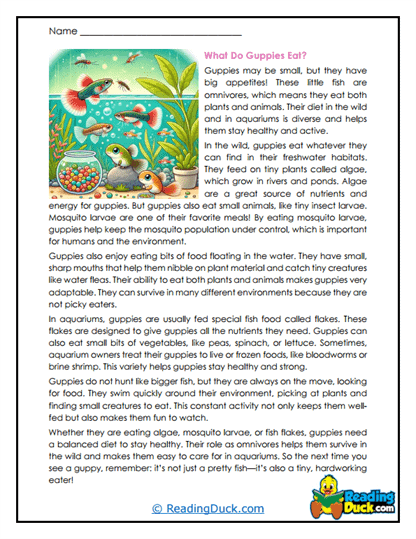
Students investigate the wide variety of foods guppies find in freshwater habitats. They learn how these omnivores eat algae, mosquito larvae, insects, plant material, and other tiny organisms while comparing wild diets with foods given to aquarium guppies. This worksheet strengthens supporting-detail and comparison skills while connecting diet with survival. Readers discover how a small fish's feeding habits can influence both its health and the environment around it.
Colorful Swimmers
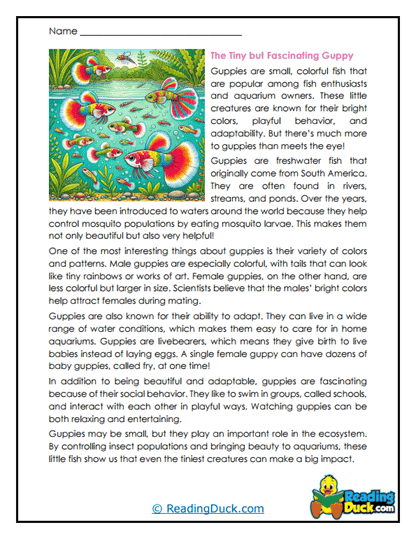
Students are introduced to guppies through their colorful appearance, lively behavior, habitats, diet, reproduction, and role in freshwater ecosystems. They learn why males are often brighter than females and how guppies can help control mosquitoes by eating their larvae. This worksheet strengthens main-idea and supporting-detail skills by bringing several areas of information together. Readers gain useful background knowledge for the more focused passages throughout the collection.
Fancy Tails
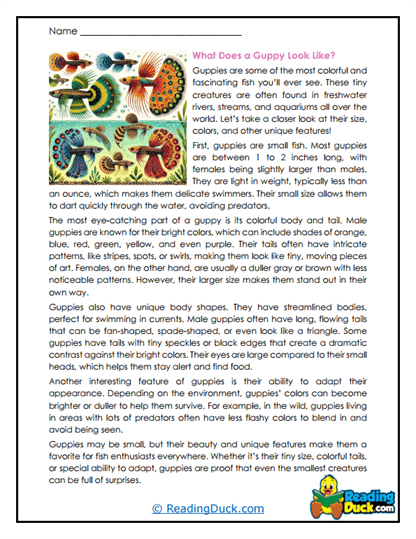
Students take a closer look at the colorful bodies and dramatic tail shapes that make guppies easy to recognize. They compare males and females while exploring fan-shaped, triangular, spear-like, and flowing tails along with different patterns and colors. This worksheet develops descriptive comprehension by connecting physical characteristics with their possible functions. Readers discover how body shape, coloration, and camouflage can support both survival and reproduction.
Freshwater Homes
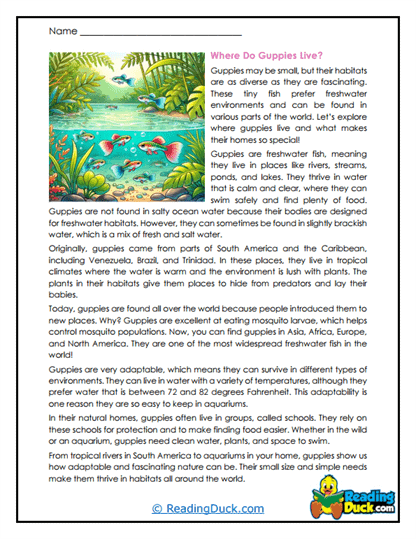
Students explore the warm freshwater environments where guppies naturally live. They learn about rivers, streams, ponds, lakes, tropical climates, plant cover, and the introduction of guppies into new regions for mosquito control. This worksheet strengthens comprehension by connecting habitat conditions with an animal's basic needs. Readers also begin thinking about what can happen when people introduce animals into ecosystems where they did not originally live.
Growing Fry
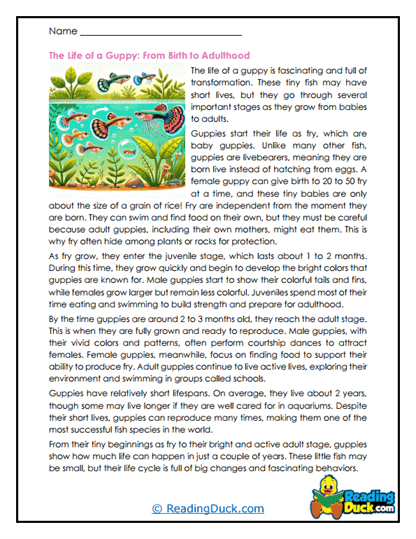
Students follow the guppy life cycle from newborn fry through the juvenile stage and into adulthood. They learn how young guppies must immediately begin swimming, hiding, and searching for food and how their colors and bodies change as they mature. This worksheet strengthens chronological thinking and summarizing skills. Readers also discover why the guppy's quick development can allow populations to grow rapidly.
Hidden Dangers
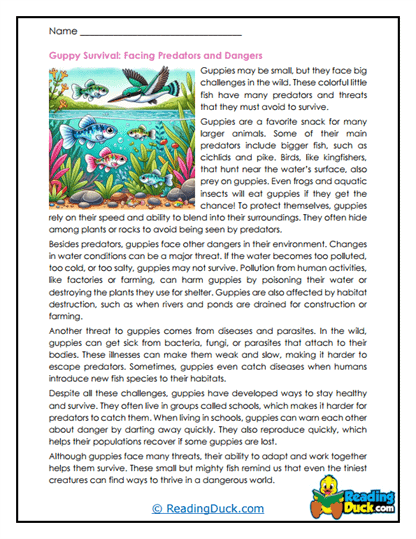
Students examine the natural and environmental challenges guppies face. They learn about larger fish, birds, parasites, disease, pollution, habitat destruction, and changing water conditions while exploring the survival strategies guppies use. This worksheet develops problem-and-solution and cause-and-effect comprehension. Readers discover how schooling, hiding, quick swimming, and rapid reproduction can help these small fish survive.
Livebearer Babies
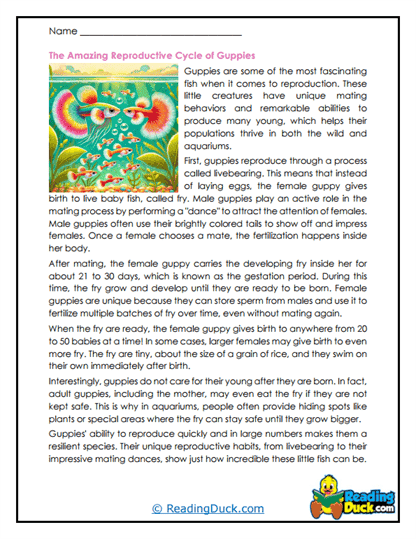
Students explore the unusual way guppies reproduce by giving birth to live young instead of laying eggs. They follow courtship, gestation, birth, and the early survival of newborn fry while learning why the babies quickly need food and hiding places. This worksheet provides strong practice with sequencing and process-based comprehension. Readers also gain an opportunity to compare live-bearing reproduction with the egg-laying strategies of other fish.
Quick Swimmers
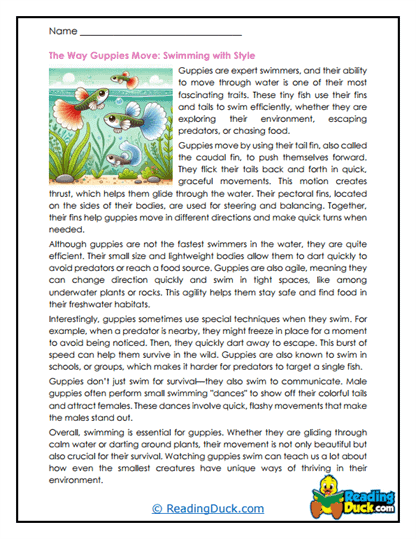
Students investigate how guppies use their tails and other fins to move quickly and precisely through the water. They learn how these body parts provide forward movement, steering, balance, and sudden changes in direction. This worksheet strengthens comprehension by connecting anatomy with movement and survival. Readers see how agility helps guppies escape predators, weave through plants, and perform courtship displays.
School Life
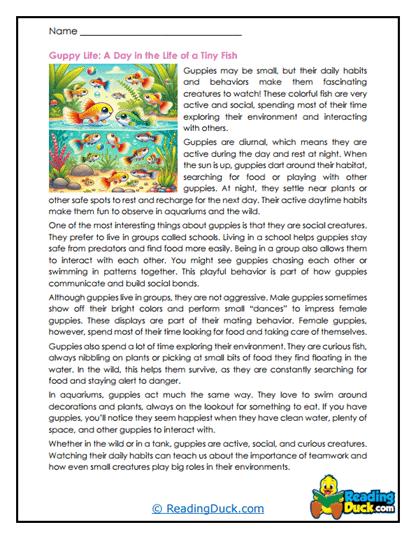
Students explore the social behavior and daily routines of guppies. They learn how these diurnal fish search for food, swim together in groups, interact with other fish, perform courtship displays, and become less active at night. This worksheet strengthens sequencing and pattern-recognition skills by helping readers organize behaviors according to time and purpose. Students discover how group living and daily routines can contribute to survival.
Tiny Helpers
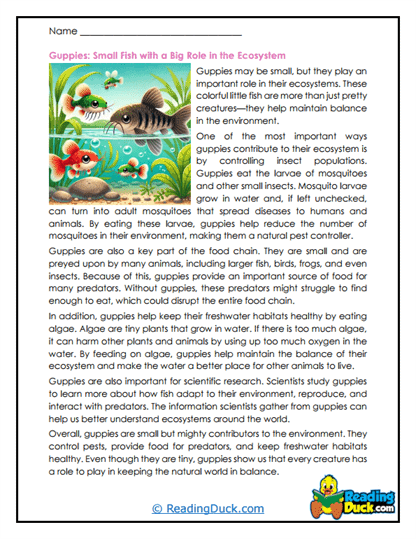
Students discover how guppies contribute to freshwater food webs despite their small size. They learn how guppies eat mosquito larvae, algae, and other organisms while also becoming food for fish, birds, frogs, and insects. This worksheet develops systems thinking by connecting one small species with many other parts of an ecosystem. Readers see how even tiny animals can influence the balance of a habitat.
Visual Signals
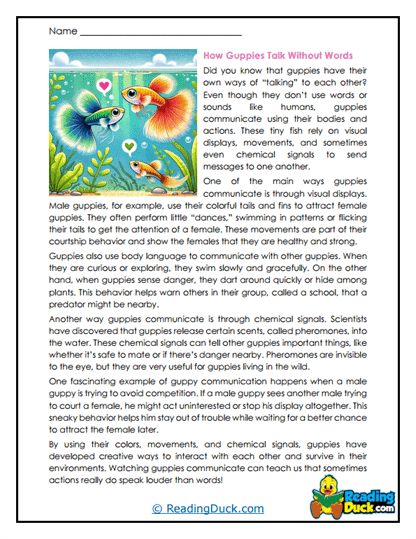
Students learn how guppies communicate through colorful displays, swimming patterns, body movements, and chemical signals. They explore how these signals can be used during courtship, schooling, competition, and responses to danger. This worksheet strengthens inference skills by encouraging readers to connect different signals with their likely meanings. Students discover that animals can share information in many ways without relying on words.
Water Connections
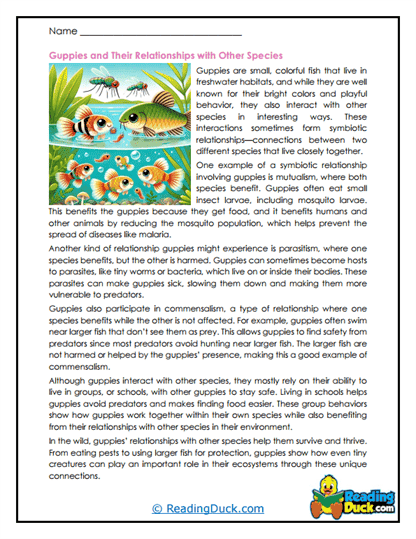
Students explore the many relationships guppies have with other organisms in freshwater environments. They examine predators, parasites, mosquito larvae, schooling behavior, and other ecological interactions while learning about mutualism, parasitism, and commensalism. This worksheet strengthens comparison, classification, and reasoning skills. Readers discover how guppies remain connected to a much larger network of living things.
A Better Look At Guppies
Guppies may be small, but their colorful bodies, adaptable diets, social behaviors, rapid reproduction, and quick swimming abilities make them fascinating animals to study. Their lives also demonstrate how physical traits and behaviors can help animals respond to predators, find food, attract mates, and survive in changing environments. Guppies are connected to freshwater food webs as both consumers and prey, giving them an important place within their habitats. Studying these fish helps students understand how anatomy, behavior, habitat, and ecological relationships work together.
Reading about guppies also helps students become stronger readers and scientific thinkers. They practice following life cycles and processes, comparing physical characteristics, making inferences about communication, recognizing cause-and-effect relationships, and connecting body structures with their functions. These skills support learning across reading and life science while encouraging children to look more carefully at even the smallest animals. With every passage, students gain confidence while discovering how much activity and complexity can be packed into one tiny freshwater fish.
Make sure to bookmark our website now.
Enjoy all our free reading worksheets.
Our materials adhere to the principles of the Science of Reading.