About Our Koi Fish Reading Comprehension Worksheets
Koi are beautiful freshwater fish known for their brilliant colors, graceful movements, and long history with people. These relatives of carp were selectively bred in Japan to produce the striking reds, whites, oranges, yellows, blacks, and other patterns that make koi so recognizable today. These worksheets introduce students to koi habitats, diets, physical features, behaviors, reproduction, life cycles, communication, movement, and ecological relationships. Along the way, children also discover why koi have become important cultural symbols of strength, determination, happiness, and good fortune.
Our Koi Reading Comprehension Worksheets help students strengthen nonfiction reading skills while exploring engaging life science concepts. As they read, students practice identifying main ideas, finding supporting details, following sequences, comparing information, making inferences, and recognizing cause-and-effect relationships. The passages also encourage readers to connect an animal's physical features and behaviors with its environment and basic needs. These skills build reading confidence while expanding science vocabulary and helping students better understand freshwater animals.
Learning about koi gives children an opportunity to look beyond their colorful appearance and discover how these fish actually live. Students explore how koi find food, communicate, reproduce, grow, avoid danger, and move through their pond environments. They also learn why clean water, oxygen, shelter, enough swimming space, and proper nutrition are so important for keeping koi healthy. We hope these worksheets encourage scientific curiosity while helping students appreciate both the beauty and biology of these remarkable fish.
Meet the Worksheets
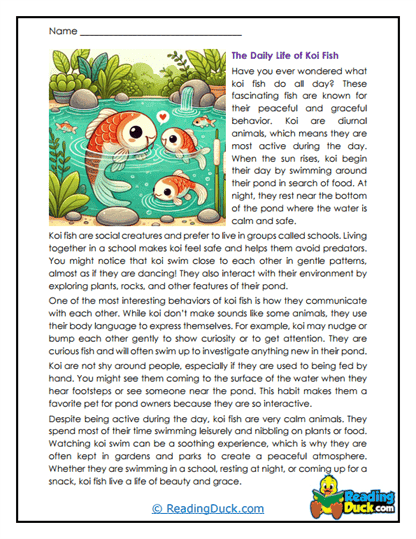
Gentle Routines
Students explore the daily routines and social behaviors of koi. They learn how these fish swim, search for food, interact with one another, respond to people, and change their behavior when they are comfortable or stressed. This worksheet strengthens sequencing and pattern-recognition skills by helping readers organize different activities and behaviors. Students also discover how careful observation can provide clues about an animal's health and surroundings.
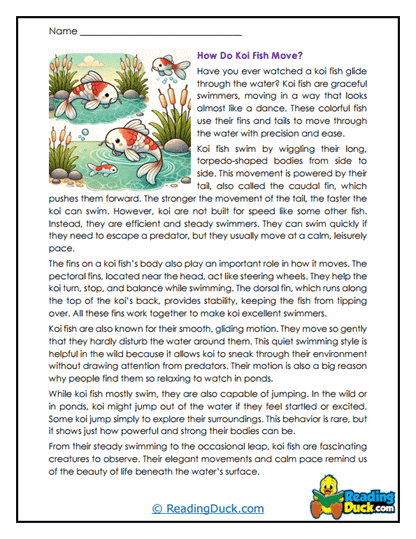
Graceful Motion
Students investigate how a koi's long body and coordinated fins create smooth, controlled movement. They learn how the tail provides forward motion while other fins help with steering, balance, and turning. This worksheet strengthens comprehension by connecting individual body parts with their functions. Readers discover how several physical features can work together to help an animal perform one important job.
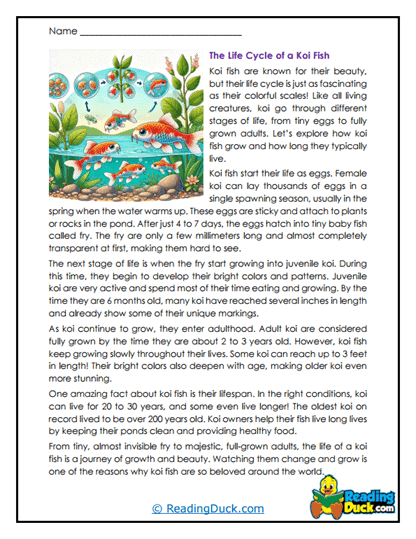
Growing Koi
Students follow the koi life cycle from tiny fry through the juvenile stage and into adulthood. They learn how young koi initially depend on their yolk sacs before swimming and feeding independently and how their colors and patterns become more noticeable as they mature. This worksheet strengthens chronological thinking and summarizing skills. Readers also discover how koi can continue growing for many years when they have healthy conditions and proper care.
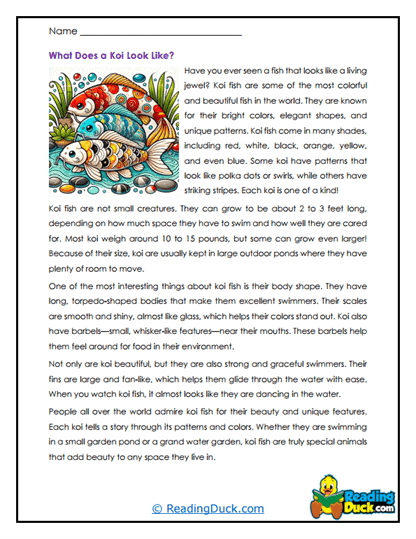
Living Jewels
Students take a closer look at the beautiful physical characteristics that make koi so recognizable. They explore colorful scales, unique patterns, streamlined bodies, flowing fins, barbels, and the impressive sizes some koi can reach. This worksheet develops descriptive comprehension by connecting physical structures with their purposes. Readers discover that many of the features that make koi attractive also help them move, feed, and survive.
Living Partnerships
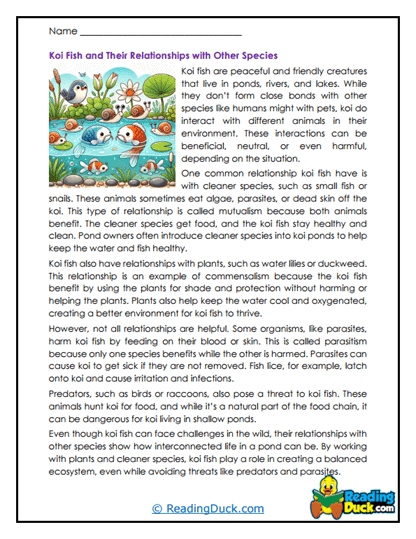
Students explore the relationships koi have with plants, parasites, cleaner organisms, and other living things. They examine ecological ideas such as mutualism, commensalism, and parasitism while determining how different organisms are affected. This worksheet strengthens comparison, classification, and reasoning skills. Readers discover that koi are connected to a much larger community of life within their aquatic environments.
Perfect Ponds
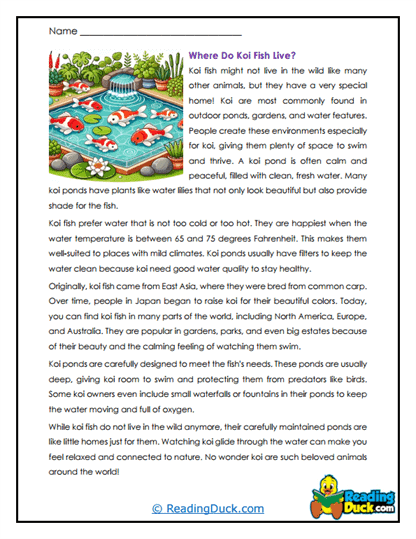
Students investigate the conditions koi need for a healthy freshwater habitat. They learn why clean, oxygen-rich water, suitable temperatures, aquatic plants, shelter, and enough swimming space all matter. This worksheet strengthens cause-and-effect comprehension by asking readers to connect particular pond conditions with the needs of the fish. Students also discover how deeper water, plants, fountains, and other pond features can help koi remain healthy and safe.
Pond Balance
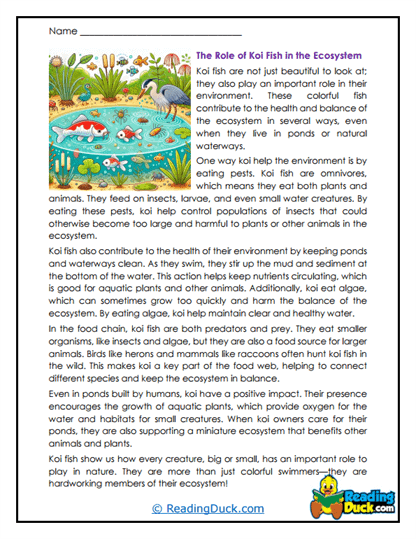
Students discover how koi can influence the aquatic environments where they live. They learn how feeding, swimming, and interactions with other organisms connect koi to larger pond food webs. This worksheet develops systems thinking by helping readers connect several smaller details to one larger ecological idea. Students see that koi can be active members of their environments rather than simply decorative pond fish.
Pond Dangers
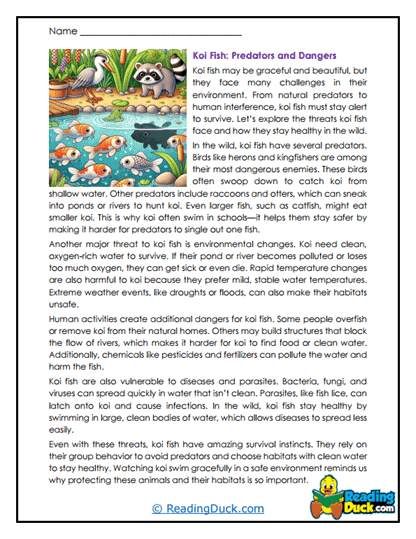
Students examine the different challenges koi may face in outdoor ponds. They learn about predators, parasites, disease, pollution, poor water quality, and temperature changes while exploring ways healthy pond design and responsible care can reduce these dangers. This worksheet strengthens problem-and-solution and cause-and-effect comprehension. Readers discover how the quality of an animal's environment can directly influence its health and safety.
Pond Foragers
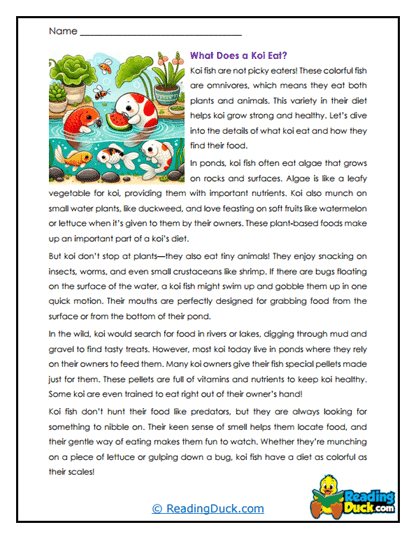
Students explore the varied diet of koi and learn why these fish are considered omnivores. They discover how koi eat algae, insects, worms, crustaceans, plants, and food provided by people while using sensitive barbels to search along the pond bottom. This worksheet strengthens supporting-detail skills while connecting diet with adaptation and health. Readers also compare naturally available foods with those provided to koi in human care.
Pond Jewels
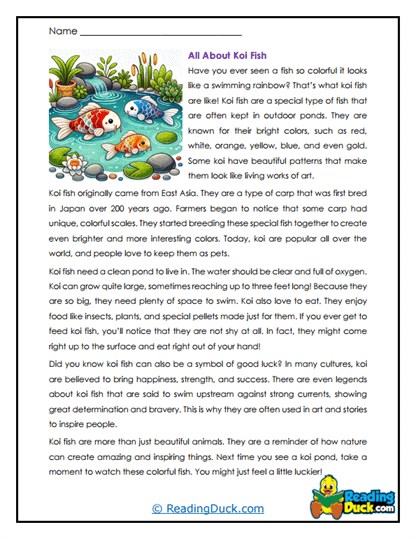
Students are introduced to koi through their history, colorful appearance, behaviors, basic needs, and cultural importance. They learn how selective breeding helped produce today's beautiful varieties and why koi have been valued by people for generations. This worksheet strengthens main-idea and supporting-detail skills by bringing several areas of information together. Readers gain useful background knowledge for the more focused koi passages throughout the collection.
Pond Signals
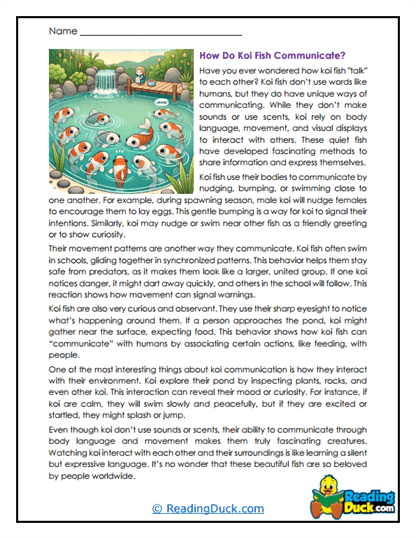
Students discover how koi communicate through body movements, swimming patterns, gentle nudges, and changes in activity. They learn how these behaviors may be connected with schooling, courtship, curiosity, and interactions with people. This worksheet strengthens inference skills by asking readers to connect observable behaviors with their likely meanings. Students see that animals do not need spoken language to share useful information.
Spring Spawning
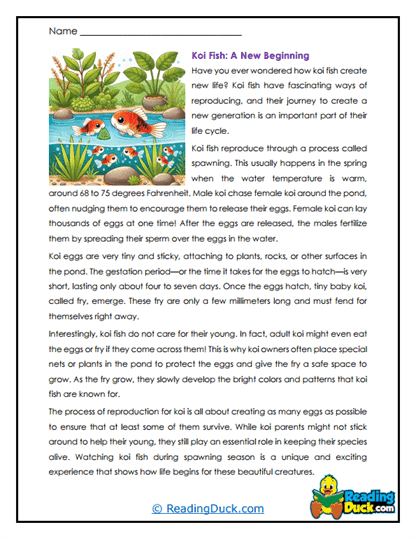
Students follow koi reproduction from courtship and spawning through fertilization, hatching, and early survival. They learn how females can produce thousands of sticky eggs and why newly hatched fry must quickly begin surviving without much parental care. This worksheet provides strong practice with sequencing and process-based comprehension. Readers also discover why producing large numbers of offspring can be an effective reproductive strategy.
A Better Look At Koi
Koi are much more than beautiful fish swimming through decorative ponds. Their specialized bodies, varied diets, social behaviors, life cycles, swimming abilities, and responses to environmental conditions make them fascinating animals to study. Their long history with people also shows how animals can become culturally important as well as biologically interesting. Studying koi helps students understand how anatomy, behavior, habitat, animal care, and ecological relationships all work together.
Reading about koi also helps students become stronger readers and scientific thinkers. They practice following life cycles and processes, comparing ecological relationships, making inferences about animal behavior, recognizing cause-and-effect connections, and explaining how physical structures perform particular jobs. These skills support learning across reading and life science while encouraging children to look more carefully at animals they may encounter in familiar settings. With every passage, students gain confidence while discovering the science behind these colorful living jewels.
Make sure to bookmark our website now.
Enjoy all our free reading worksheets.
Our materials adhere to the principles of the Science of Reading.