
Careful Swimmers Open Response
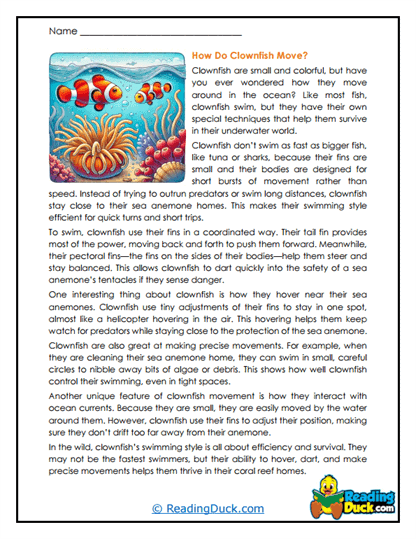
Clownfish are not the fastest fish in the ocean, but they are very well suited to moving through the tight spaces around coral reefs and sea anemones. This passage explains how their fins work together to help them steer, hover, dart, and stay close to the protective tentacles of their anemone homes. Readers learn that clownfish often use short bursts of movement rather than long-distance swimming and that their small size helps them maneuver through places where larger fish cannot easily follow.
Reading about movement helps students connect anatomy with function and survival. They practice visualizing actions, identifying supporting details, and explaining how certain body features help clownfish remain safe. Vocabulary related to fins, steering, hovering, movement, and adaptation develops naturally through the text. This worksheet is especially useful for helping students understand that successful movement is not always about speed-it can also be about control and efficiency.