
Daily Rhythms Multiple Choices
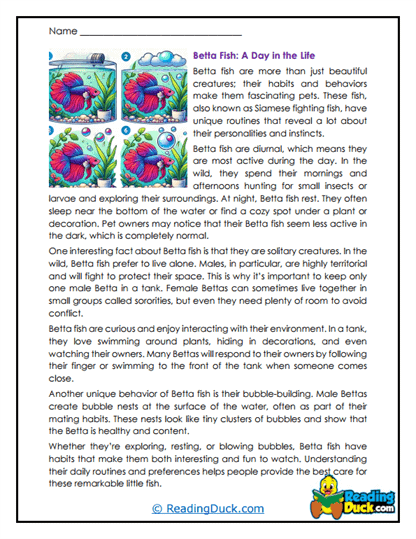
Betta fish have routines, instincts, and behaviors that make them fascinating to observe throughout the day. This passage explains that bettas are diurnal, meaning they are generally more active during daylight hours, when they explore, hunt, interact with their surroundings, and sometimes respond to people outside their tank. Readers also learn about nighttime resting behavior, territorial instincts, solitary living, curiosity, and bubble-nest building. By looking at both wild and captive bettas, the passage shows students how environment can influence what an animal does from one part of the day to another.
Reading about daily behavior helps students organize details into patterns instead of treating each fact separately. Children practice sequencing, comparing daytime and nighttime activity, and connecting certain behaviors with needs such as rest, food, reproduction, or protection. Vocabulary surrounding diurnal, territorial, solitary, and animal behavior adds depth without overwhelming young readers. This is also a nice passage for encouraging observation, because students can begin recognizing some of these behaviors in real animals.