
Graceful Gliders Multiple Choices
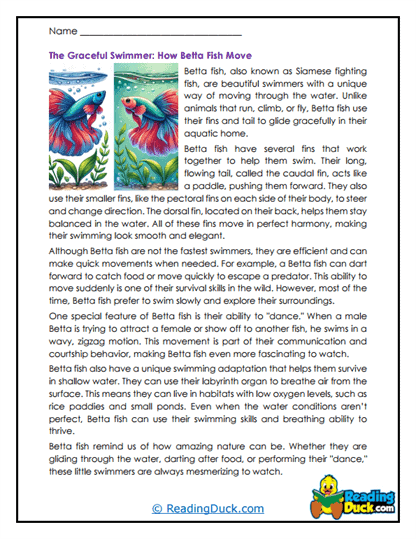
Betta fish seem to float through the water, but their graceful movement depends on several fins working together with impressive control. This passage explains how the caudal fin provides propulsion while the pectoral, dorsal, and other fins help with balance, steering, turning, and precise movement. Readers learn that bettas can glide slowly, dart toward prey, change direction quickly, and perform distinctive movements during courtship. The passage also connects their swimming abilities with the shallow, plant-filled environments where wild bettas naturally live.
Reading about animal movement gives students an opportunity to connect anatomy directly with function. They practice identifying which body part performs which job while visualizing how those parts work together. Vocabulary related to propulsion, balance, steering, fins, and movement expands science understanding through descriptive context. This worksheet is particularly useful for teaching students to explain how something happens rather than simply describing what they see.